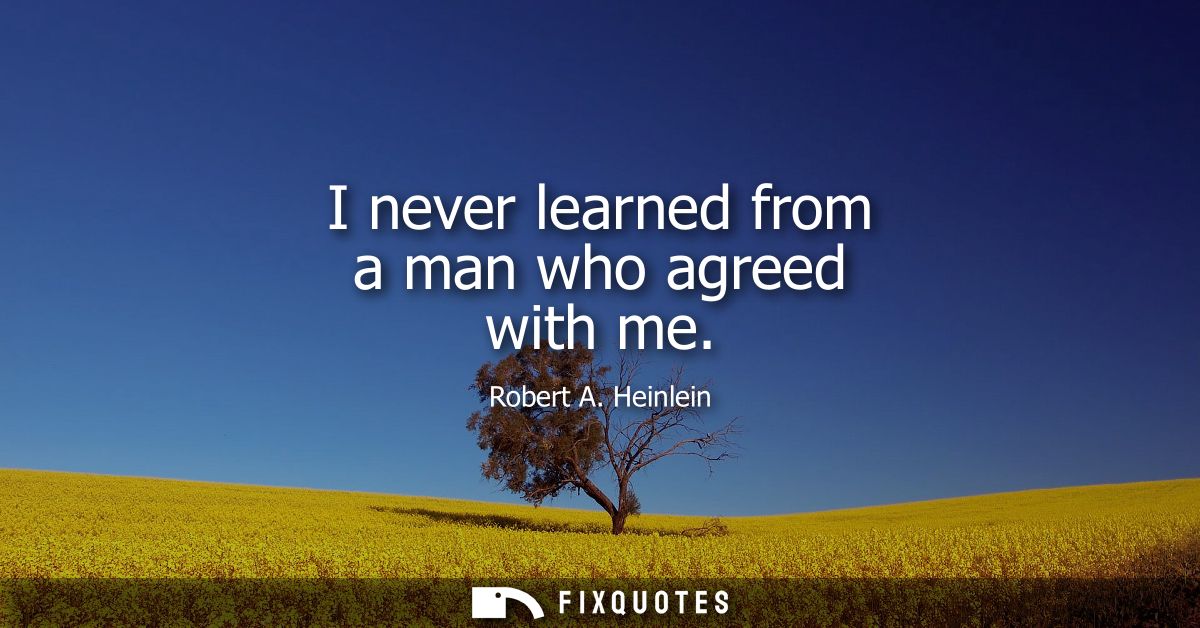
"I never learned from a man who agreed with me"
About this Quote
Heinlein’s line is a neat little grenade lobbed at intellectual comfort. It flatters the speaker as tough-minded, allergic to echo chambers, the kind of person who wants friction because friction makes heat. Coming from a science fiction writer who built entire worlds around competing political and moral systems, it’s also a craft note: stories get interesting the moment somebody pushes back. Agreement is narrative dead air; conflict is where characters - and readers - reveal what they actually believe.
The specific intent isn’t polite pluralism. It’s a provocation aimed at the self-satisfied debater who collects consensus as proof of correctness. Heinlein reframes disagreement as utility, not insult. The subtext is transactional: other people are valuable when they supply the one thing you can’t manufacture alone, the angle that exposes your blind spots. A man who agrees with you may be kind, loyal, even wise - but he’s not adding information. He’s confirming.
There’s also a sharp, slightly combative masculinity embedded in the phrasing: “a man” as the arena, the sparring partner, the worthy opponent. That’s period, personality, and posture rolled together. Heinlein wrote through the Cold War, when ideological certainty was a national sport and dissent could be treated as disloyalty. The quote pitches an alternative ethic: treat opposition as education. Not because everyone is equally right, but because certainty without challenge becomes dogma - and dogma makes for bad politics, bad science, and bad fiction.
The specific intent isn’t polite pluralism. It’s a provocation aimed at the self-satisfied debater who collects consensus as proof of correctness. Heinlein reframes disagreement as utility, not insult. The subtext is transactional: other people are valuable when they supply the one thing you can’t manufacture alone, the angle that exposes your blind spots. A man who agrees with you may be kind, loyal, even wise - but he’s not adding information. He’s confirming.
There’s also a sharp, slightly combative masculinity embedded in the phrasing: “a man” as the arena, the sparring partner, the worthy opponent. That’s period, personality, and posture rolled together. Heinlein wrote through the Cold War, when ideological certainty was a national sport and dissent could be treated as disloyalty. The quote pitches an alternative ethic: treat opposition as education. Not because everyone is equally right, but because certainty without challenge becomes dogma - and dogma makes for bad politics, bad science, and bad fiction.
Quote Details
| Topic | Learning |
|---|---|
| Source | Later attribution: Quotes: The Famous and Not so Famous (Terence M. Dorn Ph.D., 2021) modern compilationISBN: 9781662447952 · ID: ptZSEAAAQBAJ
Evidence:
... Robert A. Heinlein Progress isn't made by early risers . It's made by lazy men trying to find easier ways to do something . - Robert Heinlein I never learned from a man who agreed with me . - Robert A. Heinlein The universe never did ... |
| Cite |
Citation Formats
APA Style (7th ed.)
Heinlein, Robert A. (2026, March 3). I never learned from a man who agreed with me. FixQuotes. https://fixquotes.com/quotes/i-never-learned-from-a-man-who-agreed-with-me-1464/
Chicago Style
Heinlein, Robert A. "I never learned from a man who agreed with me." FixQuotes. March 3, 2026. https://fixquotes.com/quotes/i-never-learned-from-a-man-who-agreed-with-me-1464/.
MLA Style (9th ed.)
"I never learned from a man who agreed with me." FixQuotes, 3 Mar. 2026, https://fixquotes.com/quotes/i-never-learned-from-a-man-who-agreed-with-me-1464/. Accessed 27 Mar. 2026.
More Quotes by Robert
Add to List