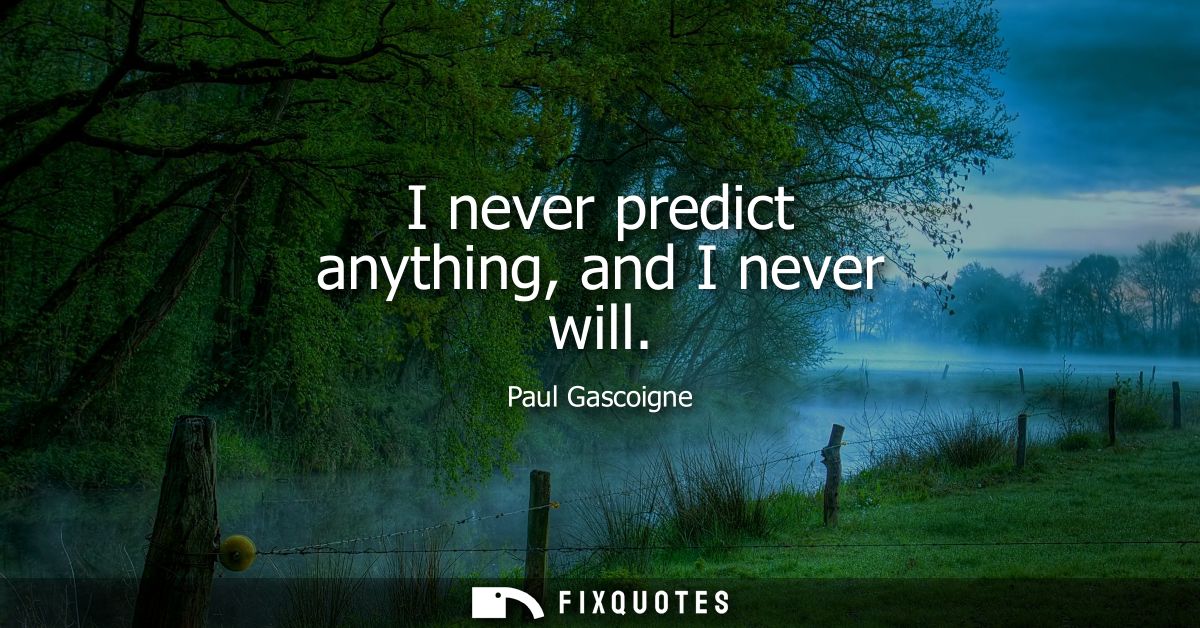
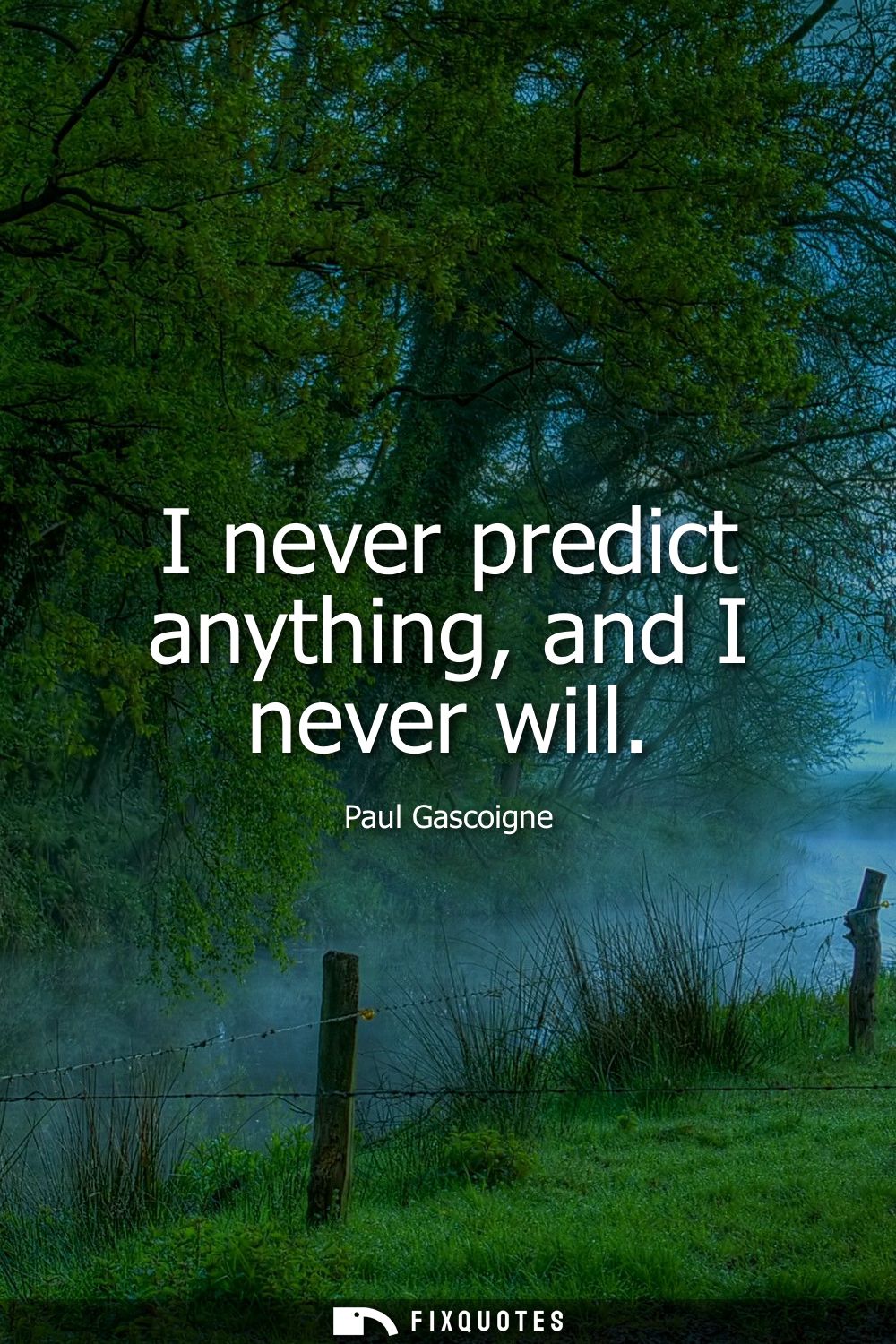
"I never predict anything, and I never will"
About this Quote
A perfect little paradox from a footballer who spent his career being forecasted like weather. Gascoigne’s “I never predict anything, and I never will” lands because it’s both a refusal and a prediction, delivered with the shrugging charm that made “Gazza” a tabloid magnet and a fan favorite. The line isn’t trying to be philosophically airtight; it’s trying to dodge the trap.
The intent feels defensive but playful: don’t pin me down, don’t make me responsible for tomorrow. Athletes are constantly baited into prophecies - scorelines, transfer rumors, comebacks, redemption arcs - and those predictions get replayed as receipts when reality turns. Gascoigne’s move is to opt out with a joke that doubles as a shield. If you won’t forecast, you can’t be caught being wrong. If you never will, you’ve already made a claim about the future, and the contradiction is the point: it signals that the interview game is absurd.
The subtext is bigger than media training. Gascoigne’s public life, especially post-peak, became a story about volatility: genius, impulsiveness, injury, addiction, fragile recoveries. Prediction, for someone living inside that kind of turbulence, can feel less like strategy and more like temptation - a promise you’ll be punished for making. So he turns uncertainty into punchline, and the punchline into autonomy.
Culturally, it’s an athlete’s version of anti-expertise at a time when everyone is expected to have a take. Gascoigne’s brilliance was always in the moment; the quote insists the moment is the only honest place to stand.
The intent feels defensive but playful: don’t pin me down, don’t make me responsible for tomorrow. Athletes are constantly baited into prophecies - scorelines, transfer rumors, comebacks, redemption arcs - and those predictions get replayed as receipts when reality turns. Gascoigne’s move is to opt out with a joke that doubles as a shield. If you won’t forecast, you can’t be caught being wrong. If you never will, you’ve already made a claim about the future, and the contradiction is the point: it signals that the interview game is absurd.
The subtext is bigger than media training. Gascoigne’s public life, especially post-peak, became a story about volatility: genius, impulsiveness, injury, addiction, fragile recoveries. Prediction, for someone living inside that kind of turbulence, can feel less like strategy and more like temptation - a promise you’ll be punished for making. So he turns uncertainty into punchline, and the punchline into autonomy.
Culturally, it’s an athlete’s version of anti-expertise at a time when everyone is expected to have a take. Gascoigne’s brilliance was always in the moment; the quote insists the moment is the only honest place to stand.
Quote Details
| Topic | Free Will & Fate |
|---|---|
| Source | Help us find the source |
| Cite |
Citation Formats
APA Style (7th ed.)
Gascoigne, Paul. (2026, January 14). I never predict anything, and I never will. FixQuotes. https://fixquotes.com/quotes/i-never-predict-anything-and-i-never-will-164374/
Chicago Style
Gascoigne, Paul. "I never predict anything, and I never will." FixQuotes. January 14, 2026. https://fixquotes.com/quotes/i-never-predict-anything-and-i-never-will-164374/.
MLA Style (9th ed.)
"I never predict anything, and I never will." FixQuotes, 14 Jan. 2026, https://fixquotes.com/quotes/i-never-predict-anything-and-i-never-will-164374/. Accessed 12 Feb. 2026.
More Quotes by Paul
Add to List