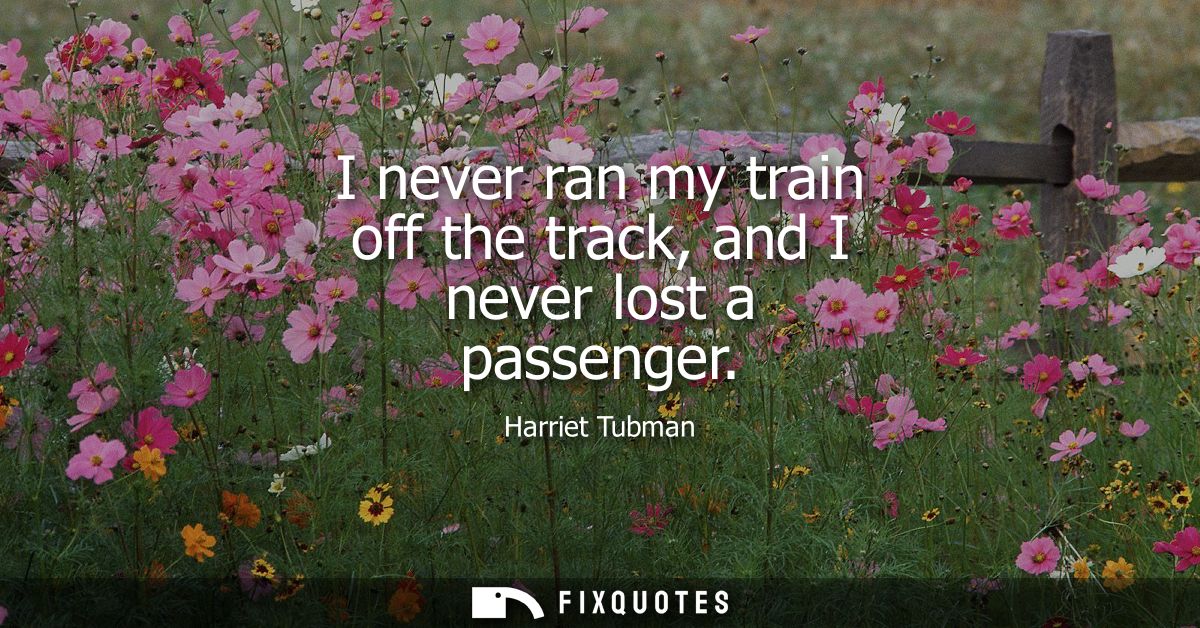
"I never ran my train off the track, and I never lost a passenger"
About this Quote
Tubman talks like a conductor because metaphor was her safest public language and her sharpest flex. “Train” and “passenger” sanitize what was, in practice, a rolling act of domestic insurgency: night travel, coded routes, armed deterrence, and constant improvisation under a legal regime that treated Black freedom as theft. By framing her work as reliable transit, she hijacks the era’s most modern symbol of progress and commerce and repurposes it as a moral logistics network. The subtext is tactical: she normalizes the Underground Railroad as a service with standards, not a desperate gamble. Reliability becomes a kind of authority.
The line also carries a quiet rebuke to the sentimental version of abolitionist lore. There’s no pleading, no self-mythologizing in florid terms. Just metrics. No derailments. Zero losses. It’s a statement built to end arguments and cut through genteel doubt about a Black woman’s competence. In a culture that routinely denied her personhood, Tubman asserts professional mastery.
Context matters: “running a train” wasn’t metaphorical playacting. Slave catchers, informants, harsh weather, hunger, illness, and the omnipresent threat of betrayal made every trip a potential massacre. Tubman’s claim lands as both pride and warning: success required discipline, secrecy, and the willingness to enforce rules. It’s leadership language with steel underneath - a reminder that liberation, in her hands, was not just righteous. It was executed.
The line also carries a quiet rebuke to the sentimental version of abolitionist lore. There’s no pleading, no self-mythologizing in florid terms. Just metrics. No derailments. Zero losses. It’s a statement built to end arguments and cut through genteel doubt about a Black woman’s competence. In a culture that routinely denied her personhood, Tubman asserts professional mastery.
Context matters: “running a train” wasn’t metaphorical playacting. Slave catchers, informants, harsh weather, hunger, illness, and the omnipresent threat of betrayal made every trip a potential massacre. Tubman’s claim lands as both pride and warning: success required discipline, secrecy, and the willingness to enforce rules. It’s leadership language with steel underneath - a reminder that liberation, in her hands, was not just righteous. It was executed.
Quote Details
| Topic | Servant Leadership |
|---|---|
| Source | Later attribution: Have I Ever Told You Black Lives Matter (Shani Mahiri King, 2021) modern compilationISBN: 9780884488958 · ID: aSIIEAAAQBAJ
Evidence:
... Harriet Ross Tubman " Moses " ( 1820 ? -1913 ) " I was the conductor of the Underground Railroad for eight years , and I can say what most conductors can't say I never ran my train off the track and I never lost a passenger . " - Most ... |
| Cite |
Citation Formats
APA Style (7th ed.)
Tubman, Harriet. (2026, February 18). I never ran my train off the track, and I never lost a passenger. FixQuotes. https://fixquotes.com/quotes/i-never-ran-my-train-off-the-track-and-i-never-58930/
Chicago Style
Tubman, Harriet. "I never ran my train off the track, and I never lost a passenger." FixQuotes. February 18, 2026. https://fixquotes.com/quotes/i-never-ran-my-train-off-the-track-and-i-never-58930/.
MLA Style (9th ed.)
"I never ran my train off the track, and I never lost a passenger." FixQuotes, 18 Feb. 2026, https://fixquotes.com/quotes/i-never-ran-my-train-off-the-track-and-i-never-58930/. Accessed 18 Mar. 2026.
More Quotes by Harriet
Add to List