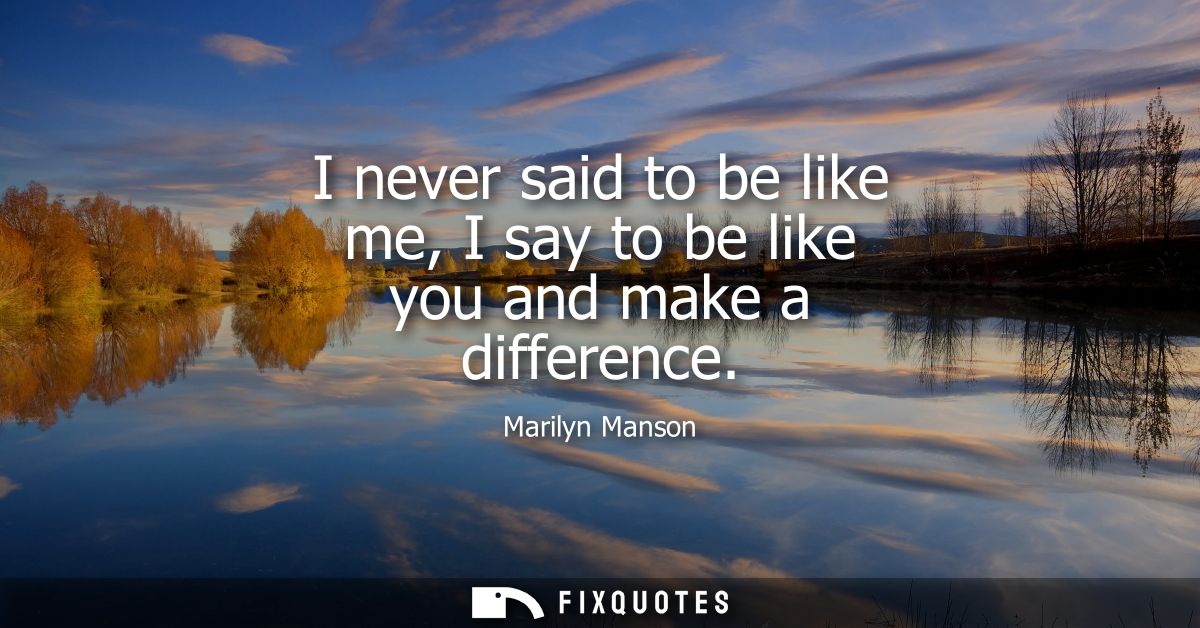
"I never said to be like me, I say to be like you and make a difference"
About this Quote
Manson’s line is a classic piece of rock-frontman judo: it takes the cult-of-personality accusation that trails any shock artist and flips it into a permission slip for the audience. The surface message is DIY selfhood, but the real maneuver is reputational triage. Marilyn Manson has always been a lightning rod for moral panic and fan obsession alike; “don’t be like me” works as both a moral disavowal and a brand defense. He rejects the role of guru while still claiming the authority to give direction.
The sentence is built on a productive contradiction. He denies imitation yet positions himself as the one who gets to define what authenticity should look like. “Be like you” sounds liberating, but it subtly re-centers the speaker as the catalyst: you become yourself because he told you to. That’s not hypocrisy so much as how pop iconography functions. Fans don’t just want songs; they want a stance, a posture toward the world. Manson offers alienation as identity, and then launders it into civic language: “make a difference.”
That last phrase is intentionally broad, almost self-help in its vagueness, because it lets “difference” mean whatever the listener needs: defying parents, surviving school, making art, rejecting hypocrisy. In the late-90s/early-2000s culture-war climate around his work, the quote also reads as tactical: he frames his provocation not as corruption but as activation. The subtext is, “I’m not your blueprint; I’m your proof of concept.”
The sentence is built on a productive contradiction. He denies imitation yet positions himself as the one who gets to define what authenticity should look like. “Be like you” sounds liberating, but it subtly re-centers the speaker as the catalyst: you become yourself because he told you to. That’s not hypocrisy so much as how pop iconography functions. Fans don’t just want songs; they want a stance, a posture toward the world. Manson offers alienation as identity, and then launders it into civic language: “make a difference.”
That last phrase is intentionally broad, almost self-help in its vagueness, because it lets “difference” mean whatever the listener needs: defying parents, surviving school, making art, rejecting hypocrisy. In the late-90s/early-2000s culture-war climate around his work, the quote also reads as tactical: he frames his provocation not as corruption but as activation. The subtext is, “I’m not your blueprint; I’m your proof of concept.”
Quote Details
| Topic | Self-Improvement |
|---|---|
| Source | Help us find the source |
| Cite | Cite this Quote |
Citation Formats
APA Style (7th ed.)
Manson, Marilyn. (n.d.). I never said to be like me, I say to be like you and make a difference. FixQuotes. https://fixquotes.com/quotes/i-never-said-to-be-like-me-i-say-to-be-like-you-720/
Chicago Style
Manson, Marilyn. "I never said to be like me, I say to be like you and make a difference." FixQuotes. Accessed February 3, 2026. https://fixquotes.com/quotes/i-never-said-to-be-like-me-i-say-to-be-like-you-720/.
MLA Style (9th ed.)
"I never said to be like me, I say to be like you and make a difference." FixQuotes, https://fixquotes.com/quotes/i-never-said-to-be-like-me-i-say-to-be-like-you-720/. Accessed 3 Feb. 2026.
More Quotes by Marilyn
Add to List