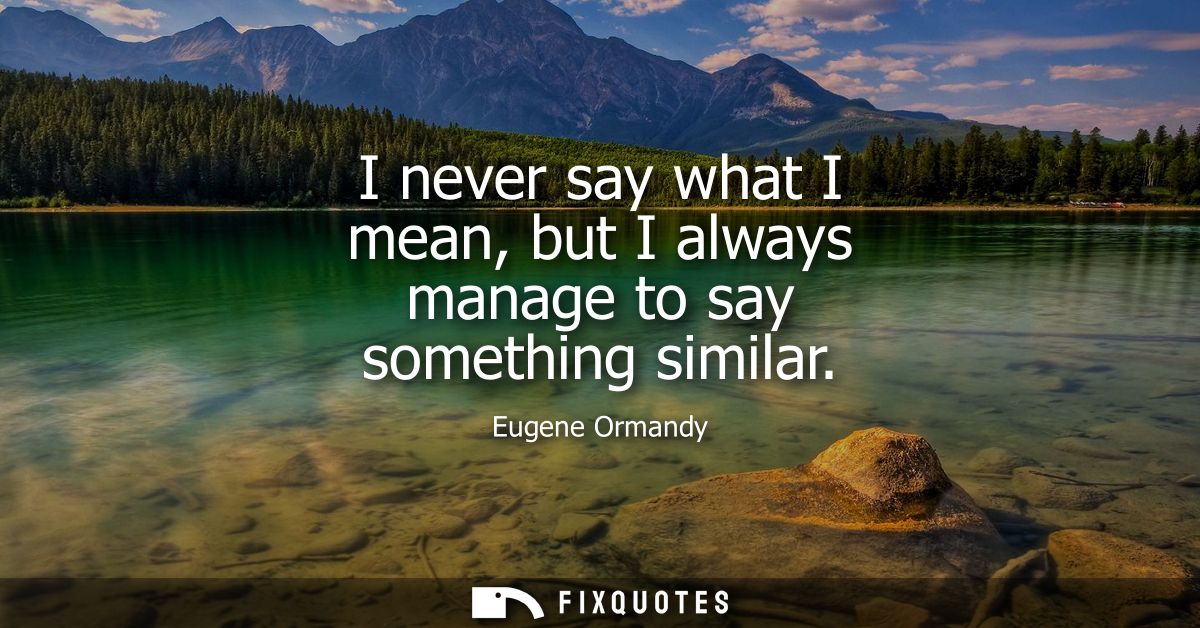
"I never say what I mean, but I always manage to say something similar"
About this Quote
The intent is slyly defensive. Ormandy frames ambiguity as a skill, not a flaw. In rehearsal, words are blunt instruments: “brighter,” “warmer,” “more air,” “less weight.” None of it is measurable, all of it is actionable. “Something similar” is the conductor’s real job description: translate a private sonic ideal into cues that 100 players can interpret in real time. If meaning were too literal, it would collapse under the complexity of what’s being asked.
The subtext is also about power. “I never say what I mean” implies a protected interiority: the maestro keeps the true target to himself, adjusting on the fly, preserving mystique, leaving room to blame the phrasing rather than the vision. It’s a gentle reminder that in elite cultural work, communication often succeeds through approximation, not transparency.
Context matters: Ormandy’s era prized smooth institutional excellence - big orchestras, big reputations, limited patience for messy process. The line captures how “professional” artistry often runs on tact, suggestion, and controlled vagueness, because the music can’t be fully explained. It has to be steered.
Quote Details
| Topic | Witty One-Liners |
|---|---|
| Source | Help us find the source |
| Cite |
Citation Formats
APA Style (7th ed.)
Ormandy, Eugene. (2026, January 16). I never say what I mean, but I always manage to say something similar. FixQuotes. https://fixquotes.com/quotes/i-never-say-what-i-mean-but-i-always-manage-to-117305/
Chicago Style
Ormandy, Eugene. "I never say what I mean, but I always manage to say something similar." FixQuotes. January 16, 2026. https://fixquotes.com/quotes/i-never-say-what-i-mean-but-i-always-manage-to-117305/.
MLA Style (9th ed.)
"I never say what I mean, but I always manage to say something similar." FixQuotes, 16 Jan. 2026, https://fixquotes.com/quotes/i-never-say-what-i-mean-but-i-always-manage-to-117305/. Accessed 11 Mar. 2026.