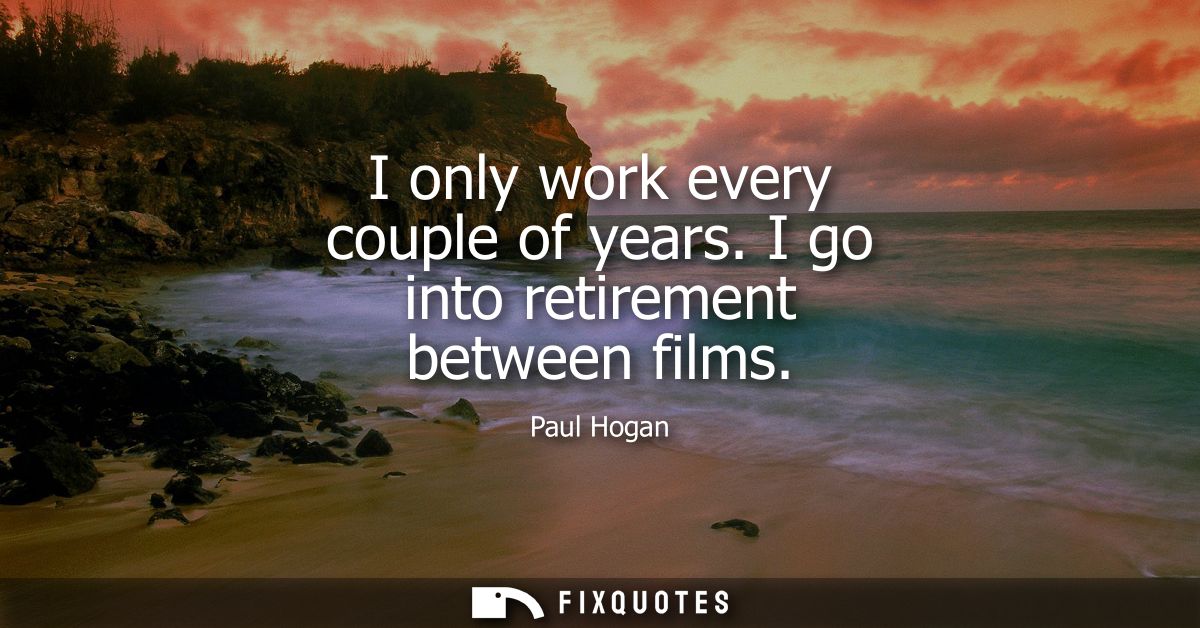
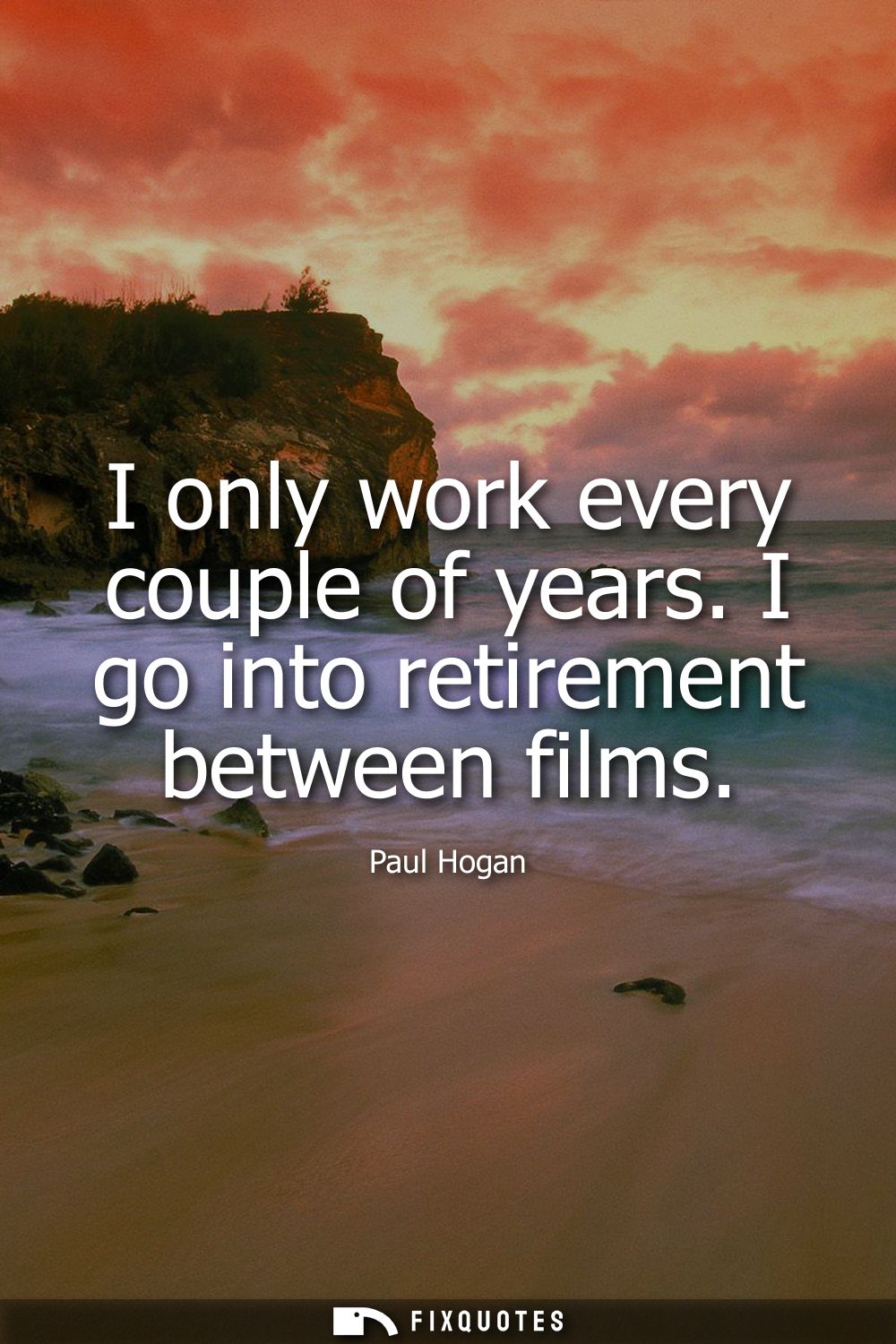
"I only work every couple of years. I go into retirement between films"
About this Quote
Paul Hogan delivers “retirement” like a punchline, and that’s the point: he takes the most loaded word in modern work culture and deflates it into a casual scheduling choice. Coming from a movie star, it’s both a flex and a wink. He’s reminding you that his job isn’t a grind; it’s an event. The gap between films becomes not unemployment but a deliberate, almost luxurious pause, framed as a lifestyle rather than a lull.
The specific intent is to normalize distance from the treadmill while staying likable. Hogan’s public persona has long traded on relaxed, anti-hustle Australian ease, and this line repackages that brand in a way Americans can’t resist: he’s technically “retired,” yet still shows up to do the big thing when it suits him. It’s a neat inversion of the usual celebrity narrative where actors insist they’re always working, always yearning, always “developing.” Hogan implies the opposite: the work is intermittent, and that intermittence is the reward.
The subtext carries a quiet critique of hustle culture without getting preachy. If someone who operates inside a high-pressure industry can step back and call it retirement, what does that say about the rest of us treating nonstop labor as virtue? Context matters, too: Hogan’s fame is tied to a few massive cultural touchstones, not constant output. He can afford to vanish. The line acknowledges that privilege, then turns it into charm, selling the fantasy of a life where work is occasional and rest is the default.
The specific intent is to normalize distance from the treadmill while staying likable. Hogan’s public persona has long traded on relaxed, anti-hustle Australian ease, and this line repackages that brand in a way Americans can’t resist: he’s technically “retired,” yet still shows up to do the big thing when it suits him. It’s a neat inversion of the usual celebrity narrative where actors insist they’re always working, always yearning, always “developing.” Hogan implies the opposite: the work is intermittent, and that intermittence is the reward.
The subtext carries a quiet critique of hustle culture without getting preachy. If someone who operates inside a high-pressure industry can step back and call it retirement, what does that say about the rest of us treating nonstop labor as virtue? Context matters, too: Hogan’s fame is tied to a few massive cultural touchstones, not constant output. He can afford to vanish. The line acknowledges that privilege, then turns it into charm, selling the fantasy of a life where work is occasional and rest is the default.
Quote Details
| Topic | Retirement |
|---|---|
| Source | Help us find the source |
| Cite |
Citation Formats
APA Style (7th ed.)
Hogan, Paul. (2026, January 16). I only work every couple of years. I go into retirement between films. FixQuotes. https://fixquotes.com/quotes/i-only-work-every-couple-of-years-i-go-into-134361/
Chicago Style
Hogan, Paul. "I only work every couple of years. I go into retirement between films." FixQuotes. January 16, 2026. https://fixquotes.com/quotes/i-only-work-every-couple-of-years-i-go-into-134361/.
MLA Style (9th ed.)
"I only work every couple of years. I go into retirement between films." FixQuotes, 16 Jan. 2026, https://fixquotes.com/quotes/i-only-work-every-couple-of-years-i-go-into-134361/. Accessed 31 Mar. 2026.
More Quotes by Paul
Add to List