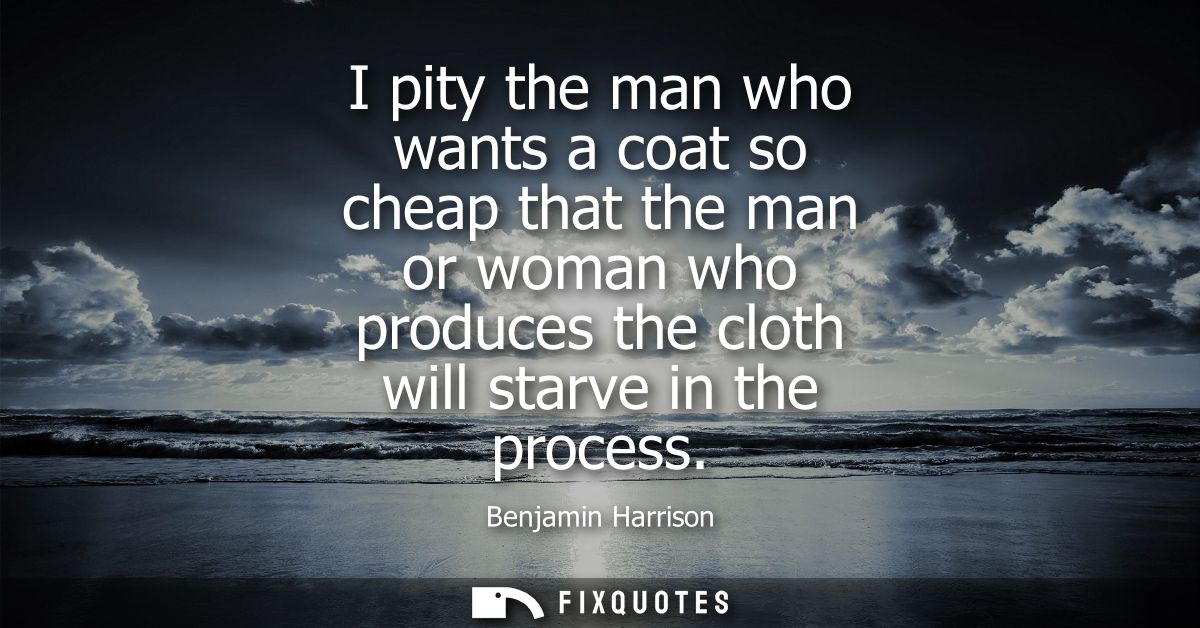
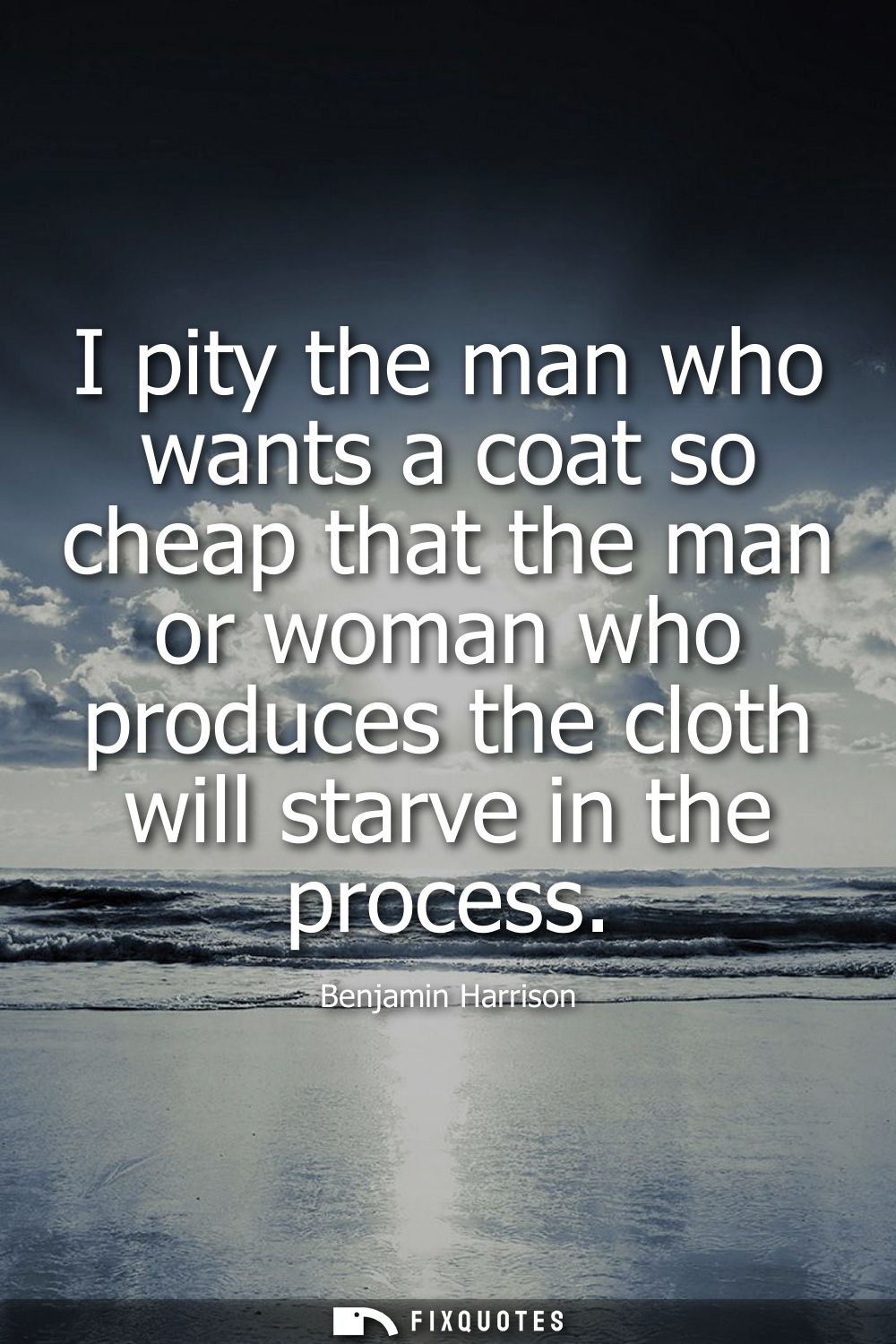
"I pity the man who wants a coat so cheap that the man or woman who produces the cloth will starve in the process"
About this Quote
As a president speaking in an era of industrial expansion and fierce fights over tariffs, wages, and labor power, Harrison is making an argument that sounds like paternal conscience but functions like policy rhetoric. The “coat” is a stand-in for the whole new consumer economy: mass production, distant supply chains (even then), and the temptation to treat human labor as an invisible input. By naming “man or woman,” he also points at the feminized, underpaid sectors of textile work without turning it into sentimentality. The starvation image is blunt and physical, refusing the euphemisms that typically protect comfortable listeners.
The subtext is a challenge to the American habit of mistaking low prices for progress. Harrison frames ethical consumption as a form of patriotism and social stability: if labor is crushed to satisfy price obsession, the nation’s prosperity becomes a shell game. It’s also a reminder that “cheap” is rarely neutral. Someone pays. The only question is whether the buyer is willing to notice.
Quote Details
| Topic | Human Rights |
|---|---|
| Source | Help us find the source |
| Cite |
Citation Formats
APA Style (7th ed.)
Harrison, Benjamin. (2026, January 17). I pity the man who wants a coat so cheap that the man or woman who produces the cloth will starve in the process. FixQuotes. https://fixquotes.com/quotes/i-pity-the-man-who-wants-a-coat-so-cheap-that-the-41667/
Chicago Style
Harrison, Benjamin. "I pity the man who wants a coat so cheap that the man or woman who produces the cloth will starve in the process." FixQuotes. January 17, 2026. https://fixquotes.com/quotes/i-pity-the-man-who-wants-a-coat-so-cheap-that-the-41667/.
MLA Style (9th ed.)
"I pity the man who wants a coat so cheap that the man or woman who produces the cloth will starve in the process." FixQuotes, 17 Jan. 2026, https://fixquotes.com/quotes/i-pity-the-man-who-wants-a-coat-so-cheap-that-the-41667/. Accessed 6 Apr. 2026.