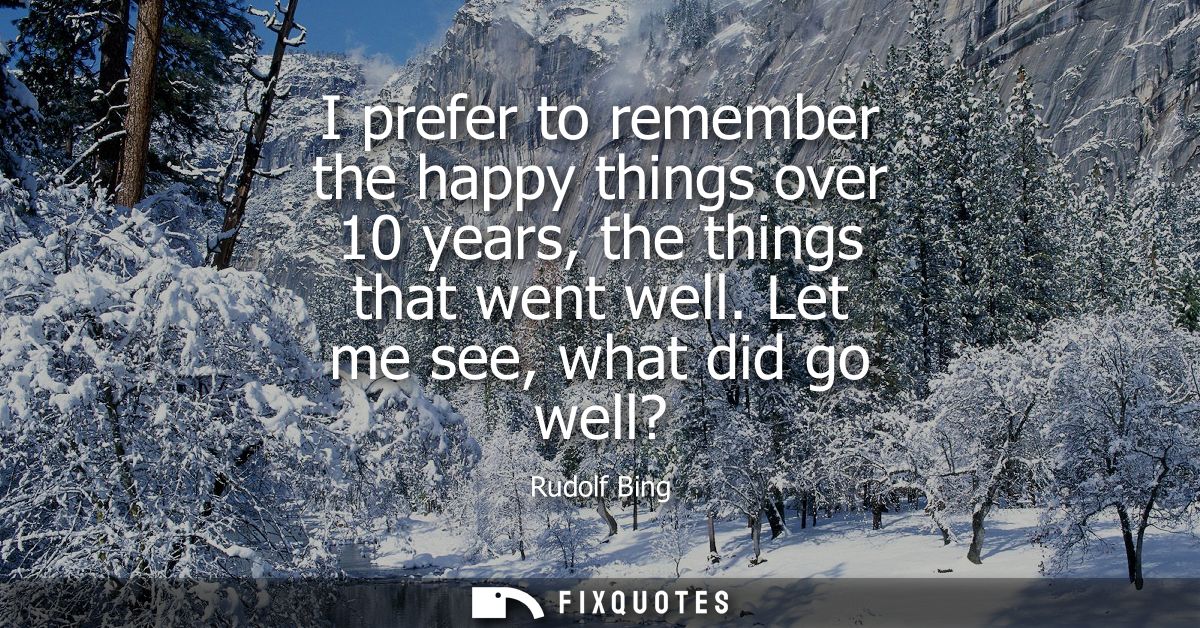
"I prefer to remember the happy things over 10 years, the things that went well. Let me see, what did go well?"
About this Quote
Bing spent much of his life in institutions where "success" is loudly advertised and privately negotiated: impresarios, boards, donors, divas, critics, budgets. His question reads like backstage candor slipping past the curtain. The subtext is not simply that things went badly; its sharper implication is that even the victories are complicated, contested, or already re-litigated. In the arts, triumph arrives with footnotes: the production that sold out but enraged purists, the singer who became a star and a headache, the balanced books that still felt like austerity.
The intent feels twofold. On the surface, it’s self-deprecating humor, the kind that makes an old-world administrator sound likable rather than bitter. Underneath, it’s a critique of the cultural memory machine: we claim we curate the "happy things", yet the mind (and the public record) keeps returning to conflict, compromise, and the relentless accounting of what it cost. Bing’s little joke works because it’s a confession disguised as a quip: even the man tasked with staging enchantment can’t immediately find the enchantment in his own ledger.
Quote Details
| Topic | Nostalgia |
|---|---|
| Source | Help us find the source |
| Cite |
Citation Formats
APA Style (7th ed.)
Bing, Rudolf. (2026, January 16). I prefer to remember the happy things over 10 years, the things that went well. Let me see, what did go well? FixQuotes. https://fixquotes.com/quotes/i-prefer-to-remember-the-happy-things-over-10-117007/
Chicago Style
Bing, Rudolf. "I prefer to remember the happy things over 10 years, the things that went well. Let me see, what did go well?" FixQuotes. January 16, 2026. https://fixquotes.com/quotes/i-prefer-to-remember-the-happy-things-over-10-117007/.
MLA Style (9th ed.)
"I prefer to remember the happy things over 10 years, the things that went well. Let me see, what did go well?" FixQuotes, 16 Jan. 2026, https://fixquotes.com/quotes/i-prefer-to-remember-the-happy-things-over-10-117007/. Accessed 14 Mar. 2026.