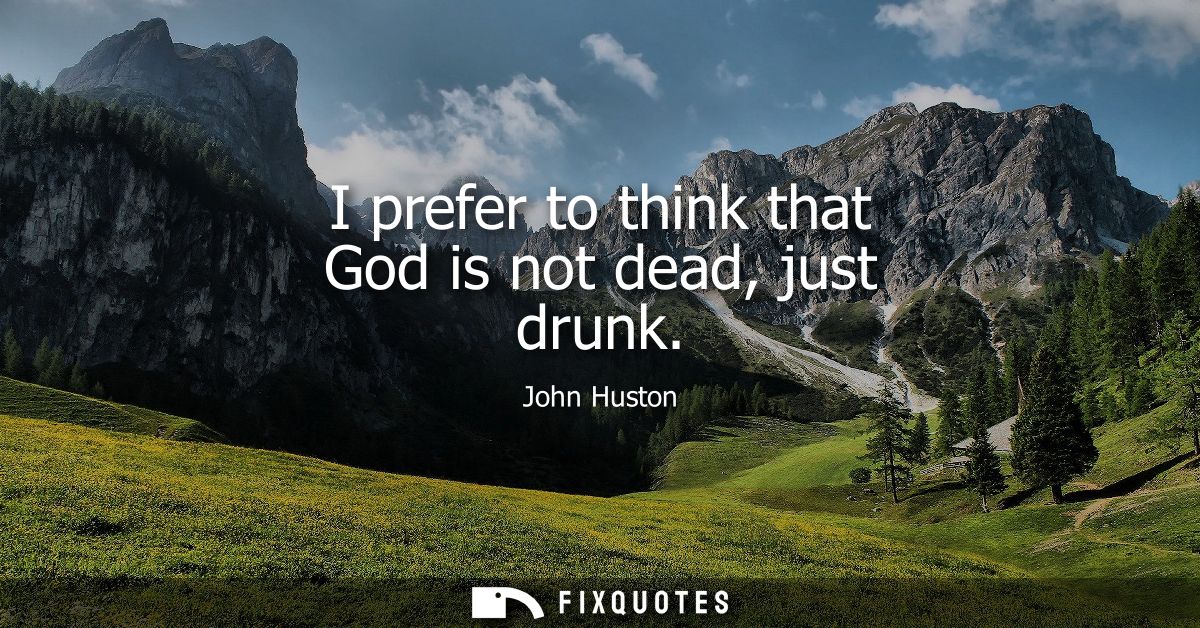
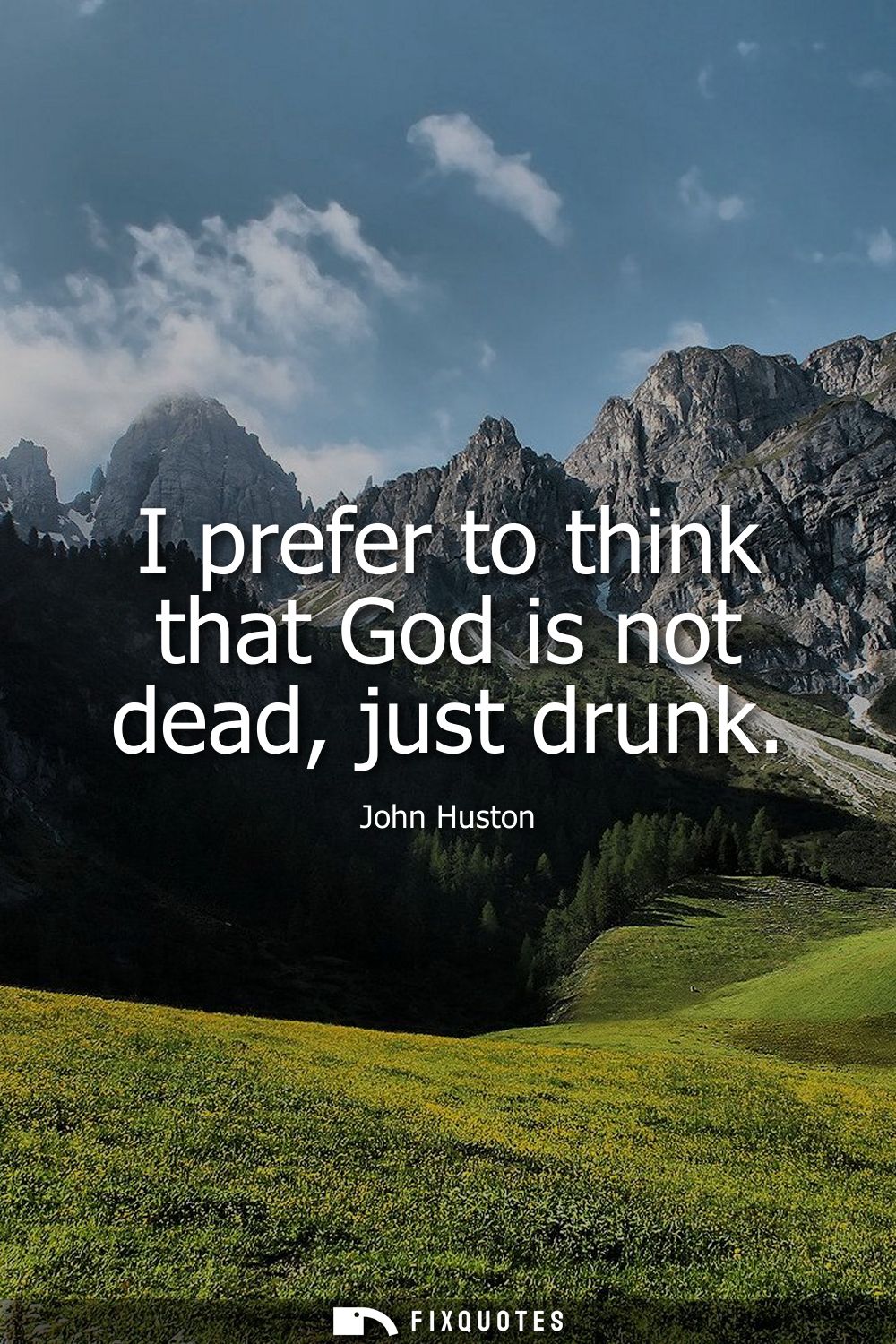
"I prefer to think that God is not dead, just drunk"
About this Quote
Huston’s line lands like a barroom correction to Nietzsche: not a grand metaphysical obituary, just a grim little status update. “God is not dead, just drunk” swaps clean philosophical rupture for something messier and more human - absence by impairment, not extinction. It’s a director’s joke with a director’s worldview: the universe still has an author, but the author might be slumped at the counter, unreliable, and occasionally cruel.
The intent is skeptical without being triumphantly atheist. Drunk gods don’t disappear; they stagger. That matters because it reframes suffering and disorder as negligence rather than proof of emptiness. If God is dead, we inherit the job. If God is drunk, we’re stuck in a cosmos where the lights are on but no one’s steering, where prayers get “heard” the way last call gets heard - vaguely, late, and with slurred judgment. The punchline carries an edge of resentment: it’s easier to forgive silence than incoherence.
Huston’s cultural context is key. He comes out of a 20th century that watched faith get chewed up by war, bureaucracy, and the casual machinery of death. His films (from The Maltese Falcon to The Treasure of the Sierra Madre) orbit greed, fatalism, and moral luck; redemption exists, but it’s never guaranteed by the cosmos. Calling God “drunk” also slyly implicates the masculine mythos of the era - hard drinking as both romance and rot. It’s blasphemy with a hangover: funny, bleak, and uncomfortably plausible.
The intent is skeptical without being triumphantly atheist. Drunk gods don’t disappear; they stagger. That matters because it reframes suffering and disorder as negligence rather than proof of emptiness. If God is dead, we inherit the job. If God is drunk, we’re stuck in a cosmos where the lights are on but no one’s steering, where prayers get “heard” the way last call gets heard - vaguely, late, and with slurred judgment. The punchline carries an edge of resentment: it’s easier to forgive silence than incoherence.
Huston’s cultural context is key. He comes out of a 20th century that watched faith get chewed up by war, bureaucracy, and the casual machinery of death. His films (from The Maltese Falcon to The Treasure of the Sierra Madre) orbit greed, fatalism, and moral luck; redemption exists, but it’s never guaranteed by the cosmos. Calling God “drunk” also slyly implicates the masculine mythos of the era - hard drinking as both romance and rot. It’s blasphemy with a hangover: funny, bleak, and uncomfortably plausible.
Quote Details
| Topic | God |
|---|---|
| Source | Help us find the source |
| Cite |
Citation Formats
APA Style (7th ed.)
Huston, John. (2026, January 15). I prefer to think that God is not dead, just drunk. FixQuotes. https://fixquotes.com/quotes/i-prefer-to-think-that-god-is-not-dead-just-drunk-57507/
Chicago Style
Huston, John. "I prefer to think that God is not dead, just drunk." FixQuotes. January 15, 2026. https://fixquotes.com/quotes/i-prefer-to-think-that-god-is-not-dead-just-drunk-57507/.
MLA Style (9th ed.)
"I prefer to think that God is not dead, just drunk." FixQuotes, 15 Jan. 2026, https://fixquotes.com/quotes/i-prefer-to-think-that-god-is-not-dead-just-drunk-57507/. Accessed 13 Feb. 2026.
More Quotes by John
Add to List