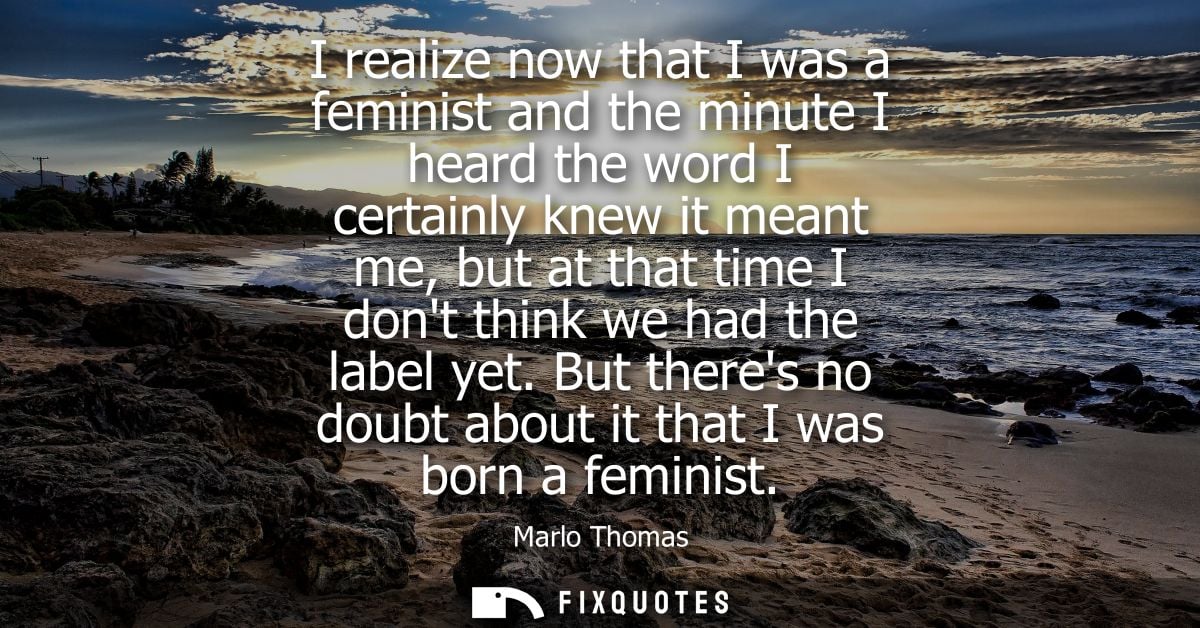
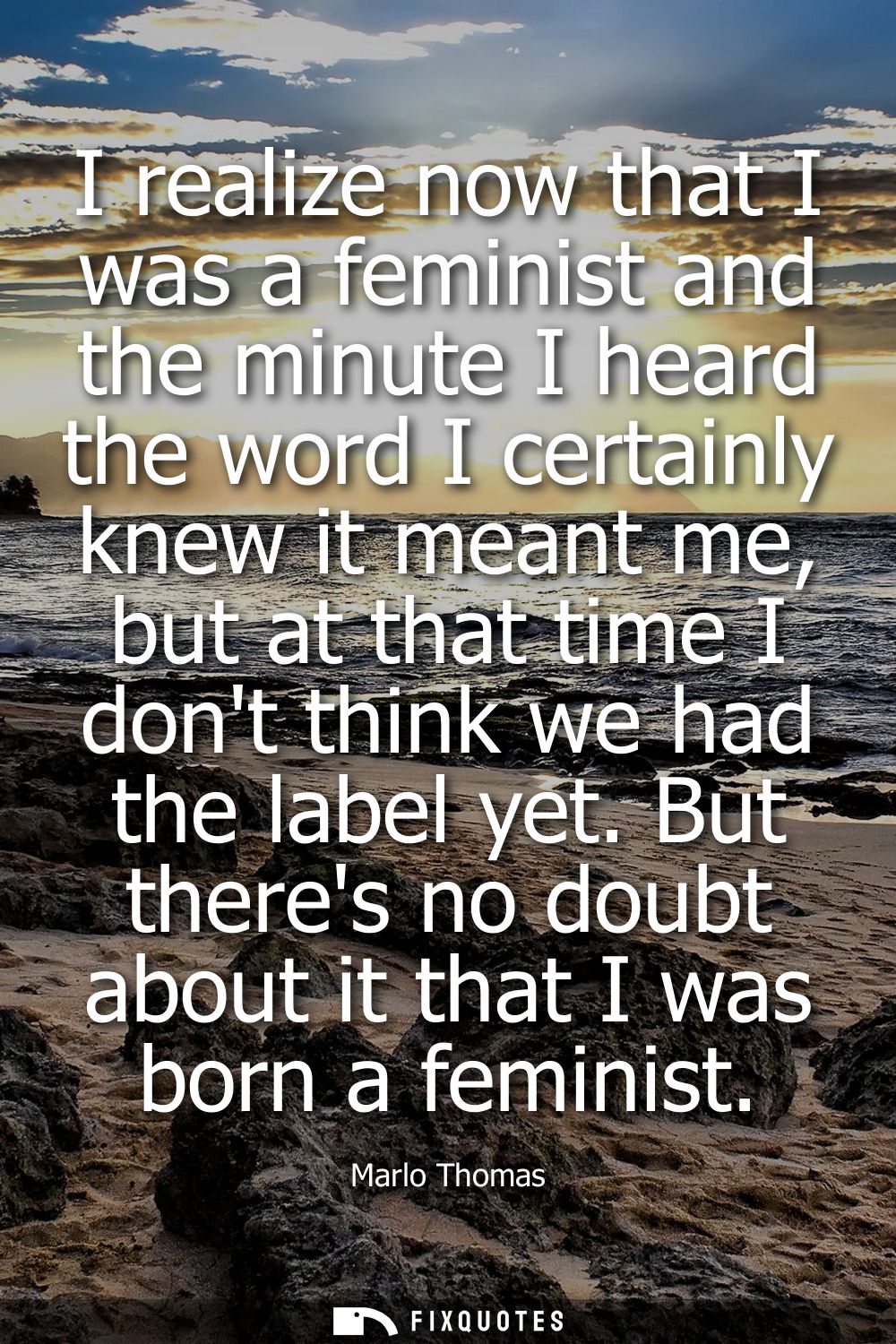
"I realize now that I was a feminist and the minute I heard the word I certainly knew it meant me, but at that time I don't think we had the label yet. But there's no doubt about it that I was born a feminist"
About this Quote
Marlo Thomas frames feminism less as an ideology she adopted than a self-recognition she finally got language for. That distinction matters. She’s not describing a political conversion; she’s describing the moment a private, lived friction with the world snaps into focus because someone hands you a word that fits. “The minute I heard the word” isn’t about trend-chasing. It’s about naming: a label that turns diffuse dissatisfaction into something legible, sharable, and therefore actionable.
The little pivot - “at that time I don’t think we had the label yet” - does cultural work. It nods to a pre-brand era of women pushing against limits without the infrastructure of slogans, hashtags, and consensus terminology. Thomas came up as a star in a mid-century entertainment machine that sold cheerful femininity while quietly policing ambition. Her claim to being “born a feminist” pushes back against the insinuation that feminism is learned, borrowed, or hostile to normal life. She turns it into temperament: an insistence on full personhood that predates the movement’s mainstream visibility.
There’s also a strategic warmth here. As an actress and public figure, Thomas makes feminism sound intimate rather than doctrinaire, a matter of identity rather than gatekeeping. It’s a way of inviting the audience in: if you’ve ever felt the mismatch between what you’re told to be and what you are, you were “already” something too. The subtext is reassurance with teeth: the label didn’t create the reality; it simply stopped you from being alone with it.
The little pivot - “at that time I don’t think we had the label yet” - does cultural work. It nods to a pre-brand era of women pushing against limits without the infrastructure of slogans, hashtags, and consensus terminology. Thomas came up as a star in a mid-century entertainment machine that sold cheerful femininity while quietly policing ambition. Her claim to being “born a feminist” pushes back against the insinuation that feminism is learned, borrowed, or hostile to normal life. She turns it into temperament: an insistence on full personhood that predates the movement’s mainstream visibility.
There’s also a strategic warmth here. As an actress and public figure, Thomas makes feminism sound intimate rather than doctrinaire, a matter of identity rather than gatekeeping. It’s a way of inviting the audience in: if you’ve ever felt the mismatch between what you’re told to be and what you are, you were “already” something too. The subtext is reassurance with teeth: the label didn’t create the reality; it simply stopped you from being alone with it.
Quote Details
| Topic | Equality |
|---|
More Quotes by Marlo
Add to List