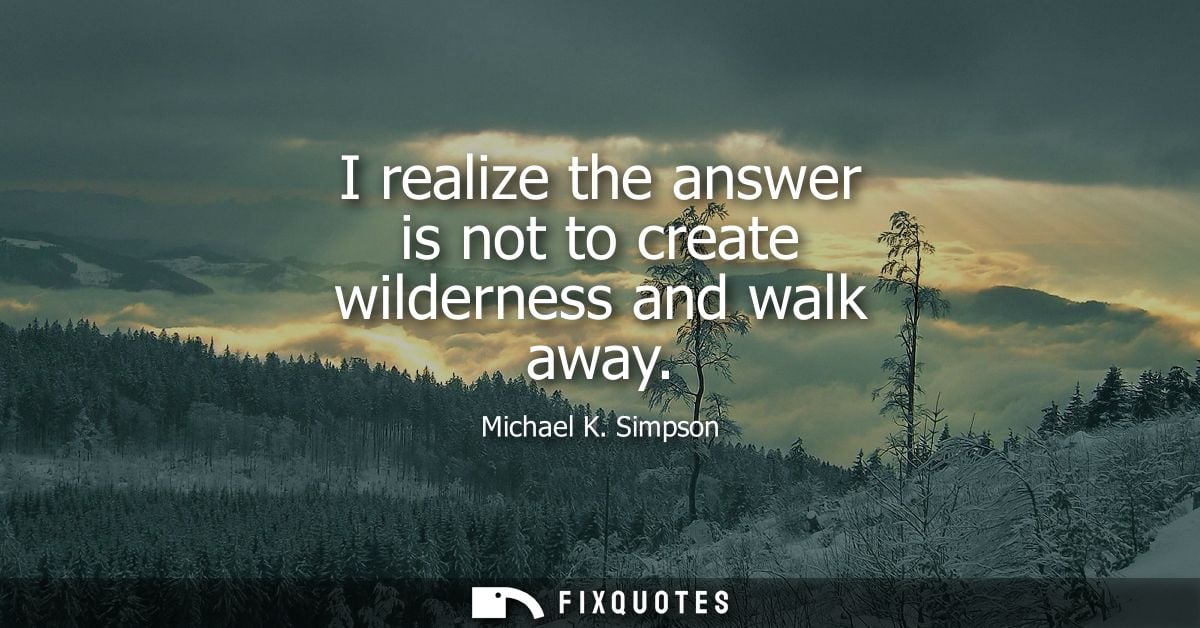
"I realize the answer is not to create wilderness and walk away"
About this Quote
There’s a quiet rebuke tucked into Simpson’s line: conservation is not a morality play where the virtuous simply draw a line on a map and disappear. “Create wilderness” sounds noble, almost biblical in its simplicity, but he pairs it with “walk away” to puncture the fantasy that land can be saved by bureaucratic designation alone. The phrasing turns “wilderness” from a pristine ideal into a managed outcome, something made - and therefore something that carries ongoing responsibility.
The intent reads as pragmatic, even preemptively defensive. As a Western Republican associated with public-lands fights, Simpson is speaking to two audiences at once: environmentalists who sometimes treat protection as a symbolic victory, and local users (ranchers, hunters, counties dependent on access) who fear that “wilderness” is code for federal lockout. By admitting “I realize,” he frames himself as a reasonable adult in a room of ideologues, someone who’s learned that governing means tending, negotiating, and funding - not just declaring.
Subtext: nature is already political. Fire suppression, invasive species, water rights, recreation pressure, tribal claims, climate stress - none of it pauses because Congress passes a designation. “Walk away” also hints at an old American habit: romanticize untouched landscapes while outsourcing the costs to rural communities, agencies, and future administrations.
Contextually, the quote fits the late-20th/early-21st century turn from preservation as purity to conservation as stewardship: collaborative management, mitigation, and accountability. It’s less about surrendering wilderness and more about refusing to use it as a feel-good endpoint.
The intent reads as pragmatic, even preemptively defensive. As a Western Republican associated with public-lands fights, Simpson is speaking to two audiences at once: environmentalists who sometimes treat protection as a symbolic victory, and local users (ranchers, hunters, counties dependent on access) who fear that “wilderness” is code for federal lockout. By admitting “I realize,” he frames himself as a reasonable adult in a room of ideologues, someone who’s learned that governing means tending, negotiating, and funding - not just declaring.
Subtext: nature is already political. Fire suppression, invasive species, water rights, recreation pressure, tribal claims, climate stress - none of it pauses because Congress passes a designation. “Walk away” also hints at an old American habit: romanticize untouched landscapes while outsourcing the costs to rural communities, agencies, and future administrations.
Contextually, the quote fits the late-20th/early-21st century turn from preservation as purity to conservation as stewardship: collaborative management, mitigation, and accountability. It’s less about surrendering wilderness and more about refusing to use it as a feel-good endpoint.
Quote Details
| Topic | Wisdom |
|---|---|
| Source | Help us find the source |
| Cite |
Citation Formats
APA Style (7th ed.)
Simpson, Michael K. (2026, January 15). I realize the answer is not to create wilderness and walk away. FixQuotes. https://fixquotes.com/quotes/i-realize-the-answer-is-not-to-create-wilderness-155628/
Chicago Style
Simpson, Michael K. "I realize the answer is not to create wilderness and walk away." FixQuotes. January 15, 2026. https://fixquotes.com/quotes/i-realize-the-answer-is-not-to-create-wilderness-155628/.
MLA Style (9th ed.)
"I realize the answer is not to create wilderness and walk away." FixQuotes, 15 Jan. 2026, https://fixquotes.com/quotes/i-realize-the-answer-is-not-to-create-wilderness-155628/. Accessed 31 Mar. 2026.
More Quotes by Michael
Add to List