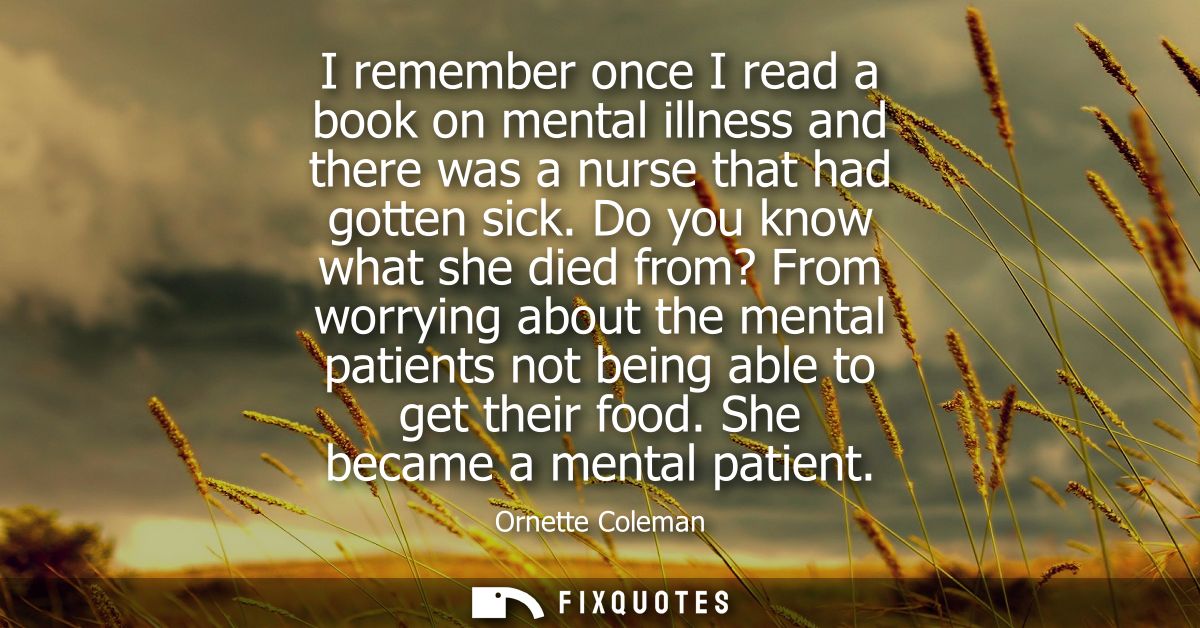
"I remember once I read a book on mental illness and there was a nurse that had gotten sick. Do you know what she died from? From worrying about the mental patients not being able to get their food. She became a mental patient"
About this Quote
Coming from a musician who spent his career challenging what counted as "order" in jazz, the anecdote doubles as a critique of systems that pretend emotion can be managed like inventory. The nurse is doing the most basic human work - worrying that people will eat - and that concern gets framed as pathology. Coleman isn't romanticizing breakdown; he's exposing how easily empathy gets punished when the environment is built to numb it. The line "She became a mental patient" hits with a blunt finality, collapsing the distance between "us" and "them" that psychiatric labels try to enforce.
There's also a sly jab at respectability: the nurse, presumably competent and stable, is undone not by moral weakness but by attention. Coleman suggests that sanity isn't a fixed trait; it's a relationship to your surroundings, your labor, your capacity to keep feeling without being swallowed by it. Like his music, the quote argues that what we call disorder might be a rational response to an irrational structure.
Quote Details
| Topic | Mental Health |
|---|---|
| Source | Help us find the source |
| Cite |
Citation Formats
APA Style (7th ed.)
Coleman, Ornette. (2026, January 16). I remember once I read a book on mental illness and there was a nurse that had gotten sick. Do you know what she died from? From worrying about the mental patients not being able to get their food. She became a mental patient. FixQuotes. https://fixquotes.com/quotes/i-remember-once-i-read-a-book-on-mental-illness-128520/
Chicago Style
Coleman, Ornette. "I remember once I read a book on mental illness and there was a nurse that had gotten sick. Do you know what she died from? From worrying about the mental patients not being able to get their food. She became a mental patient." FixQuotes. January 16, 2026. https://fixquotes.com/quotes/i-remember-once-i-read-a-book-on-mental-illness-128520/.
MLA Style (9th ed.)
"I remember once I read a book on mental illness and there was a nurse that had gotten sick. Do you know what she died from? From worrying about the mental patients not being able to get their food. She became a mental patient." FixQuotes, 16 Jan. 2026, https://fixquotes.com/quotes/i-remember-once-i-read-a-book-on-mental-illness-128520/. Accessed 7 Apr. 2026.