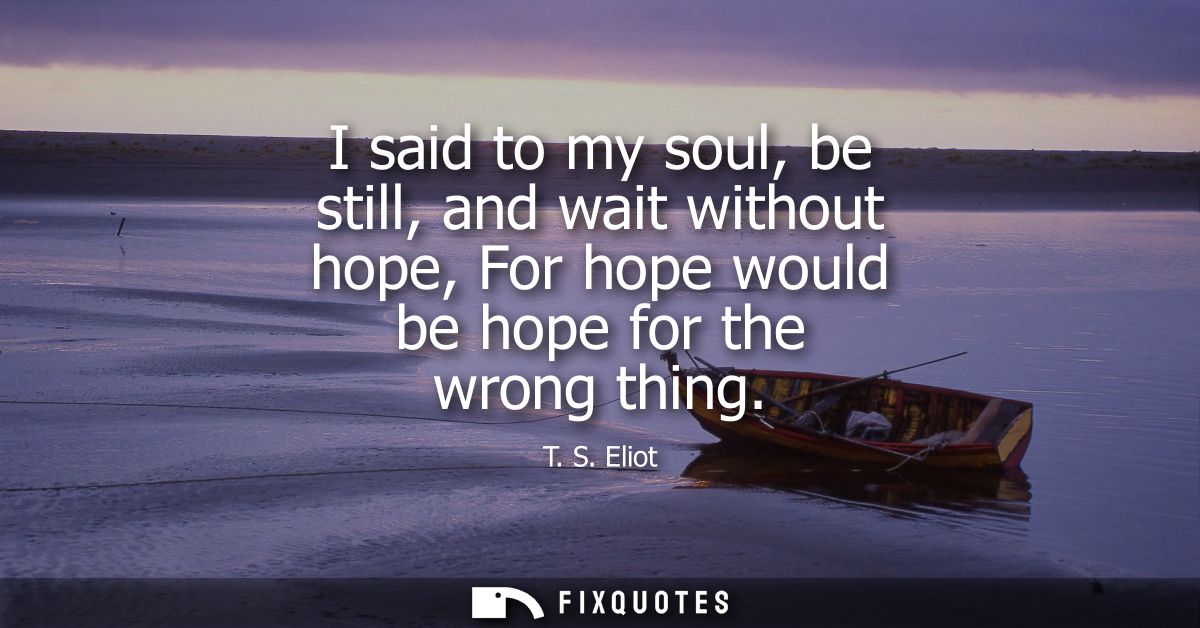
"I said to my soul, be still, and wait without hope, for hope would be hope for the wrong thing"
About this Quote
The subtext is spiritual but not syrupy. Eliot isn’t praising despair; he’s trying to clear a space where something truer than preference can appear. The soul has to be told “be still” because it won’t be. It panics, narrates, forecasts, grasps. Waiting becomes a discipline against self-deception, a refusal to turn the future into a vending machine for meaning.
Context matters: Eliot wrote out of a 20th-century landscape where old certainties had cracked - war, disillusion, the exhaustion of progress-talk - and where private faith had to survive without the props of communal confidence. The line’s austerity is the point. It’s a hard-edged mercy: stop asking life to validate you on your timetable, or you’ll mistake the first available comfort for salvation.
Quote Details
| Topic | Poetry |
|---|---|
| Source | East Coker, poem by T. S. Eliot (part of Four Quartets). First published 1940; collected in Four Quartets (1943). |
| Cite |
Citation Formats
APA Style (7th ed.)
Eliot, T. S. (2026, February 19). I said to my soul, be still, and wait without hope, for hope would be hope for the wrong thing. FixQuotes. https://fixquotes.com/quotes/i-said-to-my-soul-be-still-and-wait-without-hope-29029/
Chicago Style
Eliot, T. S. "I said to my soul, be still, and wait without hope, for hope would be hope for the wrong thing." FixQuotes. February 19, 2026. https://fixquotes.com/quotes/i-said-to-my-soul-be-still-and-wait-without-hope-29029/.
MLA Style (9th ed.)
"I said to my soul, be still, and wait without hope, for hope would be hope for the wrong thing." FixQuotes, 19 Feb. 2026, https://fixquotes.com/quotes/i-said-to-my-soul-be-still-and-wait-without-hope-29029/. Accessed 31 Mar. 2026.