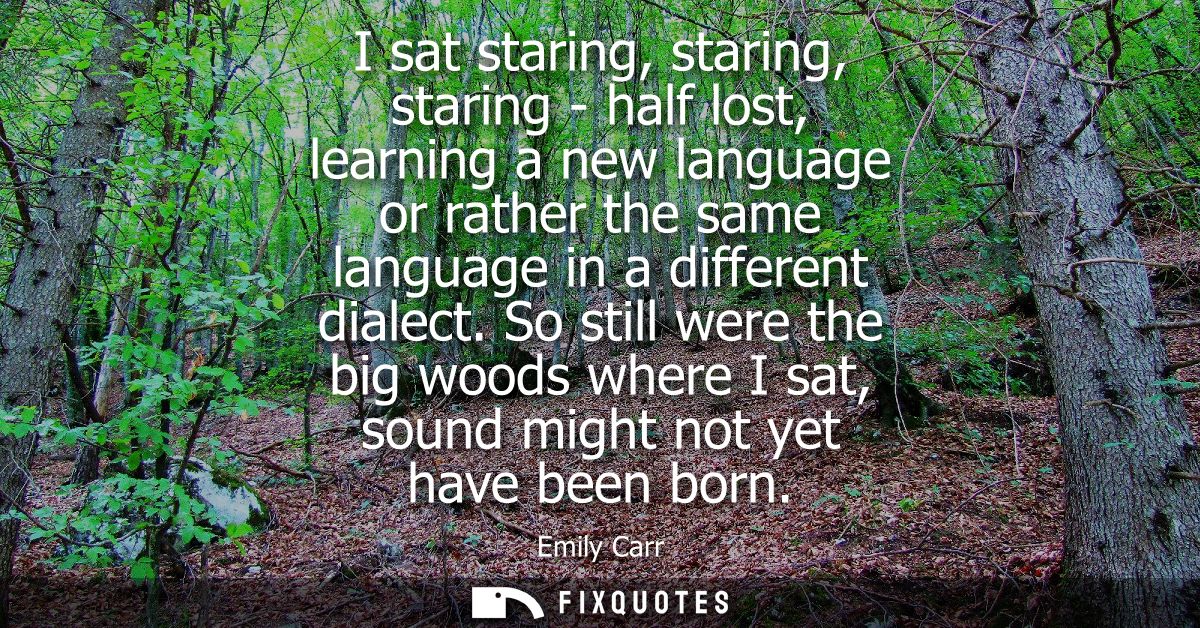
"I sat staring, staring, staring - half lost, learning a new language or rather the same language in a different dialect. So still were the big woods where I sat, sound might not yet have been born"
About this Quote
The line about sound "not yet have been born" is more than pretty mysticism. It stages the woods as pre-cultural, a place that predates narration and therefore resists possession. Carr is writing from a Canada where wilderness was routinely aestheticized as empty and therefore claimable; she refuses that convenient silence by making it uncanny, almost primordial. The subtext is humility with teeth: if sound itself feels unborn, what right does the observer have to speak first?
As an artist, Carr is also describing process. Before the brushstroke comes a kind of disciplined surrender, the moment when seeing becomes less about extracting images and more about being altered by them. The woods teach her their grammar by withholding stimulation. In that hush, she isn’t just looking at the landscape; she’s being re-made into someone capable of painting it without reducing it to scenery.
Quote Details
| Topic | Nature |
|---|---|
| Source | Verified source: Rejected (Emily Carr, 1946)
Evidence:
I went no more then to the far villages, but to the deep, quiet woods near home where I sat staring, staring, staring, half lost, learning a new language or rather the same language in a different dialect. So still were the big woods where I sat, sound might not yet have been born. (null). This exact wording appears in Emily Carr’s piece titled “Rejected,” which (at least in the digitized transcription I located) is labeled as published in 1946. This matches the quote you provided, including the em dash punctuation and the phrase “sound might not yet have been born.” However, I have not been able (from primary/archival bibliographic records in the time available) to verify the *earliest* first-publication venue beyond the 1946 publication claim on this transcription (e.g., whether it first appeared in a specific magazine/newspaper, or first appeared in a particular posthumous collected volume released in 1946). If you need “FIRST published” with high confidence, the next step would be to identify the 1946 print source that carried “Rejected” (book/periodical) and then confirm it via a scan/catalog record that includes publisher and pagination. |
| Cite |
Citation Formats
APA Style (7th ed.)
Carr, Emily. (2026, February 25). I sat staring, staring, staring - half lost, learning a new language or rather the same language in a different dialect. So still were the big woods where I sat, sound might not yet have been born. FixQuotes. https://fixquotes.com/quotes/i-sat-staring-staring-staring-half-lost-50044/
Chicago Style
Carr, Emily. "I sat staring, staring, staring - half lost, learning a new language or rather the same language in a different dialect. So still were the big woods where I sat, sound might not yet have been born." FixQuotes. February 25, 2026. https://fixquotes.com/quotes/i-sat-staring-staring-staring-half-lost-50044/.
MLA Style (9th ed.)
"I sat staring, staring, staring - half lost, learning a new language or rather the same language in a different dialect. So still were the big woods where I sat, sound might not yet have been born." FixQuotes, 25 Feb. 2026, https://fixquotes.com/quotes/i-sat-staring-staring-staring-half-lost-50044/. Accessed 28 Mar. 2026.