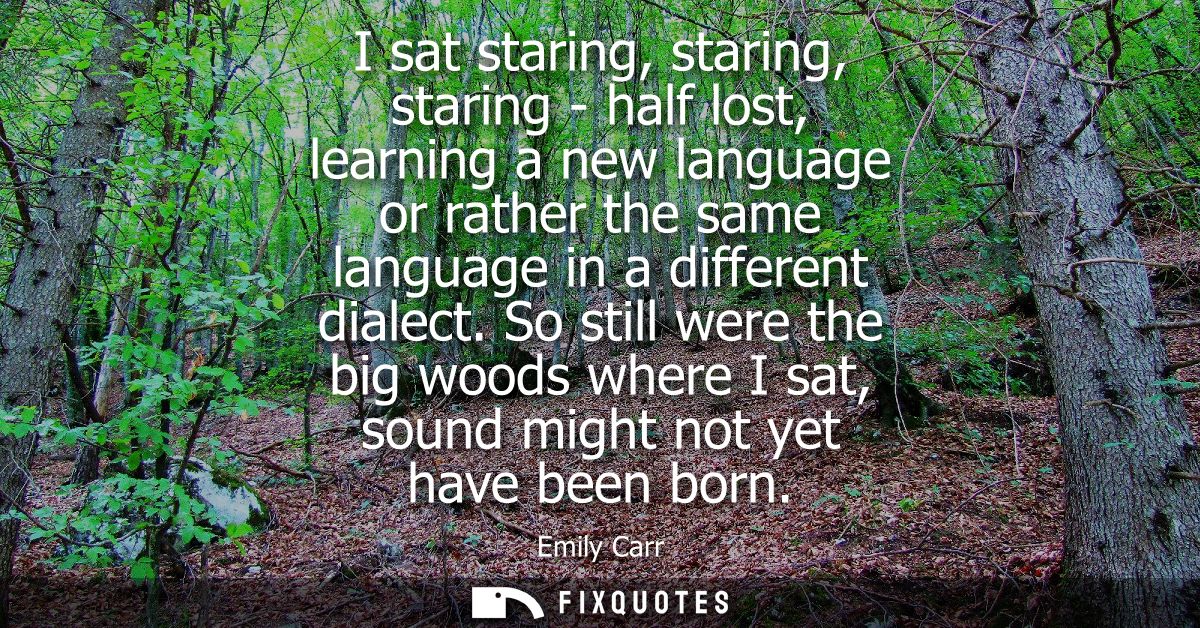
"I sat staring, staring, staring - half lost, learning a new language or rather the same language in a different dialect. So still were the big woods where I sat, sound might not yet have been born"
About this Quote
Carr frames stillness as an education, not a backdrop. The triple beat of "staring, staring, staring" reads like an artist forcing her own nervous system to slow down to the woods' tempo, a self-imposed apprenticeship in attention. She corrects herself mid-sentence - "a new language or rather the same language in a different dialect" - and that pivot is the tell: the forest isn’t an exotic "other" to be decoded so much as a familiar world that urban, colonial habits have made her temporarily illiterate in. The dialect is what changes when you stop trying to translate nature into human priorities.
The line about sound "not yet have been born" is more than pretty mysticism. It stages the woods as pre-cultural, a place that predates narration and therefore resists possession. Carr is writing from a Canada where wilderness was routinely aestheticized as empty and therefore claimable; she refuses that convenient silence by making it uncanny, almost primordial. The subtext is humility with teeth: if sound itself feels unborn, what right does the observer have to speak first?
As an artist, Carr is also describing process. Before the brushstroke comes a kind of disciplined surrender, the moment when seeing becomes less about extracting images and more about being altered by them. The woods teach her their grammar by withholding stimulation. In that hush, she isn’t just looking at the landscape; she’s being re-made into someone capable of painting it without reducing it to scenery.
The line about sound "not yet have been born" is more than pretty mysticism. It stages the woods as pre-cultural, a place that predates narration and therefore resists possession. Carr is writing from a Canada where wilderness was routinely aestheticized as empty and therefore claimable; she refuses that convenient silence by making it uncanny, almost primordial. The subtext is humility with teeth: if sound itself feels unborn, what right does the observer have to speak first?
As an artist, Carr is also describing process. Before the brushstroke comes a kind of disciplined surrender, the moment when seeing becomes less about extracting images and more about being altered by them. The woods teach her their grammar by withholding stimulation. In that hush, she isn’t just looking at the landscape; she’s being re-made into someone capable of painting it without reducing it to scenery.
Quote Details
| Topic | Nature |
|---|
More Quotes by Emily
Add to List