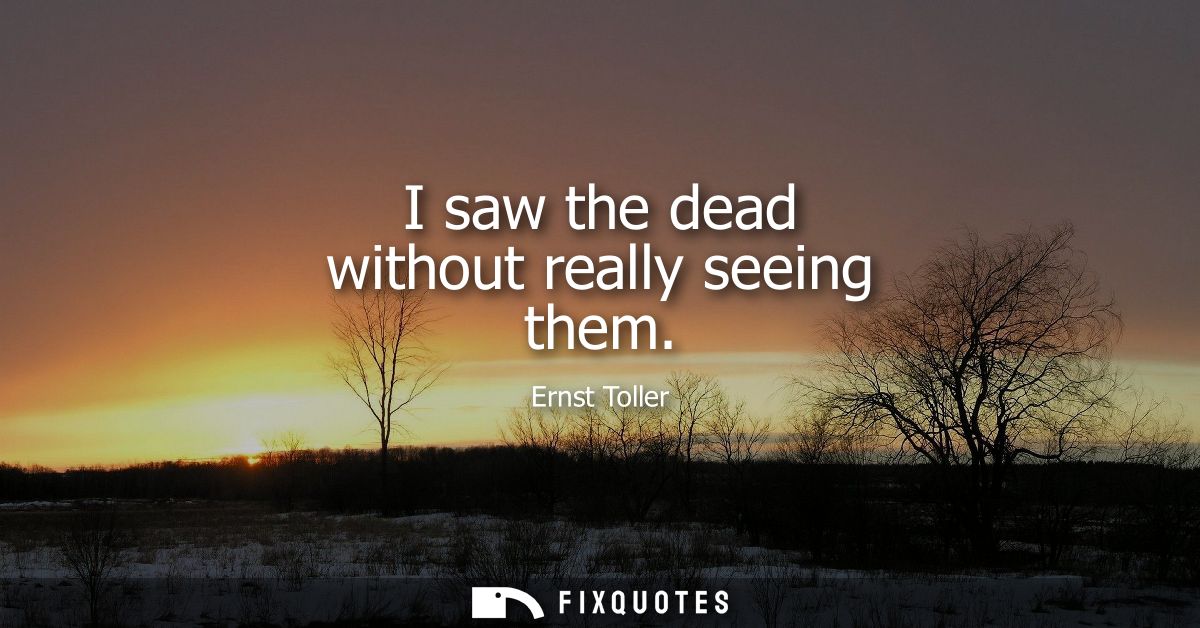
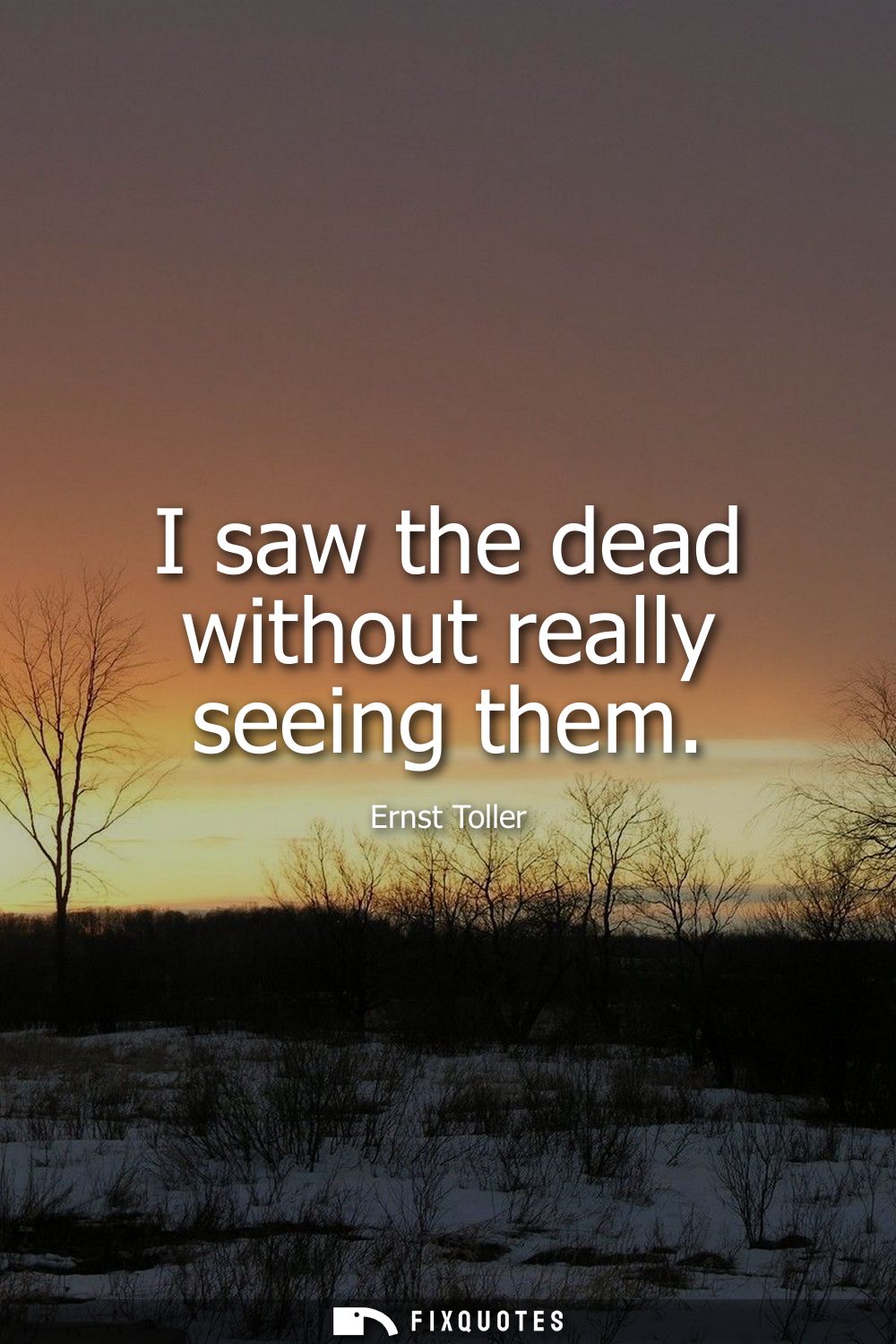
"I saw the dead without really seeing them"
About this Quote
A line like this turns on a moral glitch: the speaker is close enough to death to be haunted by it, yet still insulated enough to miss its full reality. "I saw" claims eyewitness authority, the kind that normally ends arguments. Then "without really seeing" yanks that certainty away. The sentence stages a collapse of perception in real time, exposing the difference between looking and recognizing, between registering bodies and grasping what those bodies mean.
For Ernst Toller, that difference is not abstract. He wrote out of Germany's early-20th-century rupture: the mechanized slaughter of World War I, the failed revolutionary moment after 1918, prison, and exile. In that world, "the dead" are not simply individuals; they are evidence, a ledger of political decisions and social indifference. Toller's theater often presses on the numbness that mass death produces - how repetition turns catastrophe into background noise, how survival can feel like complicity.
The subtext is guilt sharpened into critique. To "see the dead" and not really see them is to admit a failure of imagination and empathy, the kind that lets systems keep running. It's also a warning about spectatorship: modernity trains us to consume suffering at a safe distance, to treat corpses as scenery in the larger spectacle of history. Toller compresses that entire ethical indictment into a single self-incriminating paradox, forcing the reader to ask whether they, too, have been present without being awake.
For Ernst Toller, that difference is not abstract. He wrote out of Germany's early-20th-century rupture: the mechanized slaughter of World War I, the failed revolutionary moment after 1918, prison, and exile. In that world, "the dead" are not simply individuals; they are evidence, a ledger of political decisions and social indifference. Toller's theater often presses on the numbness that mass death produces - how repetition turns catastrophe into background noise, how survival can feel like complicity.
The subtext is guilt sharpened into critique. To "see the dead" and not really see them is to admit a failure of imagination and empathy, the kind that lets systems keep running. It's also a warning about spectatorship: modernity trains us to consume suffering at a safe distance, to treat corpses as scenery in the larger spectacle of history. Toller compresses that entire ethical indictment into a single self-incriminating paradox, forcing the reader to ask whether they, too, have been present without being awake.
Quote Details
| Topic | Mortality |
|---|---|
| Source | Help us find the source |
| Cite |
Citation Formats
APA Style (7th ed.)
Toller, Ernst. (2026, January 17). I saw the dead without really seeing them. FixQuotes. https://fixquotes.com/quotes/i-saw-the-dead-without-really-seeing-them-53029/
Chicago Style
Toller, Ernst. "I saw the dead without really seeing them." FixQuotes. January 17, 2026. https://fixquotes.com/quotes/i-saw-the-dead-without-really-seeing-them-53029/.
MLA Style (9th ed.)
"I saw the dead without really seeing them." FixQuotes, 17 Jan. 2026, https://fixquotes.com/quotes/i-saw-the-dead-without-really-seeing-them-53029/. Accessed 12 Feb. 2026.
More Quotes by Ernst
Add to List