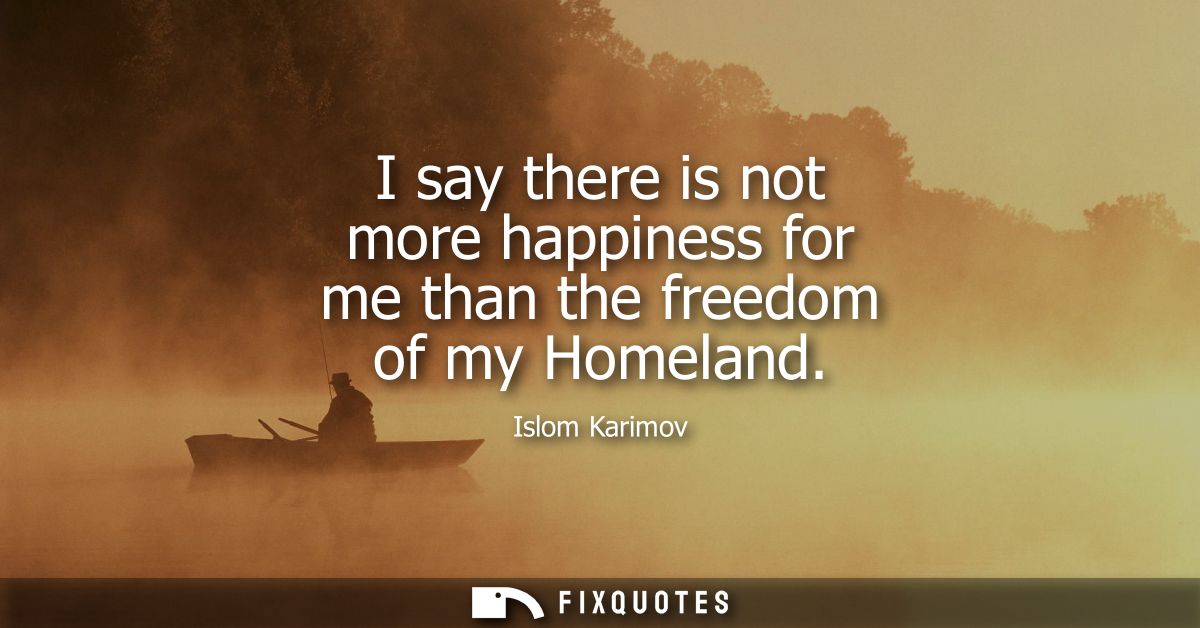
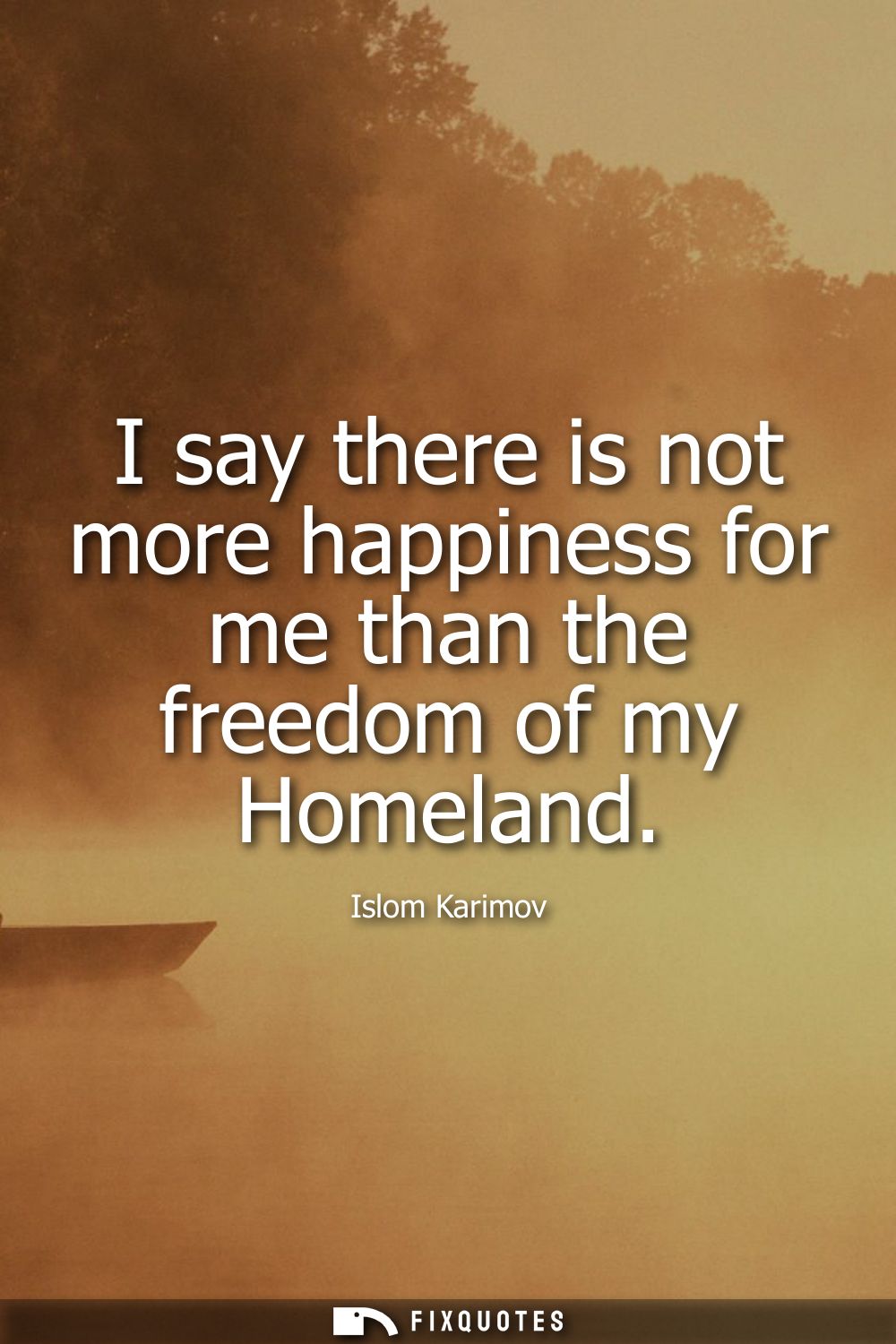
"I say there is not more happiness for me than the freedom of my Homeland"
About this Quote
The line also leans on a familiar post-Soviet register. For states that emerged from Moscow's orbit, "freedom" often signaled not liberal rights but self-determination: borders, flags, and a centralized capacity to decide one's own fate. In Uzbekistan under Karimov, that language carried a double edge. "Freedom" from external domination became the story that could justify internal controls: stability over openness, unity over opposition, security over scrutiny. The "for me" is doing extra work here; it implies a personal sacrifice, inviting citizens to mirror his emotional hierarchy and treat skepticism as ingratitude.
Rhetorically, it's compact and absolute: no happiness greater. Absolutes are useful in nation-building because they simplify a messy transition into a single, legible loyalty test. The subtext is clear: to support the state as he defines it is not merely political agreement; it's the only acceptable route to collective well-being.
Quote Details
| Topic | Freedom |
|---|---|
| Source | Help us find the source |
| Cite |
Citation Formats
APA Style (7th ed.)
Karimov, Islom. (2026, January 14). I say there is not more happiness for me than the freedom of my Homeland. FixQuotes. https://fixquotes.com/quotes/i-say-there-is-not-more-happiness-for-me-than-the-56290/
Chicago Style
Karimov, Islom. "I say there is not more happiness for me than the freedom of my Homeland." FixQuotes. January 14, 2026. https://fixquotes.com/quotes/i-say-there-is-not-more-happiness-for-me-than-the-56290/.
MLA Style (9th ed.)
"I say there is not more happiness for me than the freedom of my Homeland." FixQuotes, 14 Jan. 2026, https://fixquotes.com/quotes/i-say-there-is-not-more-happiness-for-me-than-the-56290/. Accessed 13 Feb. 2026.