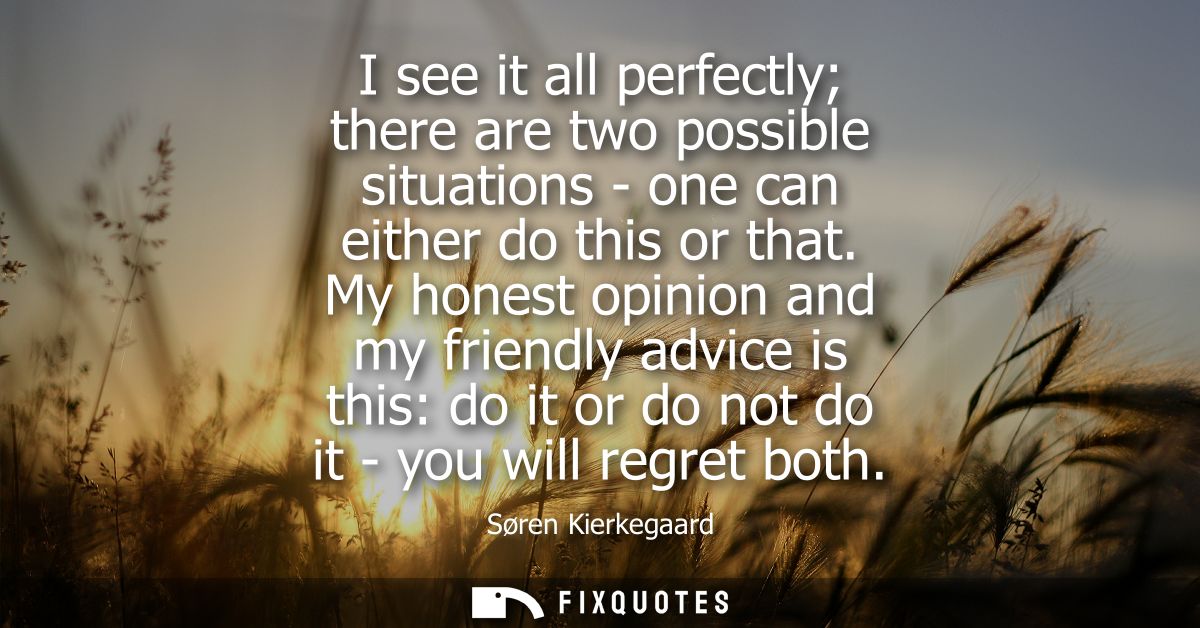
"I see it all perfectly; there are two possible situations - one can either do this or that. My honest opinion and my friendly advice is this: do it, or do not do it - you will regret both"
About this Quote
The subtext is psychological and spiritual. Regret here isn’t merely buyer’s remorse; it’s the dizziness of freedom. You regret acting because reality never matches the clean, imagined version of your decision. You regret not acting because possibility becomes its own haunting, an infinite room you never enter. Either way, you collide with finitude: you can’t have all lives at once.
Context matters. Kierkegaard wrote in a 19th-century culture increasingly enamored with systems: Hegelian total explanations, bourgeois life plans, the idea that the right framework can make existence coherent. His wit works because it mimics that system-speak ("perfectly", "two possible situations") only to reveal what systems can’t digest: the existential remainder, the emotional cost, the irreducible risk.
The intent isn’t to paralyze you; it’s to puncture the modern craving for guaranteed outcomes. If regret is inevitable, the real question shifts from "Which choice eliminates pain?" to "Which pain is worth it?" That’s where Kierkegaard smuggles in responsibility: you don’t choose the option that saves you, you choose the one you can own.
Quote Details
| Topic | Decision-Making |
|---|---|
| Source | Unverified source: Either/Or (Enten–Eller): A Fragment of Life (Søren Kierkegaard, 1843)
Evidence: Part II, "Balance between the Aesthetic and the Ethical" (exact page varies by translation/edition). This wording is an English translation of a passage from Kierkegaard’s Either/Or, first published in Danish in 1843 (original title: Enten–Eller). Multiple secondary quote sites attribute it to Ei... Other candidates (2) What Makes Your Brain Happy and Why You Should Do the Opp... (David Disalvo, 2011) compilation99.5% ... I see it all perfectly ; there are two possible situations -one can either do this or that . My honest opinion an... Søren Kierkegaard (Søren Kierkegaard) compilation36.5% stupidities of the world or you weep over them you will regret it either way trust a girl and you will regret it do n... |
| Cite |
Citation Formats
APA Style (7th ed.)
Kierkegaard, Søren. (2026, February 17). I see it all perfectly; there are two possible situations - one can either do this or that. My honest opinion and my friendly advice is this: do it, or do not do it - you will regret both. FixQuotes. https://fixquotes.com/quotes/i-see-it-all-perfectly-there-are-two-possible-1808/
Chicago Style
Kierkegaard, Søren. "I see it all perfectly; there are two possible situations - one can either do this or that. My honest opinion and my friendly advice is this: do it, or do not do it - you will regret both." FixQuotes. February 17, 2026. https://fixquotes.com/quotes/i-see-it-all-perfectly-there-are-two-possible-1808/.
MLA Style (9th ed.)
"I see it all perfectly; there are two possible situations - one can either do this or that. My honest opinion and my friendly advice is this: do it, or do not do it - you will regret both." FixQuotes, 17 Feb. 2026, https://fixquotes.com/quotes/i-see-it-all-perfectly-there-are-two-possible-1808/. Accessed 1 Apr. 2026.