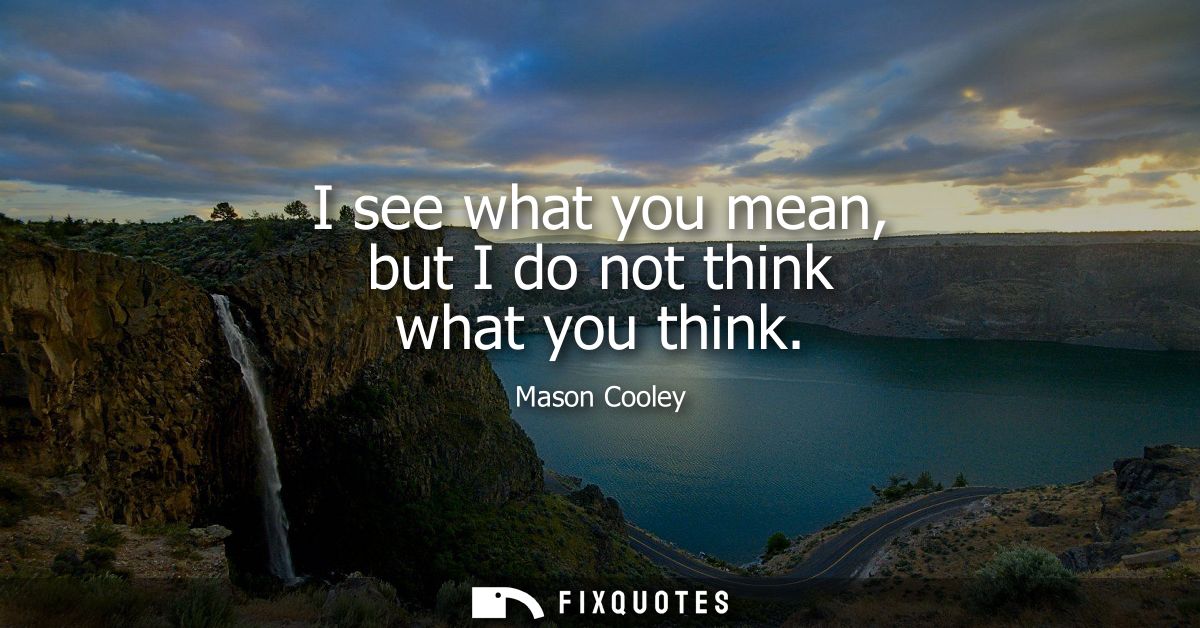
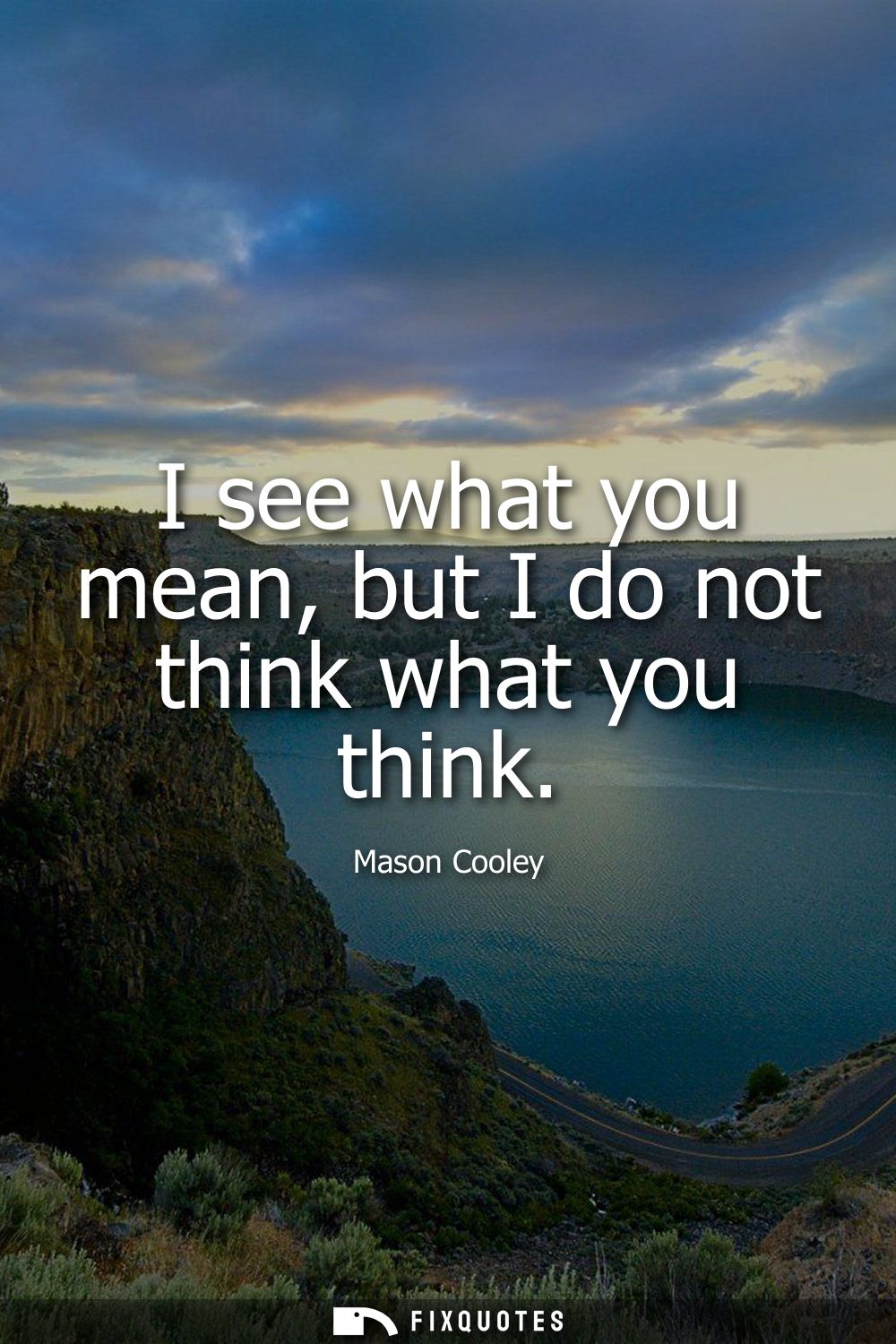
"I see what you mean, but I do not think what you think"
About this Quote
Polite dissent rarely arrives so cleanly. Cooley’s line performs a social magic trick: it grants the other person full recognition of their reasoning while refusing the conclusion. “I see what you mean” isn’t a surrender; it’s a deliberate separation of comprehension from agreement, the move that most arguments forget is possible. In a culture that treats debate like a scoreboard, Cooley insists on a slower, more exact ethic: understanding as a prerequisite for disagreement, not a consolation prize for losing.
The phrasing matters. He doesn’t say “you’re wrong.” He says “I do not think what you think,” turning difference into a description of mental weather rather than a moral verdict. The repetition of “think” highlights that what’s at stake is cognition itself - how two people can share language and still inhabit different interior logics. It’s also slyly egalitarian. “I see” and “I think” place responsibility on the speaker’s own faculties, avoiding the cheap authority of “the facts” as a cudgel.
Cooley, an aphorist by trade, wrote in a period when mass media tightened the script of public opinion and when ideological camps increasingly demanded loyalty performances. This sentence resists that pressure. Its subtext is: I’m listening, I’m not converting, and neither of us needs to pretend this conversation ends in consensus. It models disagreement as a relationship-maintaining act - firm, civil, and quietly defiant.
The phrasing matters. He doesn’t say “you’re wrong.” He says “I do not think what you think,” turning difference into a description of mental weather rather than a moral verdict. The repetition of “think” highlights that what’s at stake is cognition itself - how two people can share language and still inhabit different interior logics. It’s also slyly egalitarian. “I see” and “I think” place responsibility on the speaker’s own faculties, avoiding the cheap authority of “the facts” as a cudgel.
Cooley, an aphorist by trade, wrote in a period when mass media tightened the script of public opinion and when ideological camps increasingly demanded loyalty performances. This sentence resists that pressure. Its subtext is: I’m listening, I’m not converting, and neither of us needs to pretend this conversation ends in consensus. It models disagreement as a relationship-maintaining act - firm, civil, and quietly defiant.
Quote Details
| Topic | Witty One-Liners |
|---|---|
| Source | Help us find the source |
| Cite |
Citation Formats
APA Style (7th ed.)
Cooley, Mason. (2026, January 16). I see what you mean, but I do not think what you think. FixQuotes. https://fixquotes.com/quotes/i-see-what-you-mean-but-i-do-not-think-what-you-127814/
Chicago Style
Cooley, Mason. "I see what you mean, but I do not think what you think." FixQuotes. January 16, 2026. https://fixquotes.com/quotes/i-see-what-you-mean-but-i-do-not-think-what-you-127814/.
MLA Style (9th ed.)
"I see what you mean, but I do not think what you think." FixQuotes, 16 Jan. 2026, https://fixquotes.com/quotes/i-see-what-you-mean-but-i-do-not-think-what-you-127814/. Accessed 3 Apr. 2026.
More Quotes by Mason
Add to List