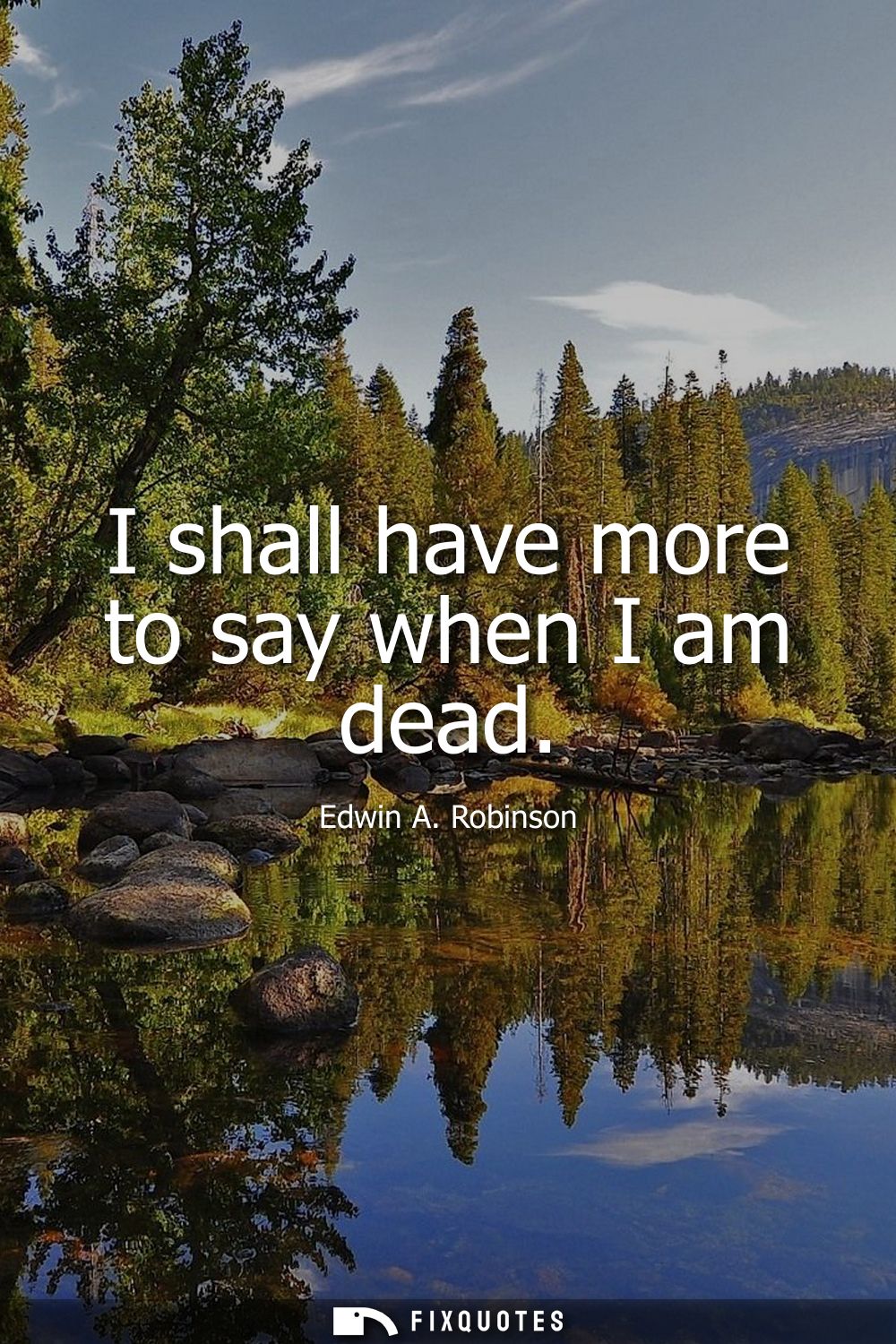
"I shall have more to say when I am dead"
About this Quote
“I shall have more to say when I am dead” lands like a dry smile delivered at the edge of a grave. Robinson, the poet of American restraint and inward collapse, isn’t indulging in gothic theatrics so much as indicting the terms of speech in the living world: what can be said, to whom, and at what social cost. The line turns the afterlife into a publishing schedule. It’s funny in the way despair can be funny - a neat, clipped sentence that refuses consolation.
The intent feels double-edged. On one side, it’s an artist’s vow: the work will outlast the body, and posterity will finally listen without interrupting, correcting, or demanding a more “uplifting” version. On the other, it’s a rebuke aimed at the present tense. If death is when he’ll “have more to say,” then life has been a long exercise in self-censorship - whether enforced by decorum, by poverty, by the small-town moral surveillance that haunts so much of Robinson’s New England-inflected imagination.
Subtext: the dead get the last word because the living control the room. Only once you’re gone do people grant you the dignity of complexity. Robinson’s speakers often circle around what they can’t confess directly; this line makes that constraint explicit, converting silence into strategy. It’s also a sly comment on literary reputation: poets become “important” when they’re safely unthreatening, preserved as quotation rather than as inconvenient contemporaries. Death, here, isn’t transcendence. It’s leverage.
The intent feels double-edged. On one side, it’s an artist’s vow: the work will outlast the body, and posterity will finally listen without interrupting, correcting, or demanding a more “uplifting” version. On the other, it’s a rebuke aimed at the present tense. If death is when he’ll “have more to say,” then life has been a long exercise in self-censorship - whether enforced by decorum, by poverty, by the small-town moral surveillance that haunts so much of Robinson’s New England-inflected imagination.
Subtext: the dead get the last word because the living control the room. Only once you’re gone do people grant you the dignity of complexity. Robinson’s speakers often circle around what they can’t confess directly; this line makes that constraint explicit, converting silence into strategy. It’s also a sly comment on literary reputation: poets become “important” when they’re safely unthreatening, preserved as quotation rather than as inconvenient contemporaries. Death, here, isn’t transcendence. It’s leverage.
Quote Details
| Topic | Mortality |
|---|---|
| Source | Help us find the source |
| Cite |
Citation Formats
APA Style (7th ed.)
Robinson, Edwin A. (2026, January 17). I shall have more to say when I am dead. FixQuotes. https://fixquotes.com/quotes/i-shall-have-more-to-say-when-i-am-dead-70385/
Chicago Style
Robinson, Edwin A. "I shall have more to say when I am dead." FixQuotes. January 17, 2026. https://fixquotes.com/quotes/i-shall-have-more-to-say-when-i-am-dead-70385/.
MLA Style (9th ed.)
"I shall have more to say when I am dead." FixQuotes, 17 Jan. 2026, https://fixquotes.com/quotes/i-shall-have-more-to-say-when-i-am-dead-70385/. Accessed 17 Feb. 2026.
More Quotes by Edwin
Add to List