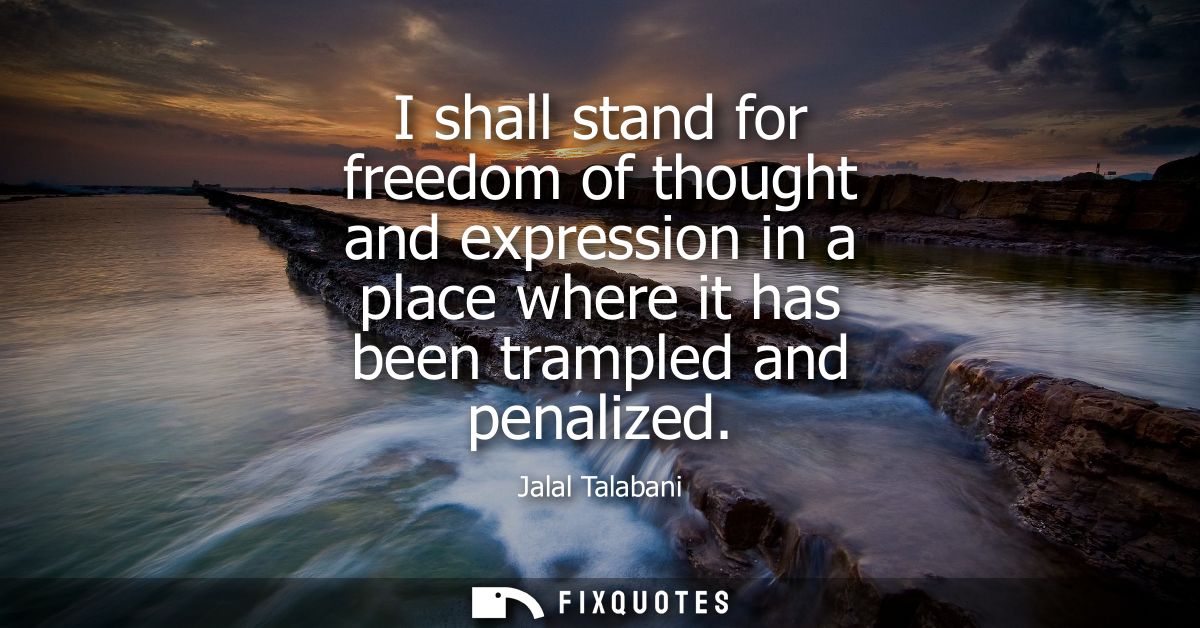
"I shall stand for freedom of thought and expression in a place where it has been trampled and penalized"
About this Quote
The most telling clause is "in a place where it has been trampled and penalized". He is not describing a neutral absence of rights; he is naming active repression. "Trampled" evokes mass violence and humiliation, the boot and the crowd. "Penalized" narrows that brutality into bureaucracy: laws, prisons, interrogations, the machinery that makes fear feel official. Paired together, the words sketch the twin faces of authoritarianism: spontaneous cruelty and codified punishment.
Context matters because Talabani's career is built inside contested statehood. As a Kurdish leader who later became Iraq's president after Saddam Hussein, he is speaking from a region and a country where speech was historically a trigger for surveillance, exile, or death, and where the post-2003 order promised openness while struggling with sectarianism and insurgency. The intent is partly aspirational and partly strategic: to signal a break with Baathist control, to reassure minorities and international partners, and to frame legitimacy around civil freedoms rather than ethnic dominance. The subtext: we are trying to build a new political culture, but we know exactly what the old one did to dissent.
Quote Details
| Topic | Freedom |
|---|---|
| Source | Help us find the source |
| Cite |
Citation Formats
APA Style (7th ed.)
Talabani, Jalal. (2026, January 15). I shall stand for freedom of thought and expression in a place where it has been trampled and penalized. FixQuotes. https://fixquotes.com/quotes/i-shall-stand-for-freedom-of-thought-and-160303/
Chicago Style
Talabani, Jalal. "I shall stand for freedom of thought and expression in a place where it has been trampled and penalized." FixQuotes. January 15, 2026. https://fixquotes.com/quotes/i-shall-stand-for-freedom-of-thought-and-160303/.
MLA Style (9th ed.)
"I shall stand for freedom of thought and expression in a place where it has been trampled and penalized." FixQuotes, 15 Jan. 2026, https://fixquotes.com/quotes/i-shall-stand-for-freedom-of-thought-and-160303/. Accessed 30 Mar. 2026.