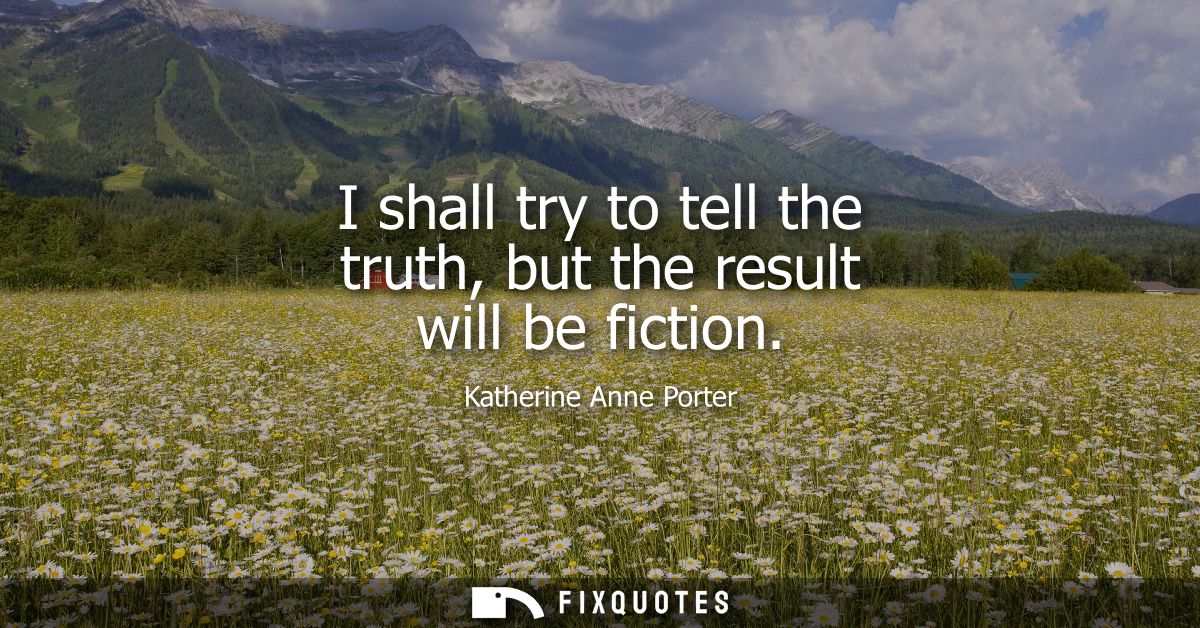
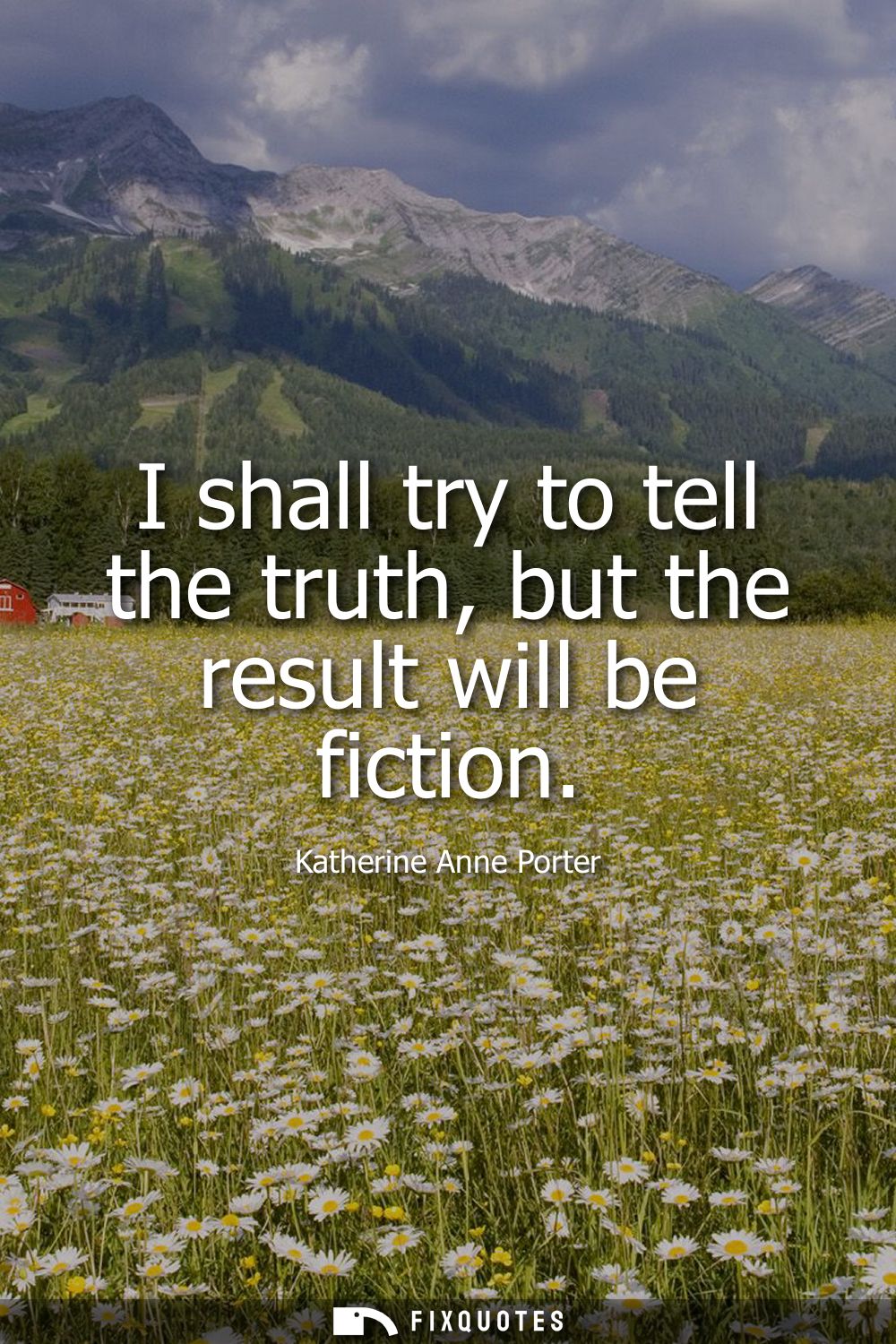
"I shall try to tell the truth, but the result will be fiction"
About this Quote
A journalist promising truth and delivering fiction sounds like a confession, until you hear the craft hiding inside it. Porter is staking out a paradox that every serious reporter and every serious novelist eventually bumps into: facts are not the same thing as truth. Facts can be itemized; truth has to be arranged. The moment you select a detail, choose an angle, recreate a scene, you move from record-keeping into story-making. Porter doesn’t pretend she’s exempt. She names the transformation up front, daring you to watch it happen.
The line also works as a warning label. “I shall try” signals humility, but it’s also an admission that truth is slippery, contingent, socially negotiated. Memory edits. Language distorts. Even sincerity can’t guarantee accuracy. By calling the result “fiction,” Porter disarms the reader’s expectation of courtroom precision and asks for a different standard: emotional exactness, moral clarity, the kind of coherence lived experience rarely provides on its own.
Context matters: Porter wrote in a 20th-century America where journalism and literature were both wrestling with modernity’s churn - propaganda, mass media, wars that broke old narratives. For a woman moving between reporting and fiction, the claim has an extra edge. Authority wasn’t freely granted; it had to be earned through technique. She’s asserting that her “fiction” isn’t an escape from reality but a strategy for getting closer to it - by shaping chaos into meaning, even at the cost of literalness.
The line also works as a warning label. “I shall try” signals humility, but it’s also an admission that truth is slippery, contingent, socially negotiated. Memory edits. Language distorts. Even sincerity can’t guarantee accuracy. By calling the result “fiction,” Porter disarms the reader’s expectation of courtroom precision and asks for a different standard: emotional exactness, moral clarity, the kind of coherence lived experience rarely provides on its own.
Context matters: Porter wrote in a 20th-century America where journalism and literature were both wrestling with modernity’s churn - propaganda, mass media, wars that broke old narratives. For a woman moving between reporting and fiction, the claim has an extra edge. Authority wasn’t freely granted; it had to be earned through technique. She’s asserting that her “fiction” isn’t an escape from reality but a strategy for getting closer to it - by shaping chaos into meaning, even at the cost of literalness.
Quote Details
| Topic | Writing |
|---|---|
| Source | Help us find the source |
| Cite |
Citation Formats
APA Style (7th ed.)
Porter, Katherine Anne. (2026, January 16). I shall try to tell the truth, but the result will be fiction. FixQuotes. https://fixquotes.com/quotes/i-shall-try-to-tell-the-truth-but-the-result-will-135671/
Chicago Style
Porter, Katherine Anne. "I shall try to tell the truth, but the result will be fiction." FixQuotes. January 16, 2026. https://fixquotes.com/quotes/i-shall-try-to-tell-the-truth-but-the-result-will-135671/.
MLA Style (9th ed.)
"I shall try to tell the truth, but the result will be fiction." FixQuotes, 16 Jan. 2026, https://fixquotes.com/quotes/i-shall-try-to-tell-the-truth-but-the-result-will-135671/. Accessed 27 Mar. 2026.
More Quotes by Katherine
Add to List