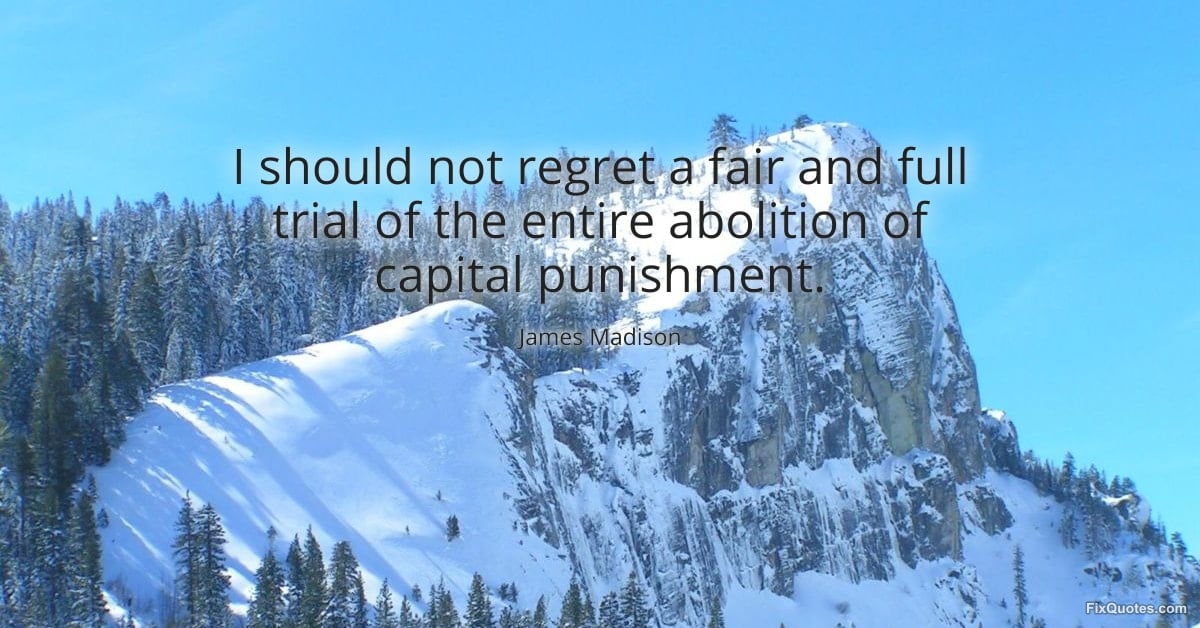
"I should not regret a fair and full trial of the entire abolition of capital punishment"
About this Quote
The key word is “trial.” Madison doesn’t frame abolition as a leap of faith or a humanitarian crusade. He frames it as an experiment in governance, something a republic confident in its institutions can test without collapsing into chaos. “Fair and full” matters, too: it’s a preemptive rebuttal to the predictable backlash that abolition would unleash if crime rose, if juries balked, if enforcement got messy. He’s not just asking whether executions are wrong; he’s asking whether they are necessary - a more politically survivable question.
Context sharpens the edge. In Madison’s America, state authority was still being invented, and punishment was a public language the state used to prove it meant business. To suggest the “entire abolition” of capital punishment is to challenge a key tool of legitimacy. Madison’s subtext is that the new republic should not need spectacles of death to command obedience. The most Madisonian move is that he makes this challenge sound like administrative prudence: let’s test whether a free society can govern itself without killing people to show it can.
Quote Details
| Topic | Justice |
|---|---|
| Source | Help us find the source |
| Cite | Cite this Quote |
Citation Formats
APA Style (7th ed.)
Madison, James. (n.d.). I should not regret a fair and full trial of the entire abolition of capital punishment. FixQuotes. https://fixquotes.com/quotes/i-should-not-regret-a-fair-and-full-trial-of-the-23856/
Chicago Style
Madison, James. "I should not regret a fair and full trial of the entire abolition of capital punishment." FixQuotes. Accessed February 3, 2026. https://fixquotes.com/quotes/i-should-not-regret-a-fair-and-full-trial-of-the-23856/.
MLA Style (9th ed.)
"I should not regret a fair and full trial of the entire abolition of capital punishment." FixQuotes, https://fixquotes.com/quotes/i-should-not-regret-a-fair-and-full-trial-of-the-23856/. Accessed 3 Feb. 2026.