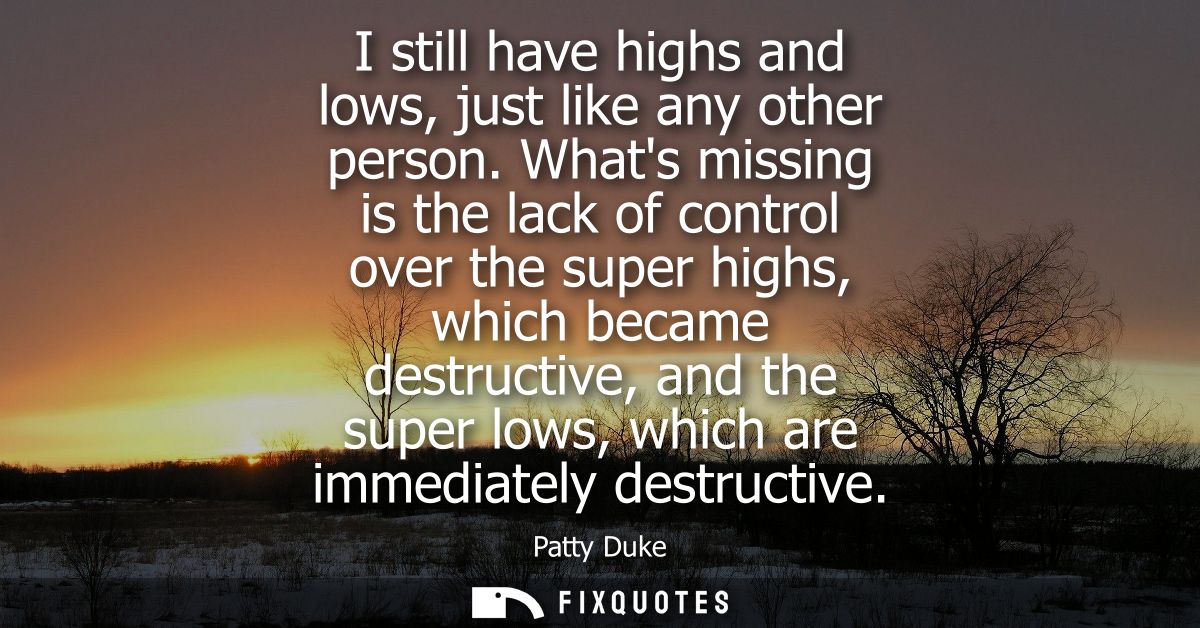
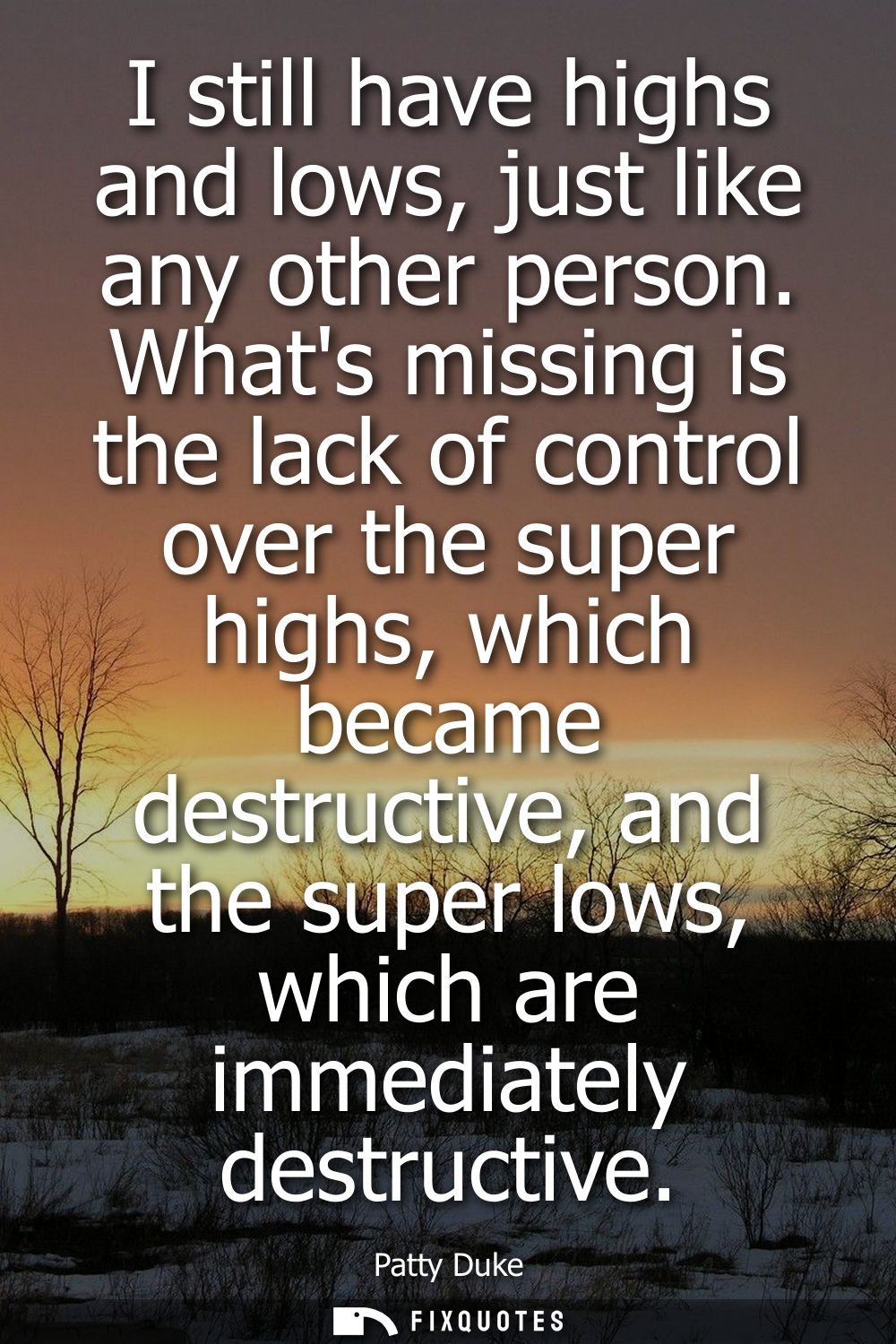
"I still have highs and lows, just like any other person. What's missing is the lack of control over the super highs, which became destructive, and the super lows, which are immediately destructive"
About this Quote
Then the hinge: “What’s missing…” The phrasing is almost clinical, but the content is brutally personal. She doesn’t deny joy or sadness; she names the real enemy as loss of control. That word matters. It shifts the story from character to condition, from moral failure to management problem. The “super highs” aren’t framed as glamorous mania, the way pop culture loves to package it, but as “destructive” - a direct rejection of the myth that the high is a gift and only the low is the illness.
Her parallel construction is the real gut punch: “super highs” that became destructive, “super lows” that are “immediately destructive.” The symmetry suggests a life lived between two equally dangerous extremes, and the adverb “immediately” kills any romantic distance. It implies risk that doesn’t wait for narrative payoff: impulsivity, self-harm, fallout that arrives fast.
In context, Duke’s era made this kind of self-description both radical and necessary. She came up in an industry that monetized volatility while punishing it, especially in young women. The quote reads like an attempt to reclaim the steering wheel: not asking for pity, demanding accuracy about what bipolar disorder actually costs.
Quote Details
| Topic | Mental Health |
|---|---|
| Source | Help us find the source |
| Cite |
Citation Formats
APA Style (7th ed.)
Duke, Patty. (2026, January 16). I still have highs and lows, just like any other person. What's missing is the lack of control over the super highs, which became destructive, and the super lows, which are immediately destructive. FixQuotes. https://fixquotes.com/quotes/i-still-have-highs-and-lows-just-like-any-other-86664/
Chicago Style
Duke, Patty. "I still have highs and lows, just like any other person. What's missing is the lack of control over the super highs, which became destructive, and the super lows, which are immediately destructive." FixQuotes. January 16, 2026. https://fixquotes.com/quotes/i-still-have-highs-and-lows-just-like-any-other-86664/.
MLA Style (9th ed.)
"I still have highs and lows, just like any other person. What's missing is the lack of control over the super highs, which became destructive, and the super lows, which are immediately destructive." FixQuotes, 16 Jan. 2026, https://fixquotes.com/quotes/i-still-have-highs-and-lows-just-like-any-other-86664/. Accessed 31 Mar. 2026.