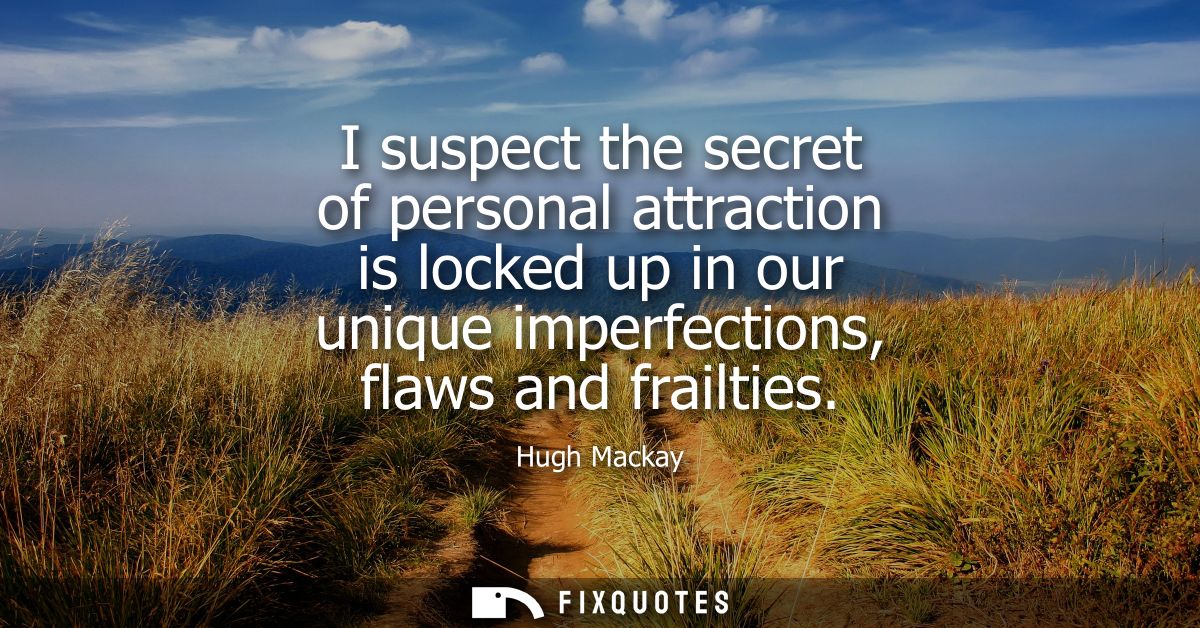
"I suspect the secret of personal attraction is locked up in our unique imperfections, flaws and frailties"
About this Quote
Personal magnetism, Hugh Mackay suggests, isn’t a polished product; it’s a leak. The line rejects the usual self-help economy of optimization, where attraction is treated like branding: sand down the rough edges, sharpen the pitch, present the “best self.” Mackay flips that logic. The “secret” isn’t in what we control, but in what we can’t fully hide: the small tells of being human.
The phrasing does quiet psychological work. “I suspect” softens the claim, signaling curiosity rather than doctrine. It invites recognition instead of demanding belief, which is itself a kind of social intelligence. Then there’s the metaphor of something “locked up” in “unique imperfections.” Flaws become a vault, not a stain. That inversion matters: it frames vulnerability as a scarce asset, not a liability, and implies that intimacy is less about performance than permission.
Subtext: people bond through asymmetry. We trust those who have visible limits because limits feel legible. A spotless persona reads as rehearsed; a manageable crack reads as real. “Imperfections, flaws and frailties” is a deliberate escalation from quirks to weakness, suggesting that what draws us in isn’t only charming eccentricity but the deeper evidence of struggle, sensitivity, and need.
Contextually, Mackay’s background as a social researcher and writer in a culture saturated with curated self-presentation gives the quote its bite. It’s an argument against the tyranny of “put-togetherness”: connection often arrives not when we finally become admirable, but when we become recognizable.
The phrasing does quiet psychological work. “I suspect” softens the claim, signaling curiosity rather than doctrine. It invites recognition instead of demanding belief, which is itself a kind of social intelligence. Then there’s the metaphor of something “locked up” in “unique imperfections.” Flaws become a vault, not a stain. That inversion matters: it frames vulnerability as a scarce asset, not a liability, and implies that intimacy is less about performance than permission.
Subtext: people bond through asymmetry. We trust those who have visible limits because limits feel legible. A spotless persona reads as rehearsed; a manageable crack reads as real. “Imperfections, flaws and frailties” is a deliberate escalation from quirks to weakness, suggesting that what draws us in isn’t only charming eccentricity but the deeper evidence of struggle, sensitivity, and need.
Contextually, Mackay’s background as a social researcher and writer in a culture saturated with curated self-presentation gives the quote its bite. It’s an argument against the tyranny of “put-togetherness”: connection often arrives not when we finally become admirable, but when we become recognizable.
Quote Details
| Topic | Love |
|---|---|
| Source | Help us find the source |
More Quotes by Hugh
Add to List