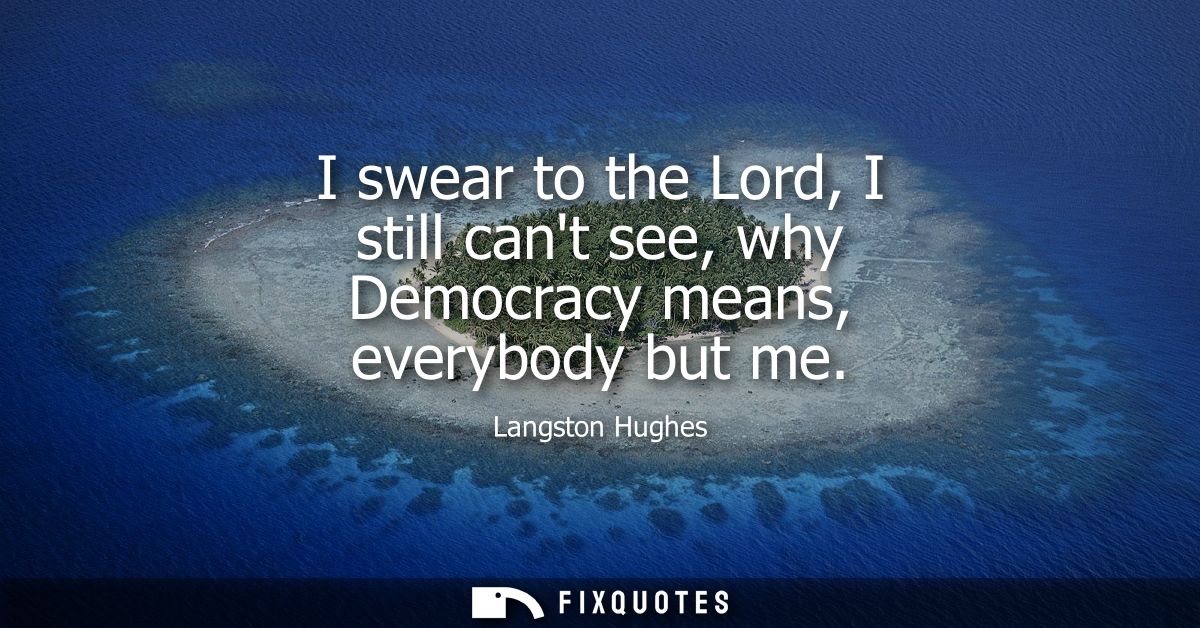
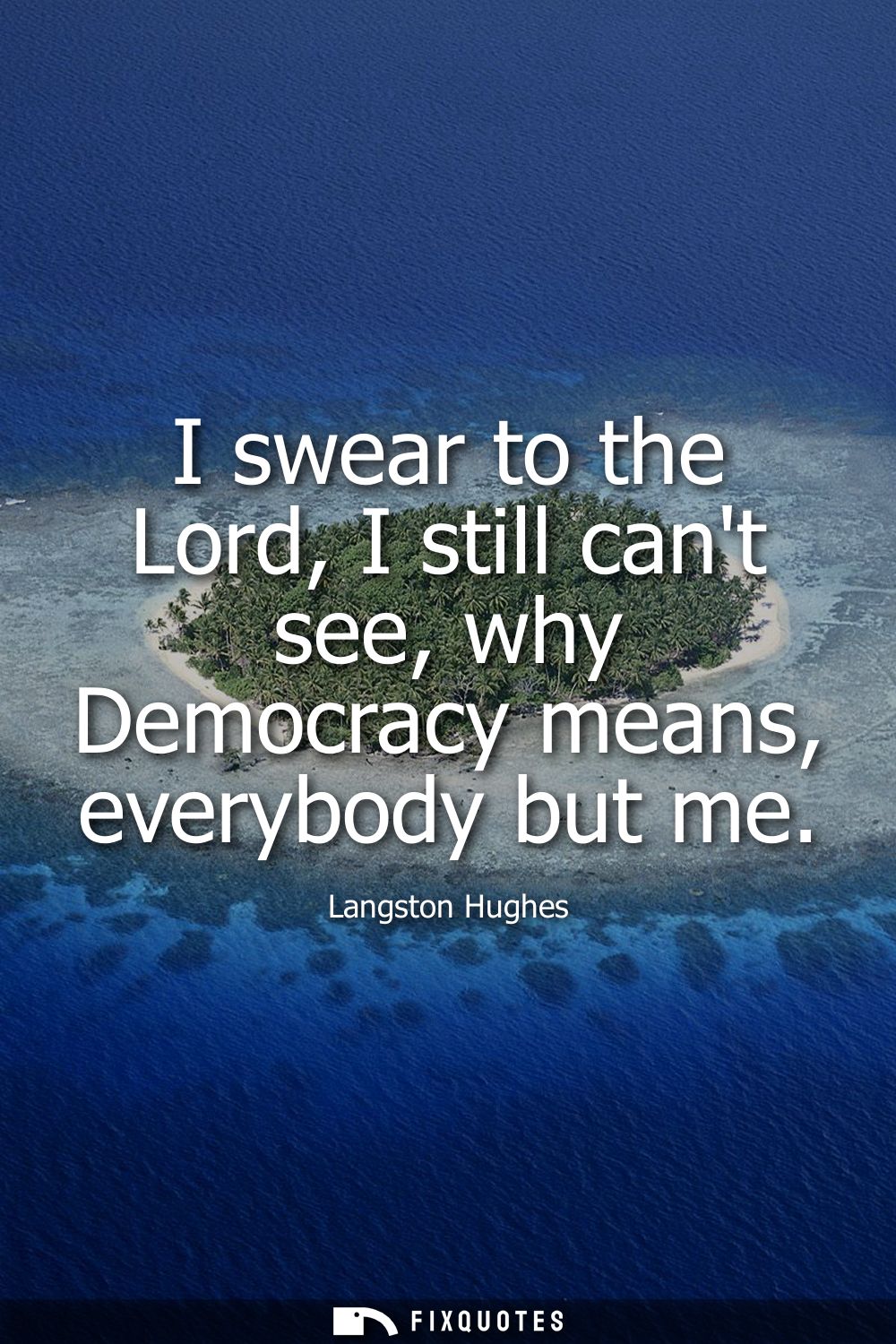
"I swear to the Lord, I still can't see, why Democracy means, everybody but me"
About this Quote
Hughes is writing from the lived contradiction of Black life in the early-to-mid 20th century: a nation that exports democratic mythology while running Jim Crow, suppressing votes, rationing housing, and policing labor. The speaker isn’t debating political theory; he’s testifying to a repeated pattern where equality is always addressed to an imagined “everybody” that doesn’t include him. That “still” matters, too. It implies he’s heard the sermon many times, watched the pageantry, maybe even fought in its wars, and yet the revelation never arrives.
There’s also a sly performance of American reverence. By invoking “the Lord,” Hughes echoes the moral language the country uses to bless itself, then flips it into a complaint that sounds almost too plain to refute. The line makes democracy answer a humiliating question: if it’s real, why does it keep skipping the same people?
Quote Details
| Topic | Equality |
|---|---|
| Source | Help us find the source |
| Cite |
Citation Formats
APA Style (7th ed.)
Hughes, Langston. (2026, January 17). I swear to the Lord, I still can't see, why Democracy means, everybody but me. FixQuotes. https://fixquotes.com/quotes/i-swear-to-the-lord-i-still-cant-see-why-32424/
Chicago Style
Hughes, Langston. "I swear to the Lord, I still can't see, why Democracy means, everybody but me." FixQuotes. January 17, 2026. https://fixquotes.com/quotes/i-swear-to-the-lord-i-still-cant-see-why-32424/.
MLA Style (9th ed.)
"I swear to the Lord, I still can't see, why Democracy means, everybody but me." FixQuotes, 17 Jan. 2026, https://fixquotes.com/quotes/i-swear-to-the-lord-i-still-cant-see-why-32424/. Accessed 18 Mar. 2026.