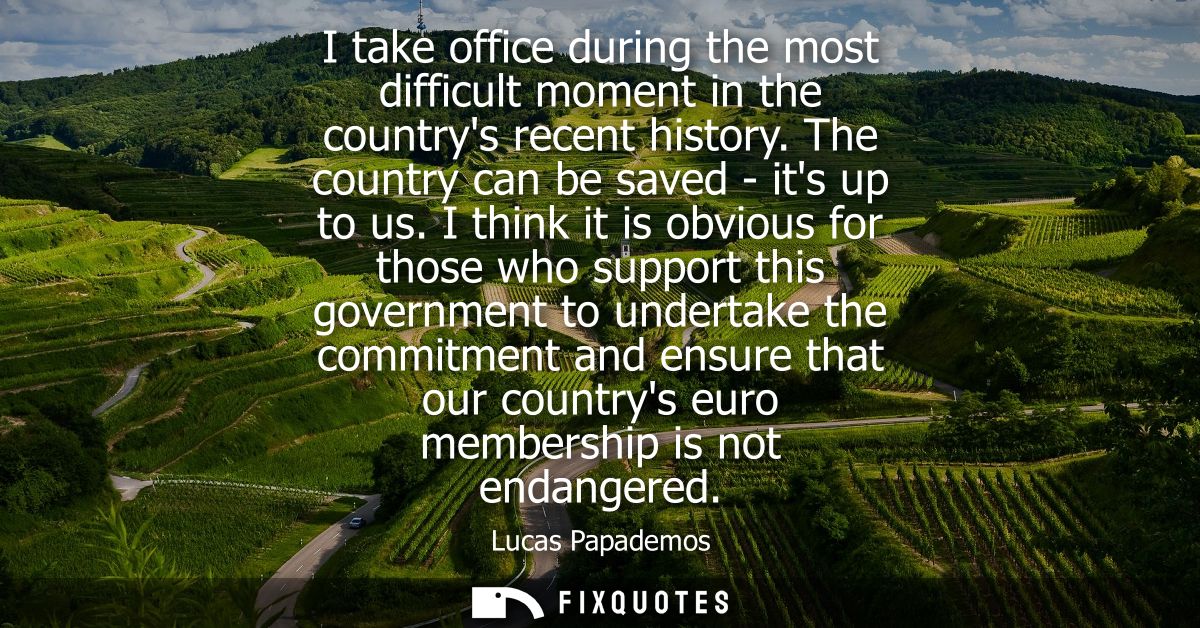
"I take office during the most difficult moment in the country's recent history. The country can be saved - it's up to us. I think it is obvious for those who support this government to undertake the commitment and ensure that our country's Euro membership is not endangered"
About this Quote
“The country can be saved - it’s up to us” is deliberately elastic. It spreads responsibility across the political class and, implicitly, the public. In Greece’s debt-crisis context, that “us” functions as a coalition-building tool and a pressure tactic: if salvation is collective, then dissent can be cast as sabotage. The line makes austerity and painful reforms feel like civic duty rather than ideological choice.
The real center of gravity is the final clause: “ensure that our country’s euro membership is not endangered.” Euro membership is the stand-in for stability, legitimacy, and continued access to European support. Papademos doesn’t argue for the euro; he assumes it as the obvious baseline, which is rhetorically savvy in a moment when markets, EU partners, and domestic institutions were watching for any sign of wavering. “Not endangered” also recasts policy as risk management: he’s not promising prosperity, he’s promising to avoid catastrophe.
Subtextually, this is a message aimed as much at Brussels and Frankfurt as at Athens: Greece will behave predictably. It’s a pledge of continuity dressed up as national rescue, the language of constrained sovereignty delivered as statesmanship.
Quote Details
| Topic | Leadership |
|---|---|
| Source | Help us find the source |
| Cite |
Citation Formats
APA Style (7th ed.)
Papademos, Lucas. (2026, February 18). I take office during the most difficult moment in the country's recent history. The country can be saved - it's up to us. I think it is obvious for those who support this government to undertake the commitment and ensure that our country's Euro membership is not endangered. FixQuotes. https://fixquotes.com/quotes/i-take-office-during-the-most-difficult-moment-in-81218/
Chicago Style
Papademos, Lucas. "I take office during the most difficult moment in the country's recent history. The country can be saved - it's up to us. I think it is obvious for those who support this government to undertake the commitment and ensure that our country's Euro membership is not endangered." FixQuotes. February 18, 2026. https://fixquotes.com/quotes/i-take-office-during-the-most-difficult-moment-in-81218/.
MLA Style (9th ed.)
"I take office during the most difficult moment in the country's recent history. The country can be saved - it's up to us. I think it is obvious for those who support this government to undertake the commitment and ensure that our country's Euro membership is not endangered." FixQuotes, 18 Feb. 2026, https://fixquotes.com/quotes/i-take-office-during-the-most-difficult-moment-in-81218/. Accessed 30 Mar. 2026.