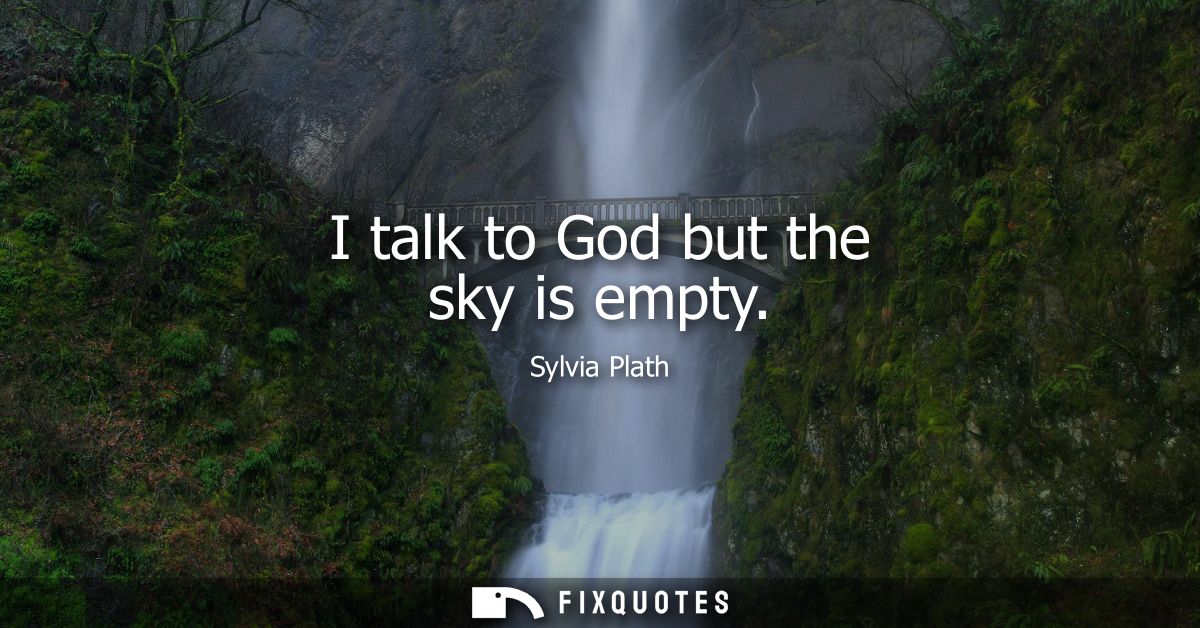
"I talk to God but the sky is empty"
About this Quote
Prayer becomes a monologue when nobody answers, and Plath makes that silence feel like weather: a sky that should hold something - light, omen, order - but doesn’t. The line’s sting is its plainness. No ornate metaphysics, no poet’s fog. Just a stark report from someone doing the “right” ritual (talking to God) and meeting a blank, indifferent surface. That bluntness is the point: it denies the reader the comfort of ambiguity.
The subtext is less atheism than abandonment. “I talk” implies effort, habit, even desperation; the speaker keeps the channel open. “But” tilts the sentence into betrayal, the emotional pivot where faith becomes evidence of its own futility. And “the sky” matters. God isn’t merely absent; the world’s most traditional stage for the divine is emptied out. If the heavens are vacant, then the architecture of meaning is, too. Plath compresses a whole crisis of belief into one image you can see in your peripheral vision every day.
Context sharpens the knife. Writing in mid-century modernity, Plath inherits a culture where older religious certainties were already eroding, yet the expectation of belief - especially for women trained to be good, compliant, grateful - still lingered. The line reads like a private revolt against sanctioned consolation. It also fits her wider project: exposing how language meant to soothe (“God,” “faith,” “purpose”) can collapse under lived experience, leaving not melodrama but a clean, terrifying vacancy.
The subtext is less atheism than abandonment. “I talk” implies effort, habit, even desperation; the speaker keeps the channel open. “But” tilts the sentence into betrayal, the emotional pivot where faith becomes evidence of its own futility. And “the sky” matters. God isn’t merely absent; the world’s most traditional stage for the divine is emptied out. If the heavens are vacant, then the architecture of meaning is, too. Plath compresses a whole crisis of belief into one image you can see in your peripheral vision every day.
Context sharpens the knife. Writing in mid-century modernity, Plath inherits a culture where older religious certainties were already eroding, yet the expectation of belief - especially for women trained to be good, compliant, grateful - still lingered. The line reads like a private revolt against sanctioned consolation. It also fits her wider project: exposing how language meant to soothe (“God,” “faith,” “purpose”) can collapse under lived experience, leaving not melodrama but a clean, terrifying vacancy.
Quote Details
| Topic | Prayer |
|---|---|
| Source | Unverified source: The Unabridged Journals of Sylvia Plath, 1950–1962 (Sylvia Plath, 2000)
Evidence: The quote as commonly circulated (“I talk to God but the sky is empty”) is a truncated line from Plath’s journals. It appears in the longer passage: “I need a father. I need a mother. I need some older, wiser being to cry to. I talk to God, but the sky is empty, and Orion walks by and doesn’t spe... Other candidates (2) Sylvia Plath (Sylvia Plath) compilation96.1% 0385720254 i talk to god but the sky is empty draft of letter to richard sassoo The Lonely Mind of God (Sherman O'Brien, 2021) compilation95.0% ... I talk to God but the sky is empty. — Sylvia Plath [1] to match concern actual of science is that any proposed hy... |
| Cite |
Citation Formats
APA Style (7th ed.)
Plath, Sylvia. (2026, January 13). I talk to God but the sky is empty. FixQuotes. https://fixquotes.com/quotes/i-talk-to-god-but-the-sky-is-empty-71552/
Chicago Style
Plath, Sylvia. "I talk to God but the sky is empty." FixQuotes. January 13, 2026. https://fixquotes.com/quotes/i-talk-to-god-but-the-sky-is-empty-71552/.
MLA Style (9th ed.)
"I talk to God but the sky is empty." FixQuotes, 13 Jan. 2026, https://fixquotes.com/quotes/i-talk-to-god-but-the-sky-is-empty-71552/. Accessed 1 Apr. 2026.
More Quotes by Sylvia
Add to List