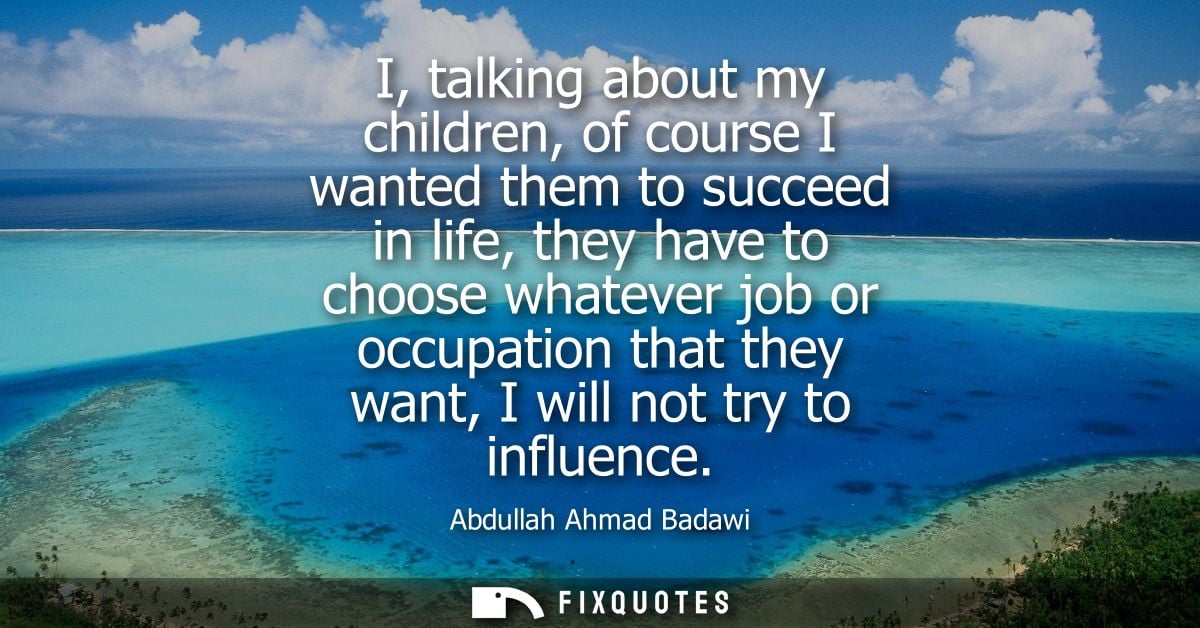
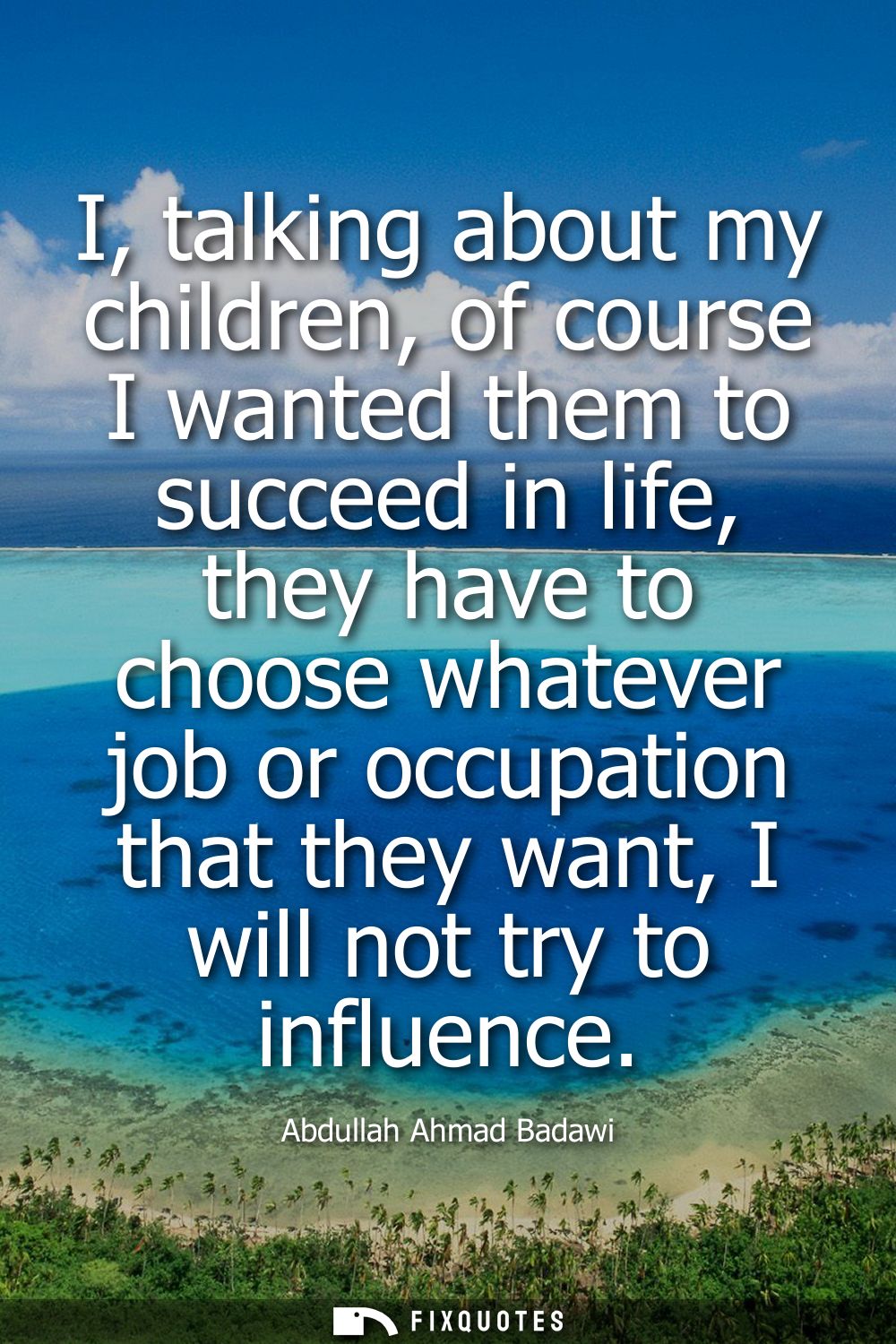
"I, talking about my children, of course I wanted them to succeed in life, they have to choose whatever job or occupation that they want, I will not try to influence"
About this Quote
The sentence is packed with careful hedges. “Of course I wanted them to succeed” signals ordinary paternal desire, a disarming baseline that makes what follows sound reasonable rather than sanctimonious. Then he pivots to liberal-sounding autonomy: “they have to choose whatever job or occupation that they want.” The phrase “have to” is telling: it frames independence as a moral obligation, not merely a preference. That’s a subtle move to portray restraint as discipline, even principle.
The most interesting subtext sits in the final clause: “I will not try to influence.” He doesn’t say he cannot, or that influence is impossible to exert; he says he won’t attempt it. The line concedes the obvious fact of his capacity to shape outcomes while claiming character as the controlling force. In a political culture where personal relationships and informal leverage are often the real currency, this is a performance of modern governance: the leader as someone who draws a boundary even when no one can enforce it.
It works because it answers two audiences at once: the parent trying to appear decent and the statesman trying to appear clean.
Quote Details
| Topic | Parenting |
|---|---|
| Source | Help us find the source |
| Cite |
Citation Formats
APA Style (7th ed.)
Badawi, Abdullah Ahmad. (2026, January 15). I, talking about my children, of course I wanted them to succeed in life, they have to choose whatever job or occupation that they want, I will not try to influence. FixQuotes. https://fixquotes.com/quotes/i-talking-about-my-children-of-course-i-wanted-41685/
Chicago Style
Badawi, Abdullah Ahmad. "I, talking about my children, of course I wanted them to succeed in life, they have to choose whatever job or occupation that they want, I will not try to influence." FixQuotes. January 15, 2026. https://fixquotes.com/quotes/i-talking-about-my-children-of-course-i-wanted-41685/.
MLA Style (9th ed.)
"I, talking about my children, of course I wanted them to succeed in life, they have to choose whatever job or occupation that they want, I will not try to influence." FixQuotes, 15 Jan. 2026, https://fixquotes.com/quotes/i-talking-about-my-children-of-course-i-wanted-41685/. Accessed 5 Apr. 2026.