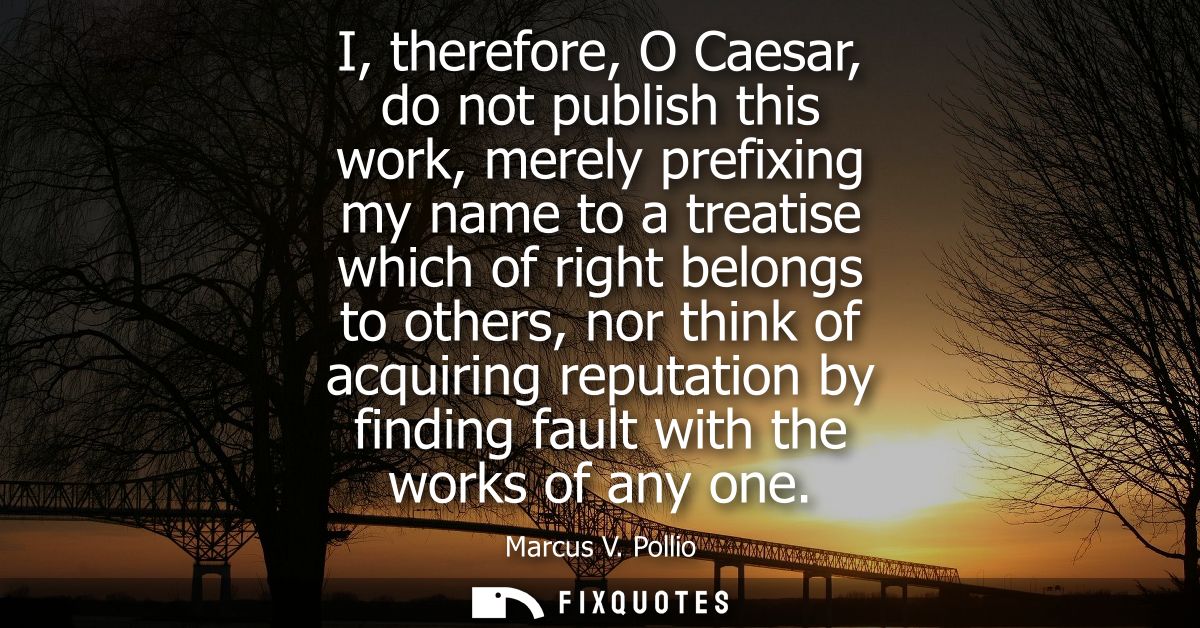
"I, therefore, O Caesar, do not publish this work, merely prefixing my name to a treatise which of right belongs to others, nor think of acquiring reputation by finding fault with the works of any one"
About this Quote
The intent is a carefully staged ethic of authorship: he positions himself as a compiler and custodian rather than an “inventor” or a critic. That posture is strategic. In a culture where patronage could make or break a career, humility functions as protection and persuasion. By refusing to “find fault,” he declines the easy path of status-through-negation, the ancient version of a takedown essay. It’s also a subtle claim to seriousness: he implies that architecture and engineering are too consequential for petty intellectual bloodsport.
Subtext: don’t mistake this modesty for smallness. By saying the treatise “of right belongs to others,” Vitruvius aligns himself with tradition and collective expertise, but he also claims the authority to curate it. He’s telling Caesar: this isn’t plagiarism, it’s administration of knowledge for the state. The Roman building program is politics in stone; his tone matches the moment. He’s offering a manual that can outlast fashion, precisely because it refuses vanity as its foundation.
Quote Details
| Topic | Honesty & Integrity |
|---|---|
| Source | Marcus Vitruvius Pollio, De architectura (Ten Books on Architecture), trans. Morris Hicky Morgan, Preface (Book I), 1914. |
| Cite |
Citation Formats
APA Style (7th ed.)
Pollio, Marcus V. (2026, January 16). I, therefore, O Caesar, do not publish this work, merely prefixing my name to a treatise which of right belongs to others, nor think of acquiring reputation by finding fault with the works of any one. FixQuotes. https://fixquotes.com/quotes/i-therefore-o-caesar-do-not-publish-this-work-102338/
Chicago Style
Pollio, Marcus V. "I, therefore, O Caesar, do not publish this work, merely prefixing my name to a treatise which of right belongs to others, nor think of acquiring reputation by finding fault with the works of any one." FixQuotes. January 16, 2026. https://fixquotes.com/quotes/i-therefore-o-caesar-do-not-publish-this-work-102338/.
MLA Style (9th ed.)
"I, therefore, O Caesar, do not publish this work, merely prefixing my name to a treatise which of right belongs to others, nor think of acquiring reputation by finding fault with the works of any one." FixQuotes, 16 Jan. 2026, https://fixquotes.com/quotes/i-therefore-o-caesar-do-not-publish-this-work-102338/. Accessed 26 Mar. 2026.