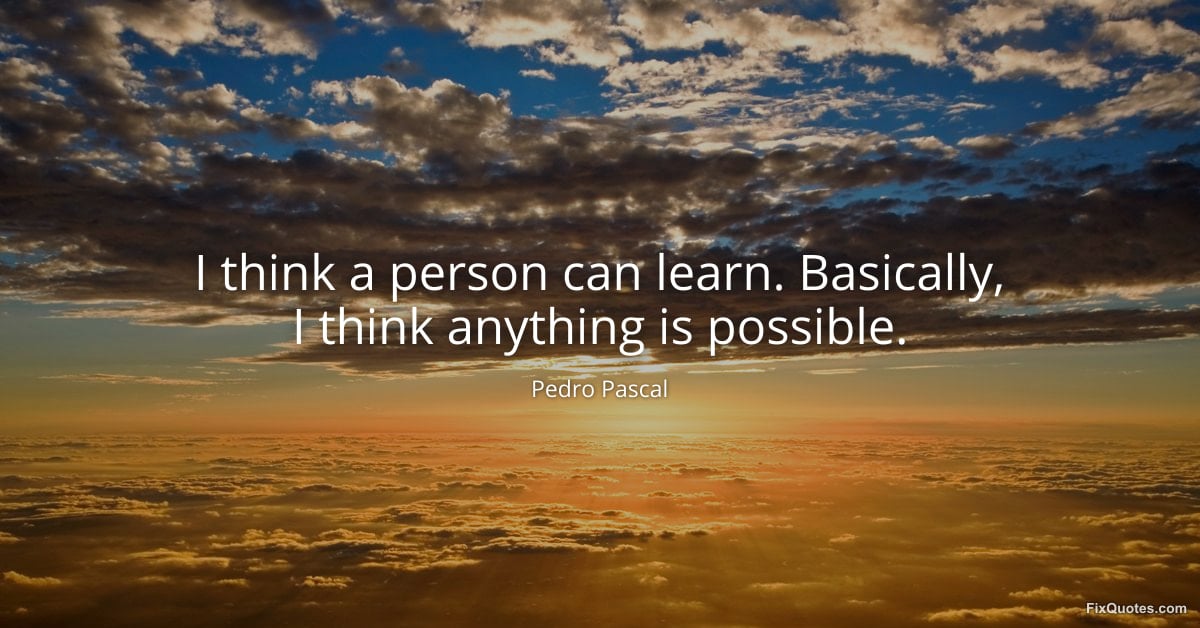
"I think a person can learn. Basically, I think anything is possible"
About this Quote
Pascal’s line lands with the casual confidence of someone who’s survived enough reinventions to treat “growth” less like a self-help slogan and more like a working method. “I think a person can learn” is deliberately modest in phrasing: not “people always change”, not “talent is earned”, just a plain belief in adjustability. The restraint matters. It signals an actor’s pragmatism, someone trained to revise choices on the fly, take direction, fail in public, and try again tomorrow. Learning, here, isn’t aspirational; it’s procedural.
Then he widens the aperture: “Basically, I think anything is possible”. That “basically” does heavy lifting, smoothing what could sound grandiose into something closer to a shrug. The subtext is permission. In a culture that loves to treat identity as either fixed destiny (“this is who I am”) or a brand strategy (“this is who I’m becoming”), Pascal offers a third stance: you can be in draft mode without apology. It’s optimism, but with an adult’s awareness that possibility is a choice you keep making, not a guarantee the universe hands you.
Contextually, it fits Pascal’s public narrative: a late-blooming career, a non-linear path, a persona that reads as empathetic without being saccharine. For audiences watching him move between genres and roles, the quote works like a quiet manifesto: stay teachable, stay porous, don’t let the current version of yourself be the final cut.
Then he widens the aperture: “Basically, I think anything is possible”. That “basically” does heavy lifting, smoothing what could sound grandiose into something closer to a shrug. The subtext is permission. In a culture that loves to treat identity as either fixed destiny (“this is who I am”) or a brand strategy (“this is who I’m becoming”), Pascal offers a third stance: you can be in draft mode without apology. It’s optimism, but with an adult’s awareness that possibility is a choice you keep making, not a guarantee the universe hands you.
Contextually, it fits Pascal’s public narrative: a late-blooming career, a non-linear path, a persona that reads as empathetic without being saccharine. For audiences watching him move between genres and roles, the quote works like a quiet manifesto: stay teachable, stay porous, don’t let the current version of yourself be the final cut.
Quote Details
| Topic | Optimism |
|---|---|
| Source | Help us find the source |
| Cite |
Citation Formats
APA Style (7th ed.)
Pascal, Pedro. (2026, February 9). I think a person can learn. Basically, I think anything is possible. FixQuotes. https://fixquotes.com/quotes/i-think-a-person-can-learn-basically-i-think-184982/
Chicago Style
Pascal, Pedro. "I think a person can learn. Basically, I think anything is possible." FixQuotes. February 9, 2026. https://fixquotes.com/quotes/i-think-a-person-can-learn-basically-i-think-184982/.
MLA Style (9th ed.)
"I think a person can learn. Basically, I think anything is possible." FixQuotes, 9 Feb. 2026, https://fixquotes.com/quotes/i-think-a-person-can-learn-basically-i-think-184982/. Accessed 13 Feb. 2026.
More Quotes by Pedro
Add to List