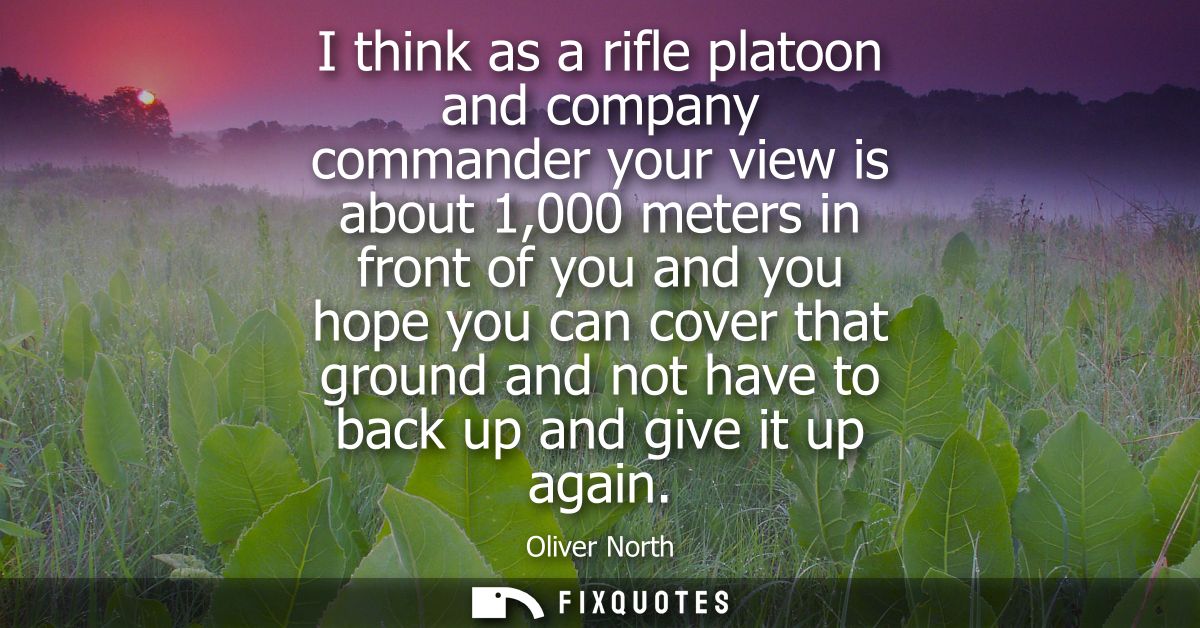
"I think, as a rifle platoon and company commander, your view is about 1,000 meters in front of you, and you hope you can cover that ground and not have to back up and give it up again"
About this Quote
The intent is to dignify a particular kind of competence: the tactical ethic of incremental gains. North frames success less as heroic breakthrough than as avoiding the humiliation and cost of giving ground back. That little clause - "and not have to back up and give it up again" - carries the subtext of war’s most brutal arithmetic: advances are expensive, retreats are demoralizing, and the same ground, fought over twice, is paid for twice in blood.
Context matters because North is not just any soldier; he became a public symbol of patriotic certainty and political controversy. Read through that lens, the quote doubles as a worldview: focus on the immediate objective, treat reversal as failure, and keep moving forward. It’s appealing because it’s concrete, managerial, almost comforting - a war reduced to doable units of effort. It also hints at the danger of that mindset when exported beyond the platoon: politics and strategy rarely fit inside 1,000 meters, and refusing to "back up" can become stubbornness masquerading as resolve.
Quote Details
| Topic | Leadership |
|---|---|
| Source | Help us find the source |
| Cite |
Citation Formats
APA Style (7th ed.)
North, Oliver. (2026, February 18). I think, as a rifle platoon and company commander, your view is about 1,000 meters in front of you, and you hope you can cover that ground and not have to back up and give it up again. FixQuotes. https://fixquotes.com/quotes/i-think-as-a-rifle-platoon-and-company-commander-83205/
Chicago Style
North, Oliver. "I think, as a rifle platoon and company commander, your view is about 1,000 meters in front of you, and you hope you can cover that ground and not have to back up and give it up again." FixQuotes. February 18, 2026. https://fixquotes.com/quotes/i-think-as-a-rifle-platoon-and-company-commander-83205/.
MLA Style (9th ed.)
"I think, as a rifle platoon and company commander, your view is about 1,000 meters in front of you, and you hope you can cover that ground and not have to back up and give it up again." FixQuotes, 18 Feb. 2026, https://fixquotes.com/quotes/i-think-as-a-rifle-platoon-and-company-commander-83205/. Accessed 18 Mar. 2026.