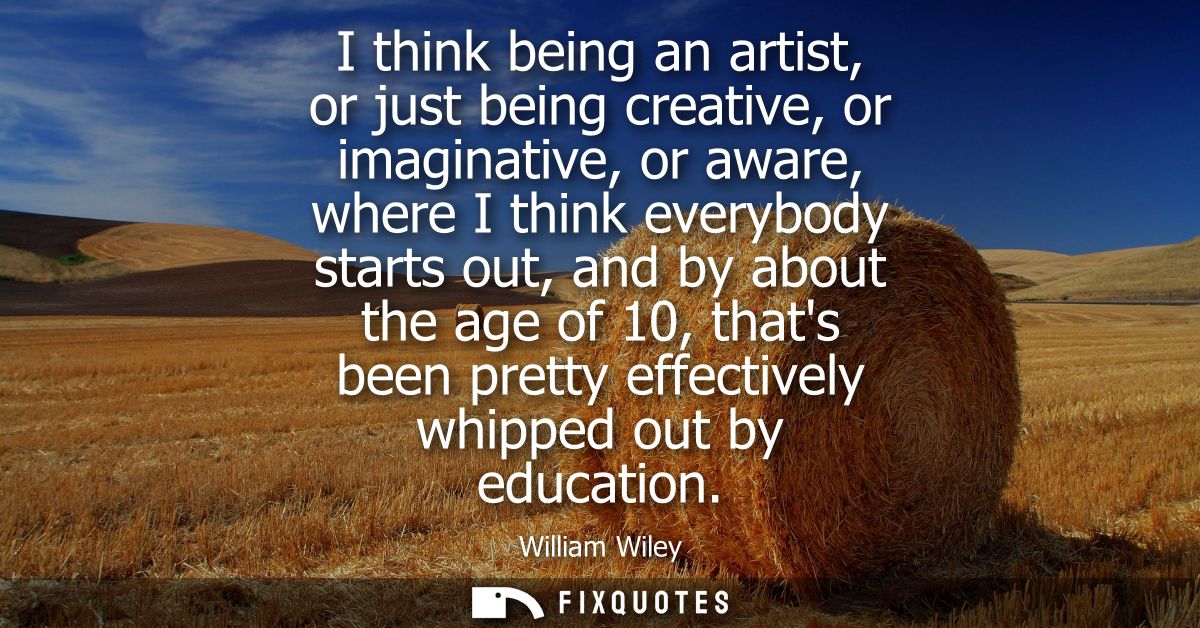
"I think being an artist, or just being creative, or imaginative, or aware, where I think everybody starts out, and by about the age of 10 that's been pretty effectively whipped out by education"
About this Quote
The quote’s intent is less nostalgia than indictment. Wiley gestures to a common childhood baseline - “where I think everybody starts out” - then pins the collapse of that openness to a specific deadline: age 10. That specificity matters. It frames creativity as something systematically engineered out of kids right as evaluation, sorting, and “correct” answers start to harden. The subtext isn’t that schools are evil; it’s that the incentives of education (standardization, measurable outcomes, risk aversion) quietly select against imaginative thinking, which is messy and time-consuming and often looks like distraction.
Wiley also slips in an expansive definition of artistry: “creative, imaginative, or aware.” “Aware” is the tell. He’s not just mourning lost painting skills; he’s arguing that education can dull perception itself, the capacity to notice, question, and interpret. It’s a critique of how a society reproduces itself: not by banning creativity outright, but by grading it into submission.
Quote Details
| Topic | Teaching |
|---|---|
| Source | Help us find the source |
| Cite |
Citation Formats
APA Style (7th ed.)
Wiley, William. (2026, February 16). I think being an artist, or just being creative, or imaginative, or aware, where I think everybody starts out, and by about the age of 10 that's been pretty effectively whipped out by education. FixQuotes. https://fixquotes.com/quotes/i-think-being-an-artist-or-just-being-creative-or-125450/
Chicago Style
Wiley, William. "I think being an artist, or just being creative, or imaginative, or aware, where I think everybody starts out, and by about the age of 10 that's been pretty effectively whipped out by education." FixQuotes. February 16, 2026. https://fixquotes.com/quotes/i-think-being-an-artist-or-just-being-creative-or-125450/.
MLA Style (9th ed.)
"I think being an artist, or just being creative, or imaginative, or aware, where I think everybody starts out, and by about the age of 10 that's been pretty effectively whipped out by education." FixQuotes, 16 Feb. 2026, https://fixquotes.com/quotes/i-think-being-an-artist-or-just-being-creative-or-125450/. Accessed 18 Mar. 2026.