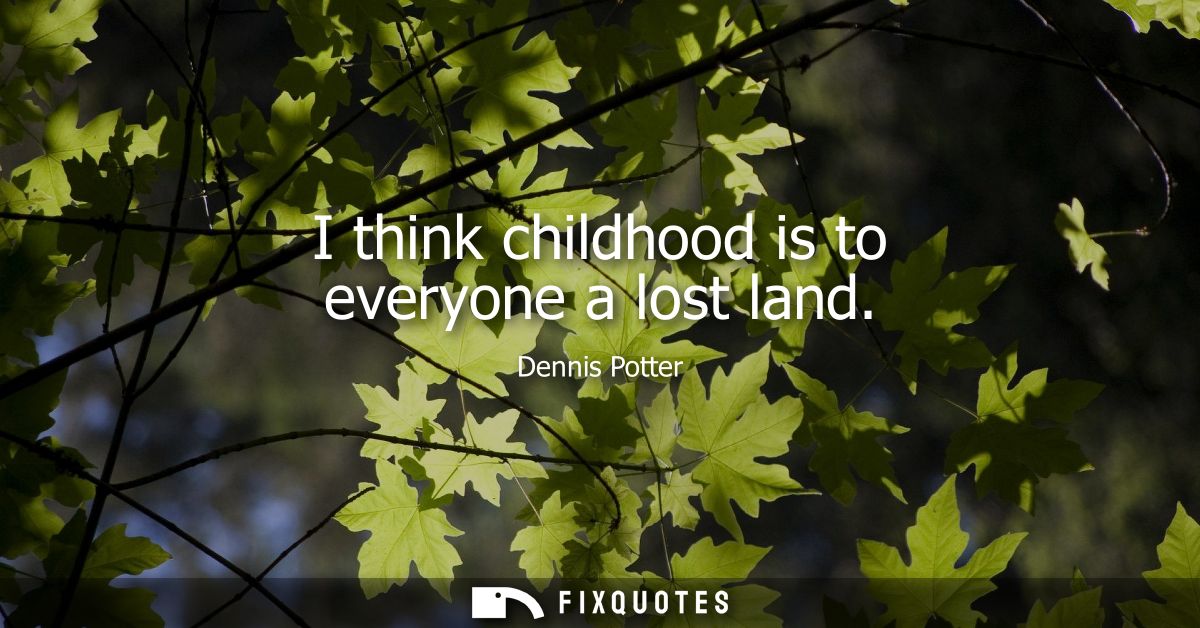
"I think childhood is to everyone a lost land"
About this Quote
Childhood as “a lost land” turns nostalgia into geography: not a scrapbook, but a territory you can’t legally re-enter. Dennis Potter’s phrasing is deliberately plain, almost lulling, which is part of its sting. “To everyone” refuses the comforting idea that loss is a personal quirk or a tragic exception; it’s the default condition of growing up. And “lost” carries a double charge: childhood is both misplaced (gone without a forwarding address) and a place where you can get lost (bewildered, unprotected, at the mercy of adults and accident).
Potter, as a dramatist, isn’t interested in childhood as innocence so much as childhood as origin story: where desire, shame, class, and sickness first show their teeth. The line’s power is how it smuggles in an argument about memory. A “land” is something you map, mythologize, and fight over; it suggests borders and ownership. Yet childhood can’t be possessed. Adults build versions of it out of selective recall, sentimental props, and cultural scripts, then wonder why the real thing won’t match.
In Potter’s work and public persona, the body’s betrayals and the mind’s evasions are constant themes. That context sharpens “lost land” into more than wistfulness. It’s about the cruel arithmetic of time: you don’t just leave childhood; it’s annexed by whatever happens next. The line works because it makes longing feel structural, not merely emotional: exile as a basic feature of consciousness.
Potter, as a dramatist, isn’t interested in childhood as innocence so much as childhood as origin story: where desire, shame, class, and sickness first show their teeth. The line’s power is how it smuggles in an argument about memory. A “land” is something you map, mythologize, and fight over; it suggests borders and ownership. Yet childhood can’t be possessed. Adults build versions of it out of selective recall, sentimental props, and cultural scripts, then wonder why the real thing won’t match.
In Potter’s work and public persona, the body’s betrayals and the mind’s evasions are constant themes. That context sharpens “lost land” into more than wistfulness. It’s about the cruel arithmetic of time: you don’t just leave childhood; it’s annexed by whatever happens next. The line works because it makes longing feel structural, not merely emotional: exile as a basic feature of consciousness.
Quote Details
| Topic | Nostalgia |
|---|---|
| Source | Help us find the source |
| Cite |
Citation Formats
APA Style (7th ed.)
Potter, Dennis. (2026, January 17). I think childhood is to everyone a lost land. FixQuotes. https://fixquotes.com/quotes/i-think-childhood-is-to-everyone-a-lost-land-55867/
Chicago Style
Potter, Dennis. "I think childhood is to everyone a lost land." FixQuotes. January 17, 2026. https://fixquotes.com/quotes/i-think-childhood-is-to-everyone-a-lost-land-55867/.
MLA Style (9th ed.)
"I think childhood is to everyone a lost land." FixQuotes, 17 Jan. 2026, https://fixquotes.com/quotes/i-think-childhood-is-to-everyone-a-lost-land-55867/. Accessed 21 Mar. 2026.
More Quotes by Dennis
Add to List