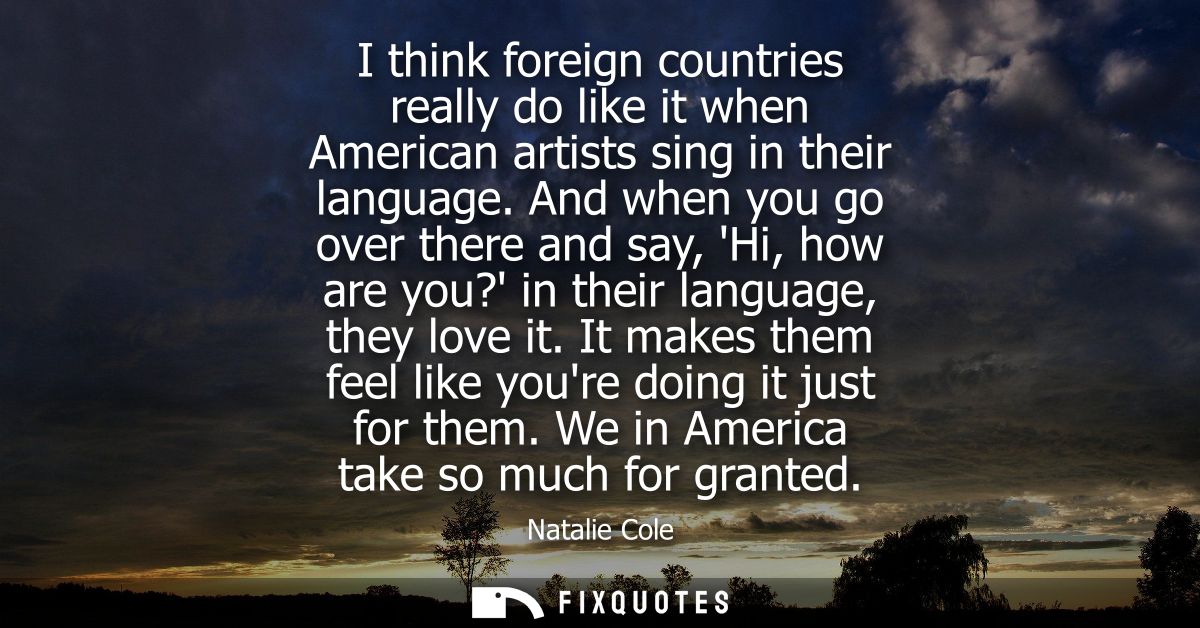
"I think foreign countries really do like it when American artists sing in their language. And when you go over there and say, 'Hi, how are you?' in their language, they love it. It makes them feel like you're doing it just for them. We in America take so much for granted"
About this Quote
There is an artist's pragmatism hiding inside Natalie Cole's warmth: audiences don't just buy tickets, they buy recognition. Her point isn't that a halting "Hi, how are you?" is fluent diplomacy; it's that the smallest linguistic gesture can read as respect rather than entitlement. In a global pop economy long tilted toward English, singing in someone else's language flips the usual flow of cultural labor. Instead of asking the world to meet America halfway, the American star takes a step toward the crowd.
The subtext is a quiet indictment of U.S. default settings. Cole doesn't scold; she slips the critique into a performer-to-performer observation: people "love it" because they're used to being treated like an export market, not an equal participant. That line about it feeling like you're doing it "just for them" captures the intimacy of live music - how fandom thrives on the illusion of personal address - but it also exposes how rarely American culture bothers to personalize its outreach abroad. The bar is low because the baseline expectation is indifference.
Context matters: Cole came of age when American music traveled easily, backed by massive labels and an almost automatic global prestige. For a Black American vocalist with deep roots in jazz and R&B traditions that have long been internationalized, the awareness is sharper: she knows cultural exchange is never neutral, and that admiration can coexist with resentment when it arrives packaged as cultural dominance. Her message doubles as career savvy and soft-power ethics: learn the words, honor the room, admit what you assume.
The subtext is a quiet indictment of U.S. default settings. Cole doesn't scold; she slips the critique into a performer-to-performer observation: people "love it" because they're used to being treated like an export market, not an equal participant. That line about it feeling like you're doing it "just for them" captures the intimacy of live music - how fandom thrives on the illusion of personal address - but it also exposes how rarely American culture bothers to personalize its outreach abroad. The bar is low because the baseline expectation is indifference.
Context matters: Cole came of age when American music traveled easily, backed by massive labels and an almost automatic global prestige. For a Black American vocalist with deep roots in jazz and R&B traditions that have long been internationalized, the awareness is sharper: she knows cultural exchange is never neutral, and that admiration can coexist with resentment when it arrives packaged as cultural dominance. Her message doubles as career savvy and soft-power ethics: learn the words, honor the room, admit what you assume.
Quote Details
| Topic | Music |
|---|
More Quotes by Natalie
Add to List