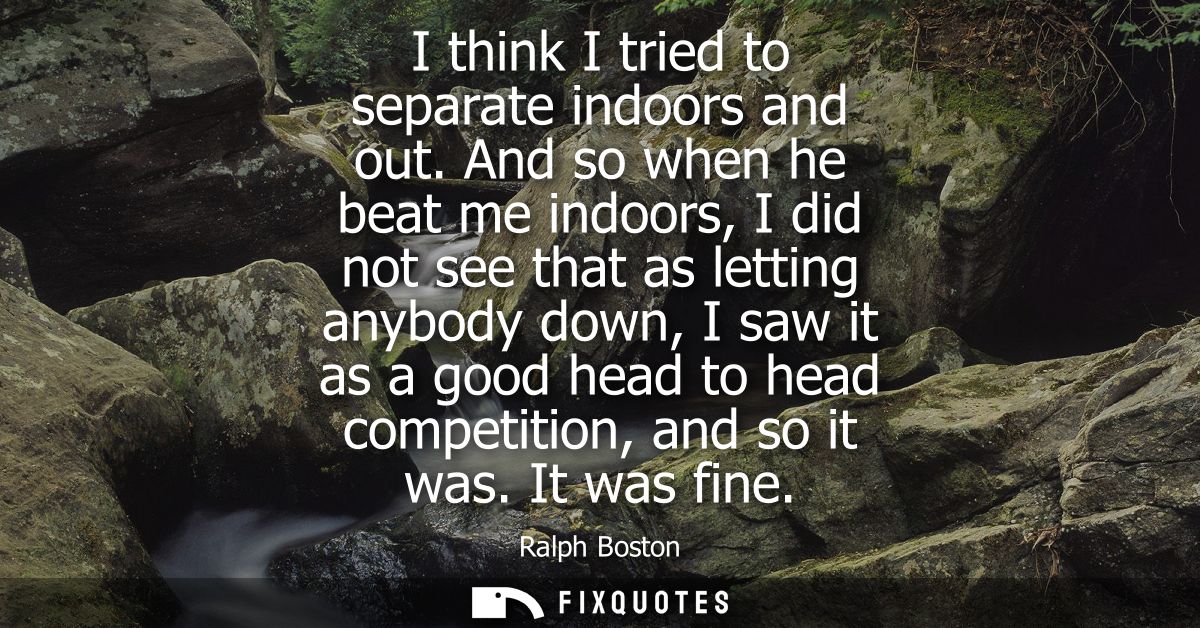
"I think I tried to separate indoors and out. And so when he beat me indoors, I did not see that as letting anybody down, I saw it as a good head to head competition, and so it was. It was fine"
About this Quote
The subtext is rivalry management. Boston came up in an era when track and field head-to-heads carried enormous symbolic weight, especially for Black American athletes who were often forced to represent more than themselves. “Letting anybody down” hints at the invisible audience: supporters, community, maybe even the broader politics of expectation. His answer rejects that burden without ever calling it out. He reframes defeat indoors as “good…competition,” a phrase that drains the drama from the result and puts it back where he wants it: in performance.
“It was fine” lands with the quiet defiance of someone who’s learned that the sport’s emotional economy can bankrupt you. Boston isn’t pretending losing doesn’t sting. He’s insisting it doesn’t get to write the story. Indoors is a chapter, not a verdict. That’s the intent: control the narrative so the rivalry stays athletic instead of existential.
Quote Details
| Topic | Defeat |
|---|---|
| Source | Help us find the source |
| Cite |
Citation Formats
APA Style (7th ed.)
Boston, Ralph. (2026, January 16). I think I tried to separate indoors and out. And so when he beat me indoors, I did not see that as letting anybody down, I saw it as a good head to head competition, and so it was. It was fine. FixQuotes. https://fixquotes.com/quotes/i-think-i-tried-to-separate-indoors-and-out-and-94456/
Chicago Style
Boston, Ralph. "I think I tried to separate indoors and out. And so when he beat me indoors, I did not see that as letting anybody down, I saw it as a good head to head competition, and so it was. It was fine." FixQuotes. January 16, 2026. https://fixquotes.com/quotes/i-think-i-tried-to-separate-indoors-and-out-and-94456/.
MLA Style (9th ed.)
"I think I tried to separate indoors and out. And so when he beat me indoors, I did not see that as letting anybody down, I saw it as a good head to head competition, and so it was. It was fine." FixQuotes, 16 Jan. 2026, https://fixquotes.com/quotes/i-think-i-tried-to-separate-indoors-and-out-and-94456/. Accessed 4 Apr. 2026.