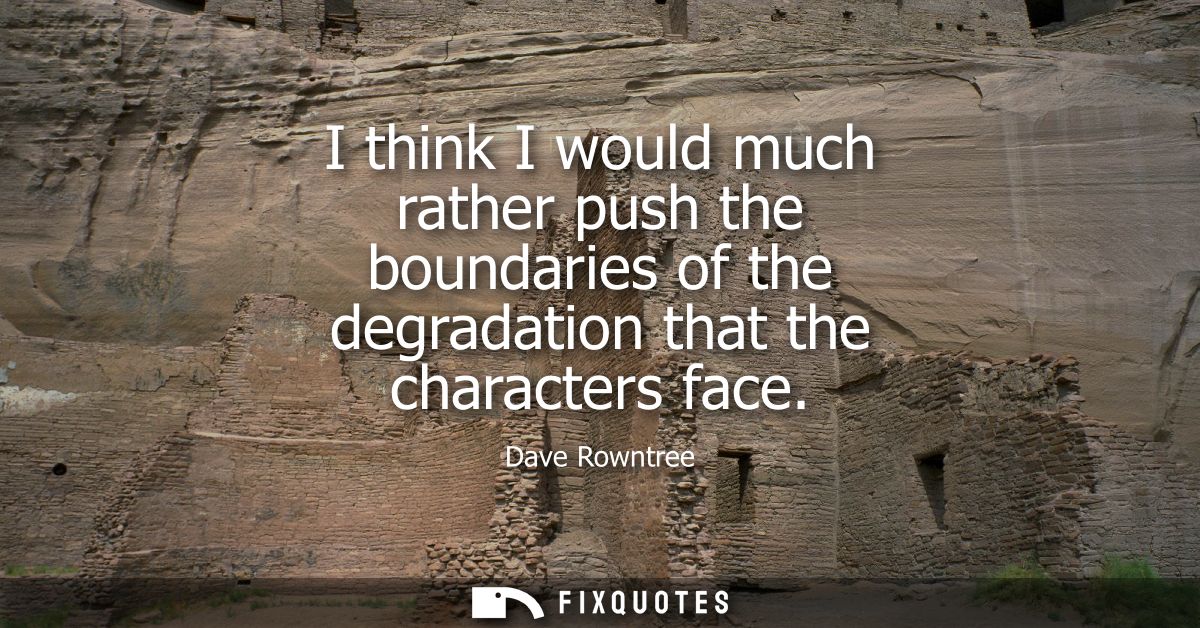
"I think I would much rather push the boundaries of the degradation that the characters face"
About this Quote
“Would much rather” signals preference, almost relief, as if conventional routes (coolness, charm, triumph) feel less honest than the downward pressure of humiliation. The subtext is that degradation reveals structure. It strips away the flattering lies characters tell themselves, forcing clearer choices: beg, perform, betray, endure, dissociate. That’s why it works. Audience empathy often sharpens not at the moment of victory but at the moment someone is reduced, then has to decide whether to claw back power or accept the terms of their reduction.
Contextually, it also taps into a late-20th/early-21st-century sensibility where the “edgy” move is no longer simply depicting bad behavior, but interrogating systems that grind people down: class, institutions, masculinity, fandom, the workplace, the media. “Push the boundaries” becomes less about shock and more about testing how much indignity a story can stage before it turns into exploitation - and whether the creator is aware of that line. Rowntree’s candor suggests he’s drawn to the discomfort because it exposes the audience too: our appetite for watching people get dragged, and our need to believe it means something.
Quote Details
| Topic | Writing |
|---|---|
| Source | Help us find the source |
| Cite |
Citation Formats
APA Style (7th ed.)
Rowntree, Dave. (2026, January 15). I think I would much rather push the boundaries of the degradation that the characters face. FixQuotes. https://fixquotes.com/quotes/i-think-i-would-much-rather-push-the-boundaries-68894/
Chicago Style
Rowntree, Dave. "I think I would much rather push the boundaries of the degradation that the characters face." FixQuotes. January 15, 2026. https://fixquotes.com/quotes/i-think-i-would-much-rather-push-the-boundaries-68894/.
MLA Style (9th ed.)
"I think I would much rather push the boundaries of the degradation that the characters face." FixQuotes, 15 Jan. 2026, https://fixquotes.com/quotes/i-think-i-would-much-rather-push-the-boundaries-68894/. Accessed 4 Mar. 2026.