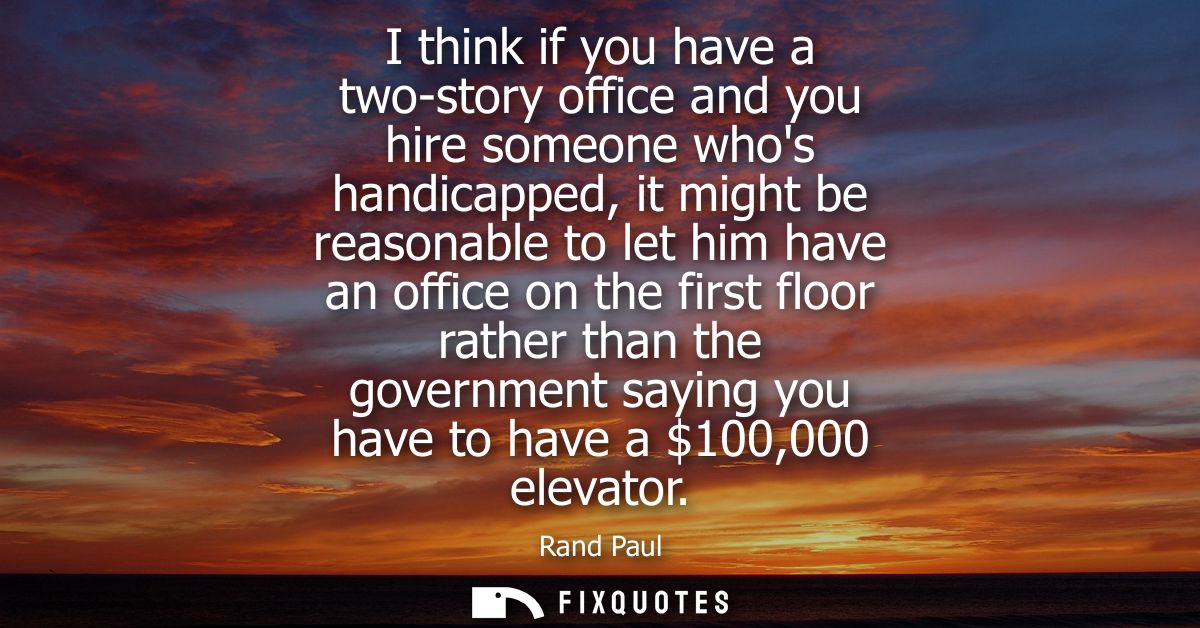
"I think if you have a two-story office and you hire someone who's handicapped, it might be reasonable to let him have an office on the first floor rather than the government saying you have to have a $100,000 elevator"
About this Quote
The subtext is a deeper argument about who gets to define fairness. Paul isn’t only questioning cost; he’s nudging listeners to accept a narrower standard of inclusion: access where it’s convenient, negotiated, or charitable, rather than guaranteed. "Let him have an office on the first floor" sounds generous, but it quietly normalizes segregation by design - the disabled employee is accommodated by being redirected, not by changing the building. Rights become conditional on the employer’s layout, budget, and goodwill.
Context matters: the Americans with Disabilities Act and related accessibility rules were built on the lesson that piecemeal kindness doesn’t scale. Without enforceable standards, the disabled person is forced to bargain for basic participation every time they change jobs, visit a business, or enter public life. Paul’s elevator number is doing rhetorical heavy lifting, too: it primes the audience to see compliance as waste, even if real-world requirements often include alternatives, phased timelines, and "undue hardship" exceptions.
The quote’s intent is less about elevators than about redefining disability access as optional - a preference the market can handle - rather than a public obligation.
Quote Details
| Topic | Human Rights |
|---|---|
| Source | Help us find the source |
| Cite |
Citation Formats
APA Style (7th ed.)
Paul, Rand. (2026, January 15). I think if you have a two-story office and you hire someone who's handicapped, it might be reasonable to let him have an office on the first floor rather than the government saying you have to have a $100,000 elevator. FixQuotes. https://fixquotes.com/quotes/i-think-if-you-have-a-two-story-office-and-you-77494/
Chicago Style
Paul, Rand. "I think if you have a two-story office and you hire someone who's handicapped, it might be reasonable to let him have an office on the first floor rather than the government saying you have to have a $100,000 elevator." FixQuotes. January 15, 2026. https://fixquotes.com/quotes/i-think-if-you-have-a-two-story-office-and-you-77494/.
MLA Style (9th ed.)
"I think if you have a two-story office and you hire someone who's handicapped, it might be reasonable to let him have an office on the first floor rather than the government saying you have to have a $100,000 elevator." FixQuotes, 15 Jan. 2026, https://fixquotes.com/quotes/i-think-if-you-have-a-two-story-office-and-you-77494/. Accessed 28 Mar. 2026.