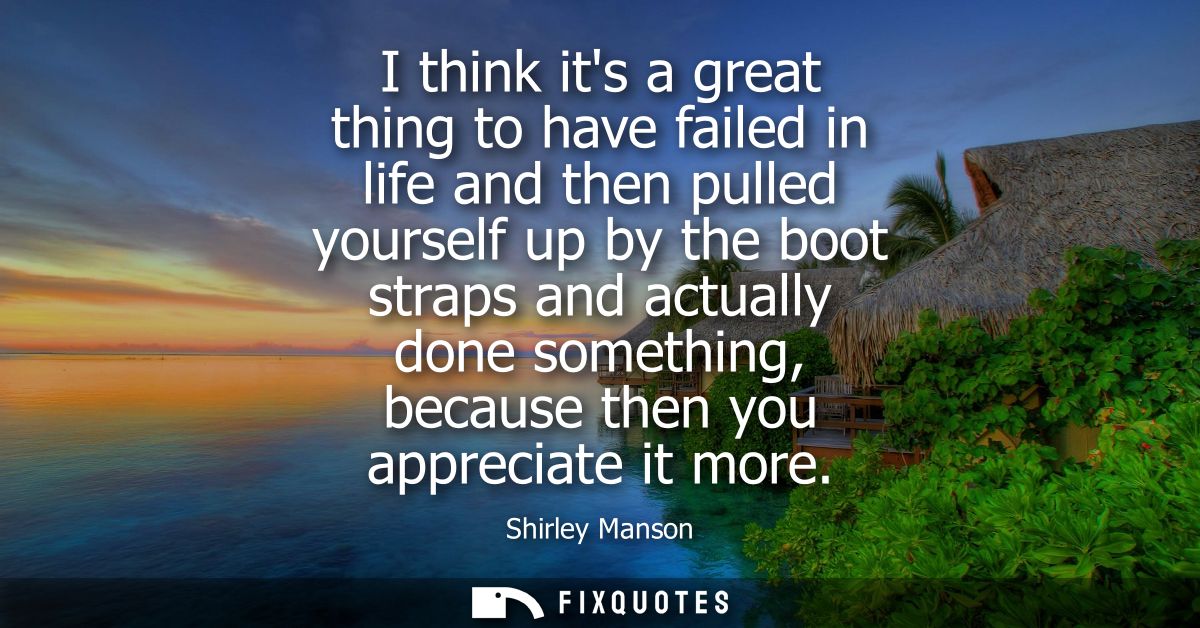
"I think it's a great thing to have failed in life and then pulled yourself up by the boot straps and actually done something, because then you appreciate it more"
About this Quote
The subtext is complicated. “Boot straps” is cultural shorthand for rugged self-reliance, even though it’s also a phrase famously criticized for ignoring structural barriers. Manson doesn’t deny those barriers; she simply spotlights what failure can do internally: it recalibrates gratitude, sharpens taste, and makes achievement feel earned rather than accidental. “Actually done something” is the tell. It’s not about purity or destiny; it’s about tangible output, the work that exists despite doubt, critics, and your own earlier collapse.
There’s also a quiet rebuke to effortless success. In pop culture, overnight narratives are addictive because they’re clean. Manson argues for the messy arc: the person who’s been broken by rejection is less likely to treat success as identity and more likely to treat it as a practice. Appreciation, in her framing, isn’t sentimental. It’s a hard-won form of attention.
Quote Details
| Topic | Perseverance |
|---|---|
| Source | Help us find the source |
| Cite |
Citation Formats
APA Style (7th ed.)
Manson, Shirley. (2026, January 15). I think it's a great thing to have failed in life and then pulled yourself up by the boot straps and actually done something, because then you appreciate it more. FixQuotes. https://fixquotes.com/quotes/i-think-its-a-great-thing-to-have-failed-in-life-162091/
Chicago Style
Manson, Shirley. "I think it's a great thing to have failed in life and then pulled yourself up by the boot straps and actually done something, because then you appreciate it more." FixQuotes. January 15, 2026. https://fixquotes.com/quotes/i-think-its-a-great-thing-to-have-failed-in-life-162091/.
MLA Style (9th ed.)
"I think it's a great thing to have failed in life and then pulled yourself up by the boot straps and actually done something, because then you appreciate it more." FixQuotes, 15 Jan. 2026, https://fixquotes.com/quotes/i-think-its-a-great-thing-to-have-failed-in-life-162091/. Accessed 5 Apr. 2026.