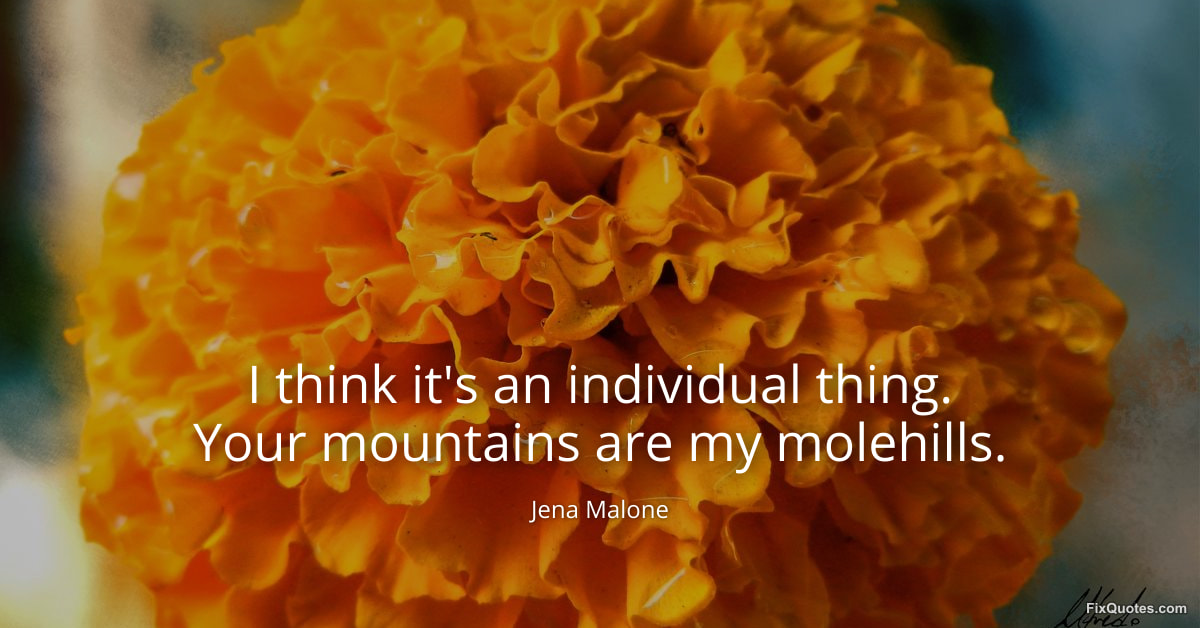
"I think it's an individual thing. Your mountains are my molehills"
About this Quote
Malone’s line lands because it quietly refuses the competitive sport we’ve turned suffering into. “I think it’s an individual thing” is a soft preface that does hard work: it blocks the listener from turning her experience into a universal rule, a hot take, or a diagnosis. In an era where every feeling wants to be a shareable framework, she insists on scale as personal, not standardized.
“Your mountains are my molehills” flips a familiar cliché into something more revealing. We’re used to hearing it as dismissal - get over it, it’s not that big. Malone’s phrasing keeps the edge but adds a crucial admission: the mismatch runs both ways. If your “mountain” might be her “molehill,” then her mountain could be your molehill, too. The subtext is empathy without theatrics: not “you’re wrong to feel that,” but “we’re calibrated differently.”
As an actress, Malone’s context matters. Performance is literally the practice of making inner weather legible, then watching audiences project their own histories onto it. The quote reads like a survival tactic for public life: a reminder that reactions to trauma, fame, criticism, or even everyday stress aren’t ranked by some objective yardstick. It’s also a boundary. She’s not asking to be excused; she’s asking not to be measured against someone else’s thresholds.
The intent is modest, almost casual, which is why it sticks: a humane pushback against both minimization and melodrama.
“Your mountains are my molehills” flips a familiar cliché into something more revealing. We’re used to hearing it as dismissal - get over it, it’s not that big. Malone’s phrasing keeps the edge but adds a crucial admission: the mismatch runs both ways. If your “mountain” might be her “molehill,” then her mountain could be your molehill, too. The subtext is empathy without theatrics: not “you’re wrong to feel that,” but “we’re calibrated differently.”
As an actress, Malone’s context matters. Performance is literally the practice of making inner weather legible, then watching audiences project their own histories onto it. The quote reads like a survival tactic for public life: a reminder that reactions to trauma, fame, criticism, or even everyday stress aren’t ranked by some objective yardstick. It’s also a boundary. She’s not asking to be excused; she’s asking not to be measured against someone else’s thresholds.
The intent is modest, almost casual, which is why it sticks: a humane pushback against both minimization and melodrama.
Quote Details
| Topic | Wisdom |
|---|---|
| Source | Help us find the source |
| Cite |
Citation Formats
APA Style (7th ed.)
Malone, Jena. (2026, January 16). I think it's an individual thing. Your mountains are my molehills. FixQuotes. https://fixquotes.com/quotes/i-think-its-an-individual-thing-your-mountains-89344/
Chicago Style
Malone, Jena. "I think it's an individual thing. Your mountains are my molehills." FixQuotes. January 16, 2026. https://fixquotes.com/quotes/i-think-its-an-individual-thing-your-mountains-89344/.
MLA Style (9th ed.)
"I think it's an individual thing. Your mountains are my molehills." FixQuotes, 16 Jan. 2026, https://fixquotes.com/quotes/i-think-its-an-individual-thing-your-mountains-89344/. Accessed 30 Mar. 2026.
More Quotes by Jena
Add to List