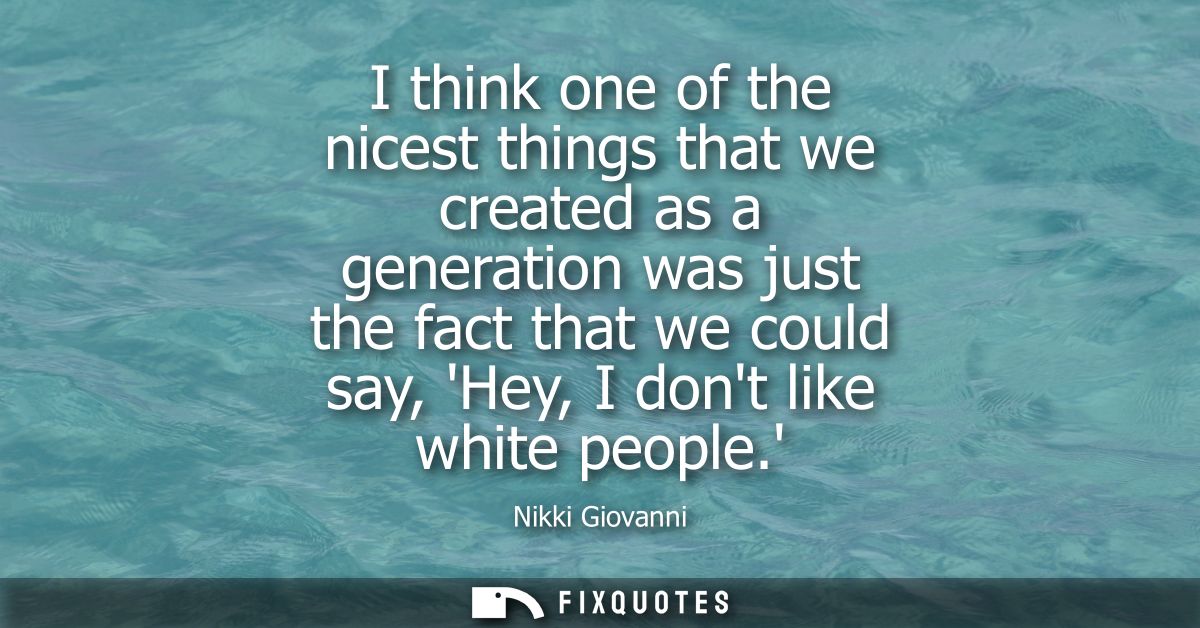
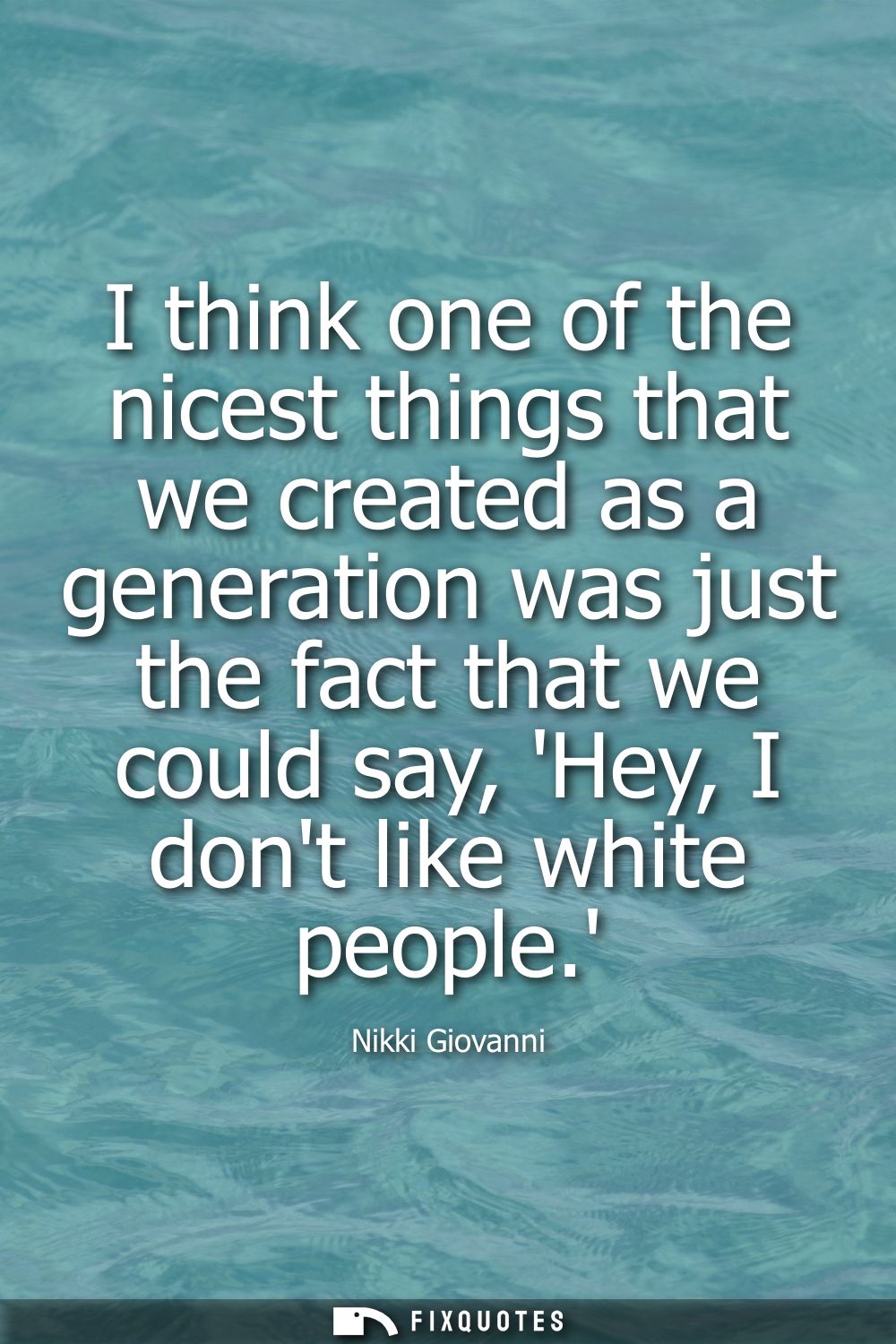
"I think one of the nicest things that we created as a generation was just the fact that we could say, 'Hey, I don't like white people.'"
About this Quote
Context matters. Giovanni comes out of the Black Arts Movement era, when art wasn’t aspiring to be “universal” so much as useful: a language of survival, refusal, and self-definition amid segregation’s afterlife and the daily humiliations of American racial hierarchy. In that world, “I don’t like white people” isn’t a manifesto of hatred as much as a shorthand for exhaustion with whiteness as an institution: the power to define norms, to demand patience, to center itself even in conversations about Black pain.
The subtext is generational memory. She’s talking about what it meant to stop performing gratitude and to stop translating your wounds into palatable lessons. The line also refuses the trap of respectability politics: that Black speech must be endlessly reasonable to be legitimate. Giovanni’s provocation forces the listener to ask why this kind of sentence feels more scandalous than the conditions that produce it. That’s the intent: rebalancing whose feelings get treated as sacred.
Quote Details
| Topic | Freedom |
|---|---|
| Source | Help us find the source |
| Cite |
Citation Formats
APA Style (7th ed.)
Giovanni, Nikki. (2026, January 16). I think one of the nicest things that we created as a generation was just the fact that we could say, 'Hey, I don't like white people.'. FixQuotes. https://fixquotes.com/quotes/i-think-one-of-the-nicest-things-that-we-created-89163/
Chicago Style
Giovanni, Nikki. "I think one of the nicest things that we created as a generation was just the fact that we could say, 'Hey, I don't like white people.'." FixQuotes. January 16, 2026. https://fixquotes.com/quotes/i-think-one-of-the-nicest-things-that-we-created-89163/.
MLA Style (9th ed.)
"I think one of the nicest things that we created as a generation was just the fact that we could say, 'Hey, I don't like white people.'." FixQuotes, 16 Jan. 2026, https://fixquotes.com/quotes/i-think-one-of-the-nicest-things-that-we-created-89163/. Accessed 3 Apr. 2026.