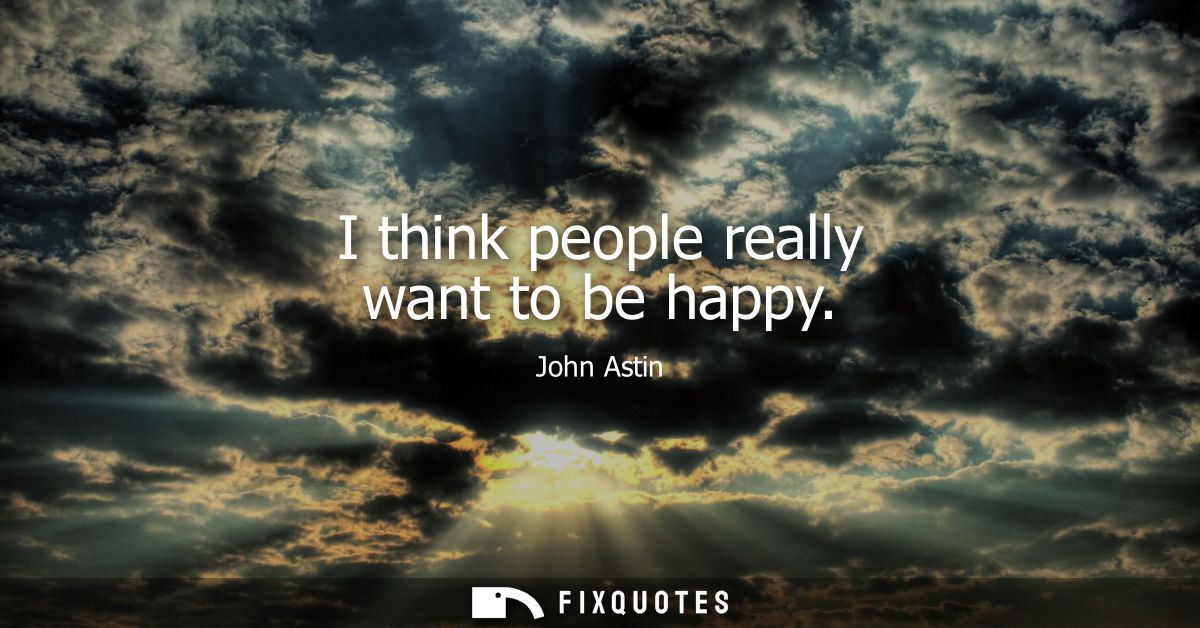
"I think people really want to be happy"
About this Quote
Astin’s line lands with the plainspoken certainty of an actor who’s watched humans up close for decades: on sets, in auditions, in green rooms where everyone is performing even when the cameras are off. “I think” softens the claim, but it also signals something more telling than a maxim. It’s an observation, almost a diagnosis, offered without preaching. The modesty is strategic; it invites agreement rather than argument.
The word doing the heavy lifting is “really.” It implies competition: people say they want success, love, status, revenge, a better body, a bigger role. “Really” suggests those are proxies, costumes happiness borrows to get through the day. Coming from an actor - a profession built on desire, image, and endless comparison - the subtext feels quietly skeptical about the stories we tell ourselves. Astin isn’t idealizing people; he’s pointing to a basic motive that keeps leaking through our more glamorous ambitions.
It also works because it’s almost disappointingly obvious, and that’s the point. In a culture that markets happiness as a product and treats misery as a personal failure, the line reframes happiness not as a constant state but as a common pursuit. “Want” matters too: it’s not “people are happy” or “people should be happy.” It’s a desire, persistent and unmet, which makes the sentence compassionate without getting sentimental. Astin’s intent seems less to inspire than to humanize: behind every odd choice and sharp edge, there’s usually someone reaching for relief.
The word doing the heavy lifting is “really.” It implies competition: people say they want success, love, status, revenge, a better body, a bigger role. “Really” suggests those are proxies, costumes happiness borrows to get through the day. Coming from an actor - a profession built on desire, image, and endless comparison - the subtext feels quietly skeptical about the stories we tell ourselves. Astin isn’t idealizing people; he’s pointing to a basic motive that keeps leaking through our more glamorous ambitions.
It also works because it’s almost disappointingly obvious, and that’s the point. In a culture that markets happiness as a product and treats misery as a personal failure, the line reframes happiness not as a constant state but as a common pursuit. “Want” matters too: it’s not “people are happy” or “people should be happy.” It’s a desire, persistent and unmet, which makes the sentence compassionate without getting sentimental. Astin’s intent seems less to inspire than to humanize: behind every odd choice and sharp edge, there’s usually someone reaching for relief.
Quote Details
| Topic | Happiness |
|---|---|
| Source | Help us find the source |
| Cite |
Citation Formats
APA Style (7th ed.)
Astin, John. (2026, January 16). I think people really want to be happy. FixQuotes. https://fixquotes.com/quotes/i-think-people-really-want-to-be-happy-91235/
Chicago Style
Astin, John. "I think people really want to be happy." FixQuotes. January 16, 2026. https://fixquotes.com/quotes/i-think-people-really-want-to-be-happy-91235/.
MLA Style (9th ed.)
"I think people really want to be happy." FixQuotes, 16 Jan. 2026, https://fixquotes.com/quotes/i-think-people-really-want-to-be-happy-91235/. Accessed 17 Mar. 2026.
More Quotes by John
Add to List