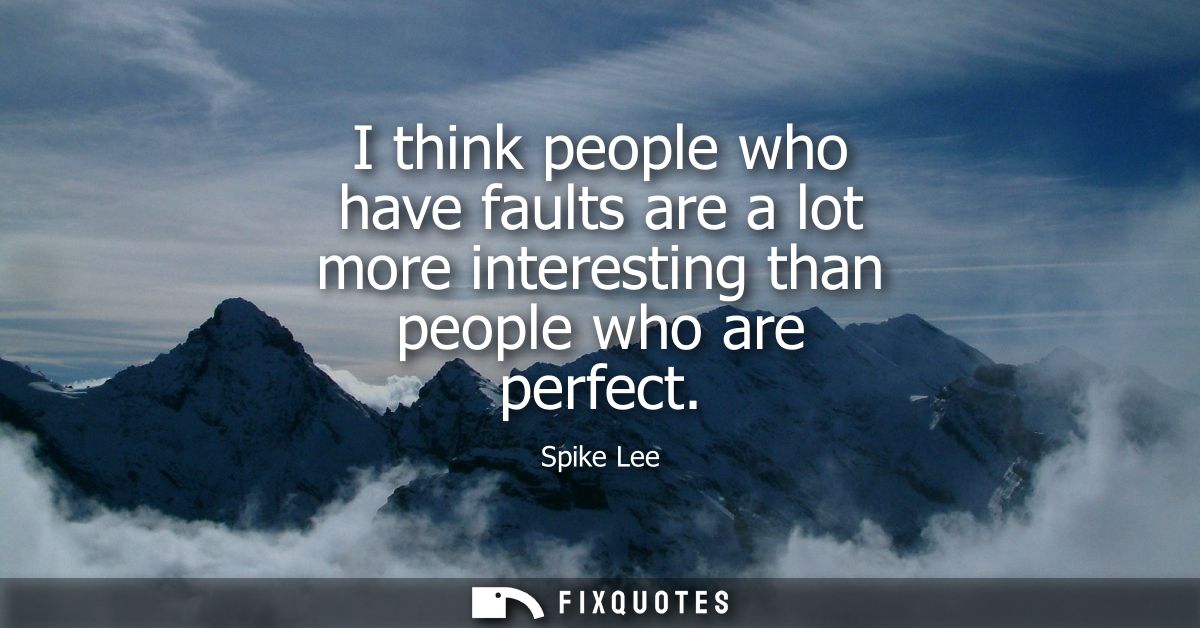
"I think people who have faults are a lot more interesting than people who are perfect"
About this Quote
Lee isn’t praising “flaws” in the cute, Instagram-caption way. He’s defending messiness as the engine of truth and conflict. In his films, people don’t behave like role models; they behave like people under pressure - angry, proud, contradictory, sometimes selfish, sometimes brave in the same breath. Faults aren’t decoration, they’re motive. They explain why someone lashes out, why they double down, why they change - or refuse to.
The subtext is also a rebuke to respectability politics: the idea that marginalized people must appear spotless to deserve empathy or safety. Lee’s work repeatedly pushes against that demand. He insists that dignity isn’t earned by being “perfect,” and that asking for perfection is often just a more socially acceptable way to deny complexity. If a person has to be flawless to be humanized, they’ll never be humanized.
There’s also a sly critique of audience comfort. We say we want authenticity, then recoil when it shows up as ugliness, bad decisions, or moral ambiguity. Lee’s point is that interest - real engagement - comes from friction. Faults create stakes. Perfection is a closed door; imperfection is an open scene.
Quote Details
| Topic | Wisdom |
|---|---|
| Source | Help us find the source |
| Cite |
Citation Formats
APA Style (7th ed.)
Lee, Spike. (2026, January 15). I think people who have faults are a lot more interesting than people who are perfect. FixQuotes. https://fixquotes.com/quotes/i-think-people-who-have-faults-are-a-lot-more-24055/
Chicago Style
Lee, Spike. "I think people who have faults are a lot more interesting than people who are perfect." FixQuotes. January 15, 2026. https://fixquotes.com/quotes/i-think-people-who-have-faults-are-a-lot-more-24055/.
MLA Style (9th ed.)
"I think people who have faults are a lot more interesting than people who are perfect." FixQuotes, 15 Jan. 2026, https://fixquotes.com/quotes/i-think-people-who-have-faults-are-a-lot-more-24055/. Accessed 7 Feb. 2026.