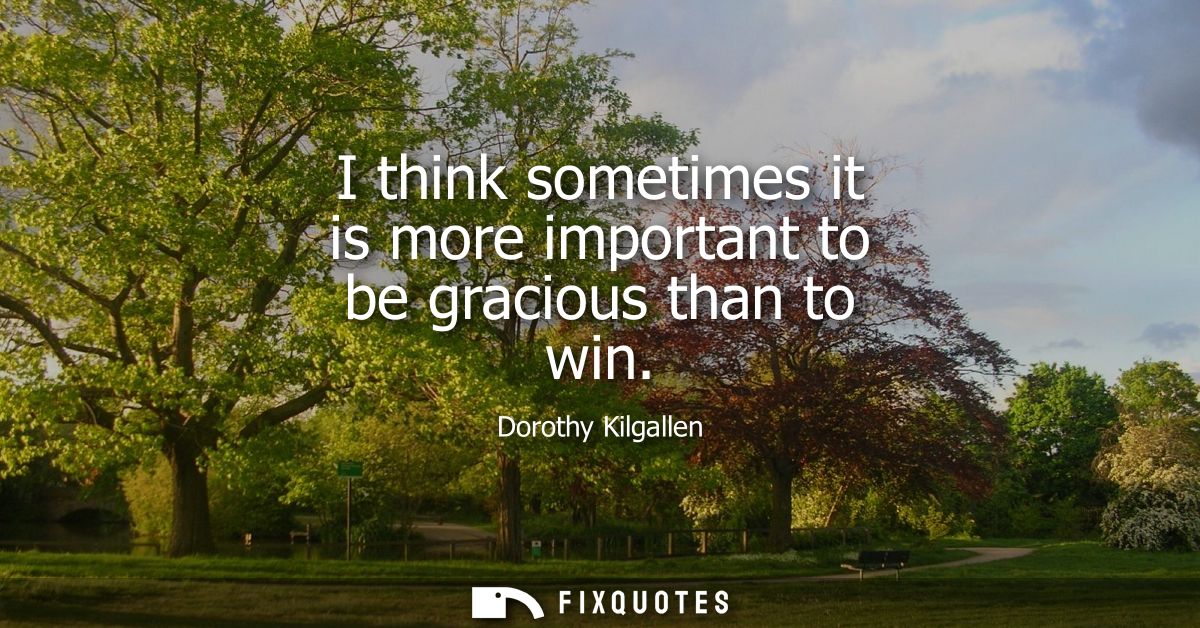
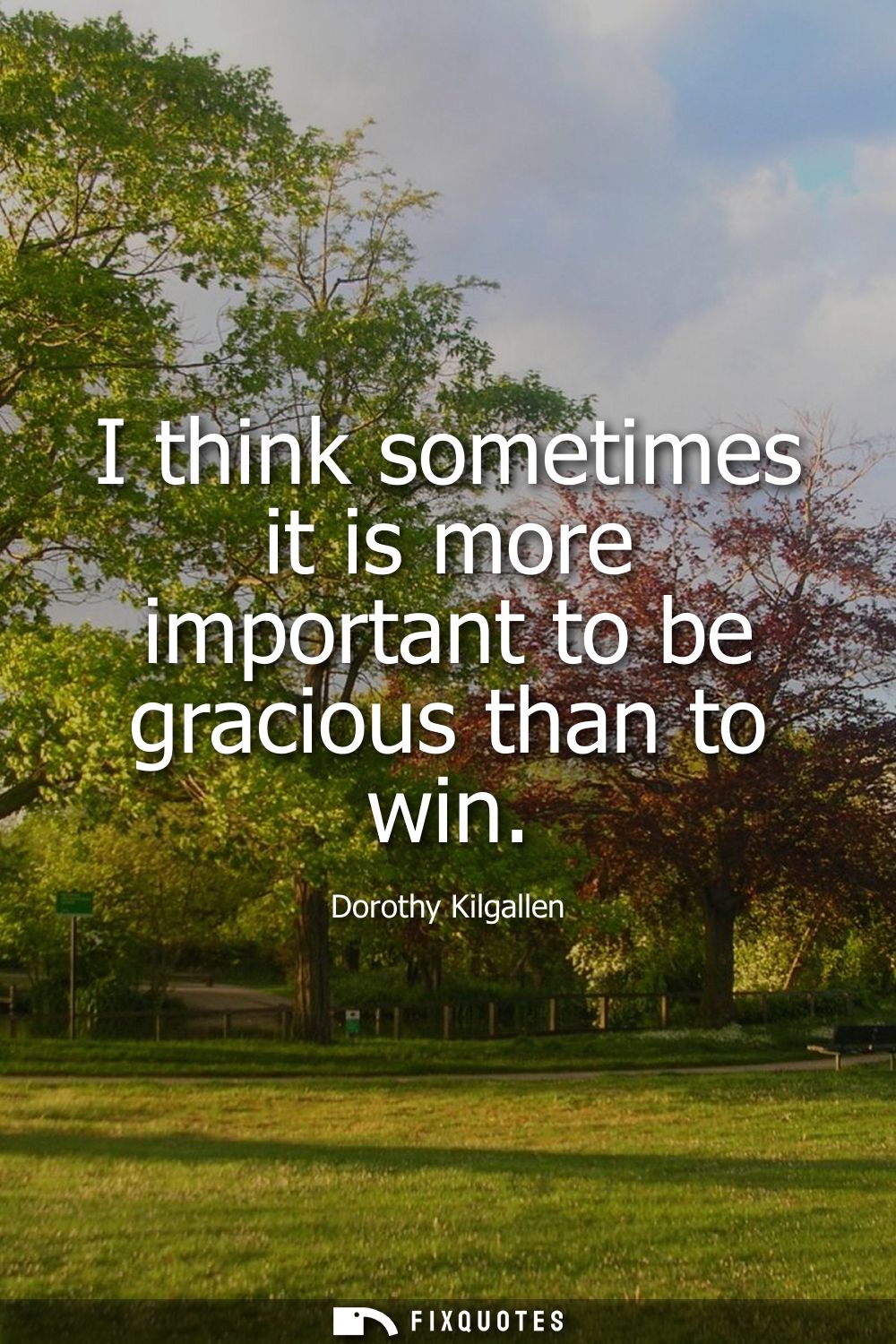
"I think sometimes it is more important to be gracious than to win"
About this Quote
In a culture that treats winning as both a moral category and a personality trait, Dorothy Kilgallen’s line reads like a small act of sabotage. “I think sometimes” is doing stealthy work: it softens the claim just enough to slip past the reflex to scoff at “good sportsmanship,” while still planting a firm hierarchy. Graciousness isn’t a consolation prize for losers; it’s framed as the higher-order choice, the one that costs you something.
The subtext is about performance, which makes sense coming from an actress who also lived in the glare of mid-century media. Winning is public and measurable; graciousness is public but harder to quantify, which is precisely why it signals control. It says: I’m not so hungry for the scoreboard that I’ll embarrass myself to get it. In celebrity and social worlds alike, the person who can lose without spiraling often looks more powerful than the person who wins and makes everyone regret watching.
There’s also a gendered edge to it. In Kilgallen’s era, women were frequently expected to be “gracious” as a form of social compliance. The line subtly reroutes that expectation into agency: graciousness becomes strategic self-possession, not obedience. She’s not praising passivity; she’s warning that victory can be a trap - the kind that reveals pettiness, insecurity, or cruelty. The quote works because it admits the allure of winning while insisting that how you win, and how you lose, is the real tell.
The subtext is about performance, which makes sense coming from an actress who also lived in the glare of mid-century media. Winning is public and measurable; graciousness is public but harder to quantify, which is precisely why it signals control. It says: I’m not so hungry for the scoreboard that I’ll embarrass myself to get it. In celebrity and social worlds alike, the person who can lose without spiraling often looks more powerful than the person who wins and makes everyone regret watching.
There’s also a gendered edge to it. In Kilgallen’s era, women were frequently expected to be “gracious” as a form of social compliance. The line subtly reroutes that expectation into agency: graciousness becomes strategic self-possession, not obedience. She’s not praising passivity; she’s warning that victory can be a trap - the kind that reveals pettiness, insecurity, or cruelty. The quote works because it admits the allure of winning while insisting that how you win, and how you lose, is the real tell.
Quote Details
| Topic | Kindness |
|---|---|
| Source | Help us find the source |
| Cite |
Citation Formats
APA Style (7th ed.)
Kilgallen, Dorothy. (2026, January 16). I think sometimes it is more important to be gracious than to win. FixQuotes. https://fixquotes.com/quotes/i-think-sometimes-it-is-more-important-to-be-110736/
Chicago Style
Kilgallen, Dorothy. "I think sometimes it is more important to be gracious than to win." FixQuotes. January 16, 2026. https://fixquotes.com/quotes/i-think-sometimes-it-is-more-important-to-be-110736/.
MLA Style (9th ed.)
"I think sometimes it is more important to be gracious than to win." FixQuotes, 16 Jan. 2026, https://fixquotes.com/quotes/i-think-sometimes-it-is-more-important-to-be-110736/. Accessed 15 Feb. 2026.
More Quotes by Dorothy
Add to List