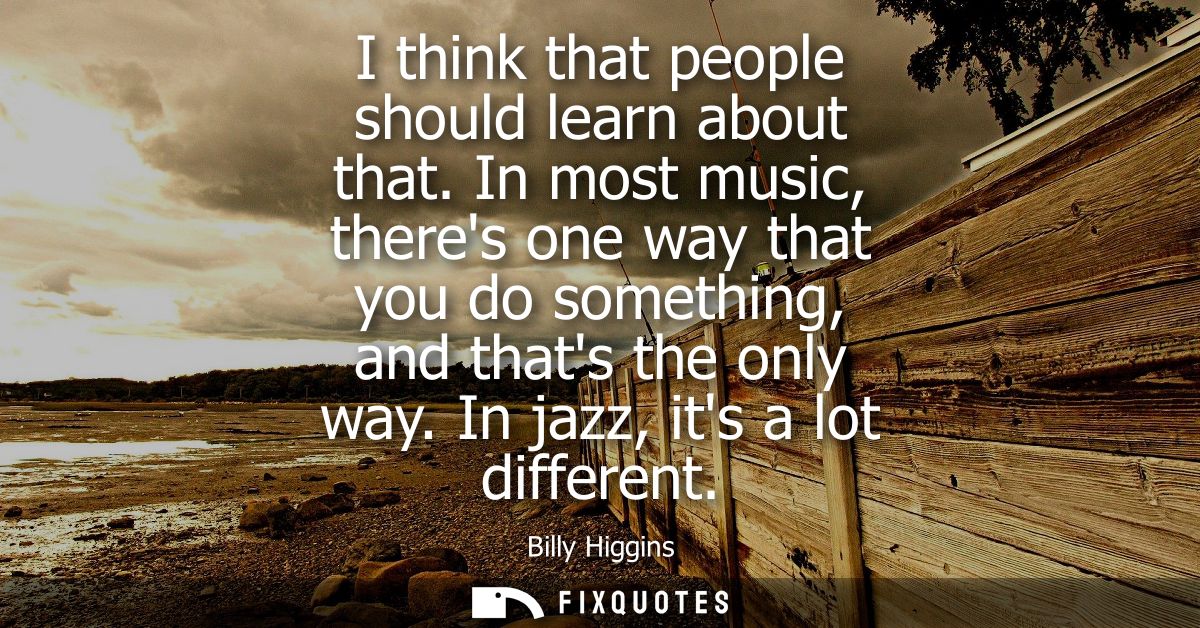
"I think that people should learn about that. In most music, there's one way that you do something, and that's the only way. In jazz, it's a lot different"
About this Quote
The contrast he draws is deliberately blunt: "most music" has "one way" and "that's the only way". He is exaggerating, but strategically. By flattening everything else into a single, correct method, he makes jazz pop as an ethical alternative: music built on multiple right answers, negotiated in real time. The subtext is anti-authoritarian without sounding like a manifesto. Higgins doesn't need to say "freedom"; he implies it through structure. Jazz is a practice where listening outranks obedience, where mistakes can become material, where individuality is only meaningful if it stays in conversation with the group.
Coming from Higgins, a master of accompaniment, the line carries extra bite. Drummers are often treated as the human metronome; Higgins reframes the job as a kind of social intelligence, shaping time rather than merely keeping it. His context is late-20th-century America, where jazz was simultaneously canonized and misunderstood: celebrated as heritage while its improvisational risk was domesticated into background music. Higgins is insisting that the point was never polish. The point was possibility.
Quote Details
| Topic | Music |
|---|---|
| Source | Help us find the source |
| Cite |
Citation Formats
APA Style (7th ed.)
Higgins, Billy. (2026, January 15). I think that people should learn about that. In most music, there's one way that you do something, and that's the only way. In jazz, it's a lot different. FixQuotes. https://fixquotes.com/quotes/i-think-that-people-should-learn-about-that-in-167054/
Chicago Style
Higgins, Billy. "I think that people should learn about that. In most music, there's one way that you do something, and that's the only way. In jazz, it's a lot different." FixQuotes. January 15, 2026. https://fixquotes.com/quotes/i-think-that-people-should-learn-about-that-in-167054/.
MLA Style (9th ed.)
"I think that people should learn about that. In most music, there's one way that you do something, and that's the only way. In jazz, it's a lot different." FixQuotes, 15 Jan. 2026, https://fixquotes.com/quotes/i-think-that-people-should-learn-about-that-in-167054/. Accessed 31 Mar. 2026.