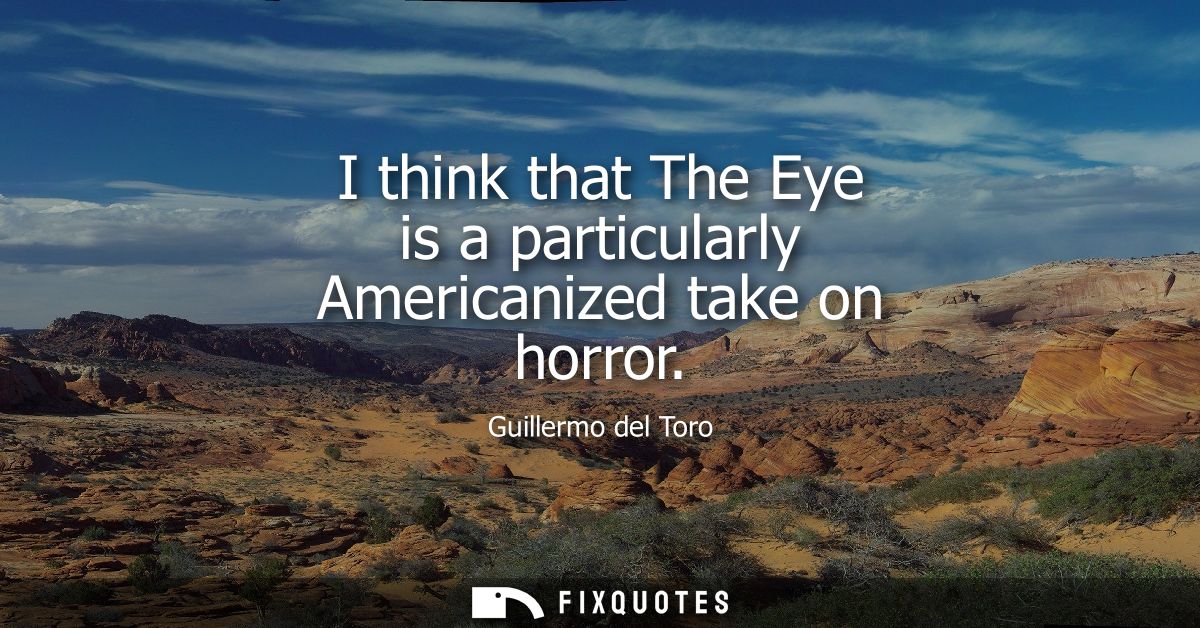
"I think that The Eye is a particularly Americanized take on horror"
About this Quote
Guillermo del Toro’s compliment is a scalpel, not a bouquet. Calling The Eye “a particularly Americanized take on horror” sounds neutral, even polite, but it carries a filmmaker’s diagnosis: the story has been translated not just in language, but in emotional priorities. Del Toro is alert to how Hollywood remakes often sand down the cultural grain that made an Asian horror film unsettling in the first place. Where the original The Eye (rooted in Hong Kong/Southeast Asian sensibilities) treats the supernatural as porous with everyday life, the American version tends to reframe dread as a solvable problem with a clean narrative arc: trauma explained, threat identified, climax delivered on schedule.
His phrasing matters. “Take on horror” implies a choice of lens rather than a faithful reproduction. “Particularly” suggests it isn’t merely American-made; it’s shaped by recognizable American genre habits: heightened backstory, a clearer moral map, and a preference for spectacle and psychological motivation over lingering ambiguity. In del Toro’s world, horror is strongest when it refuses to be fully domesticated, when the uncanny doesn’t arrive with a therapist’s note attached.
Context sharpens the edge. Del Toro, a Mexican director who built a career bridging Hollywood and international cinema, has watched remakes become a kind of cultural customs checkpoint: foreign fears go in, American beats come out. He isn’t condemning the result so much as naming the exchange rate. The subtext: what gets lost isn’t just “scares,” but an entire worldview about fate, guilt, and the afterlife that doesn’t comfortably fit America’s need for closure.
His phrasing matters. “Take on horror” implies a choice of lens rather than a faithful reproduction. “Particularly” suggests it isn’t merely American-made; it’s shaped by recognizable American genre habits: heightened backstory, a clearer moral map, and a preference for spectacle and psychological motivation over lingering ambiguity. In del Toro’s world, horror is strongest when it refuses to be fully domesticated, when the uncanny doesn’t arrive with a therapist’s note attached.
Context sharpens the edge. Del Toro, a Mexican director who built a career bridging Hollywood and international cinema, has watched remakes become a kind of cultural customs checkpoint: foreign fears go in, American beats come out. He isn’t condemning the result so much as naming the exchange rate. The subtext: what gets lost isn’t just “scares,” but an entire worldview about fate, guilt, and the afterlife that doesn’t comfortably fit America’s need for closure.
Quote Details
| Topic | Movie |
|---|
More Quotes by Guillermo
Add to List