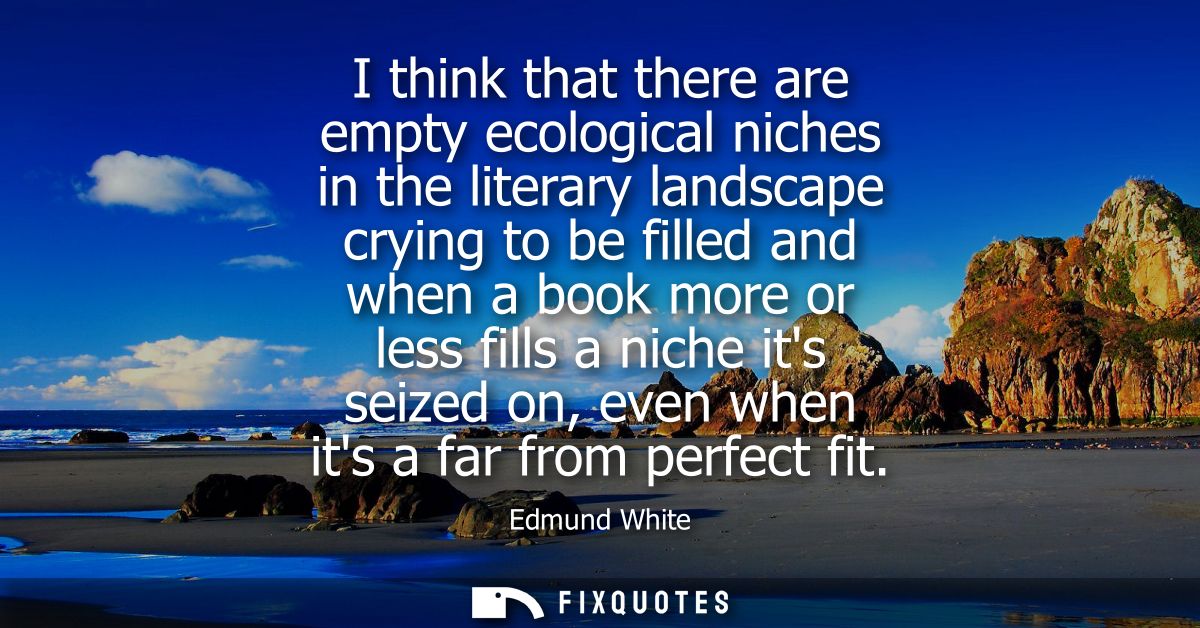
"I think that there are empty ecological niches in the literary landscape crying to be filled, and when a book more or less fills a niche, it's seized on, even when it's a far from perfect fit"
About this Quote
The sharpness is in the quiet demystification. White isn’t insulting writers so much as puncturing the fantasy that reception is purely meritocratic. “Seized on” is a blunt verb: the public doesn’t gently discover; it grabs, claims, rallies. That’s how books become “important” faster than they become good. The niche itself confers value, because it answers a cultural need, not necessarily because the craft is flawless.
Subtext: the marketplace and the discourse machine (publishers, reviewers, prize committees, book clubs) are constantly hungry for “the” novel that represents a moment or a constituency. White, long central to gay American letters, knows how quickly a single work can be anointed as representative simply because the field is underpopulated or newly visible. The burden on the book becomes unfairly symbolic.
His final clause - “even when it’s a far from perfect fit” - carries both skepticism and rue. Cultural ecosystems don’t wait for ideal specimens. They promote the first credible organism that wanders into the clearing, then retroactively treat it like destiny.
Quote Details
| Topic | Book |
|---|---|
| Source | Help us find the source |
| Cite |
Citation Formats
APA Style (7th ed.)
White, Edmund. (2026, February 19). I think that there are empty ecological niches in the literary landscape crying to be filled, and when a book more or less fills a niche, it's seized on, even when it's a far from perfect fit. FixQuotes. https://fixquotes.com/quotes/i-think-that-there-are-empty-ecological-niches-in-56093/
Chicago Style
White, Edmund. "I think that there are empty ecological niches in the literary landscape crying to be filled, and when a book more or less fills a niche, it's seized on, even when it's a far from perfect fit." FixQuotes. February 19, 2026. https://fixquotes.com/quotes/i-think-that-there-are-empty-ecological-niches-in-56093/.
MLA Style (9th ed.)
"I think that there are empty ecological niches in the literary landscape crying to be filled, and when a book more or less fills a niche, it's seized on, even when it's a far from perfect fit." FixQuotes, 19 Feb. 2026, https://fixquotes.com/quotes/i-think-that-there-are-empty-ecological-niches-in-56093/. Accessed 3 Apr. 2026.