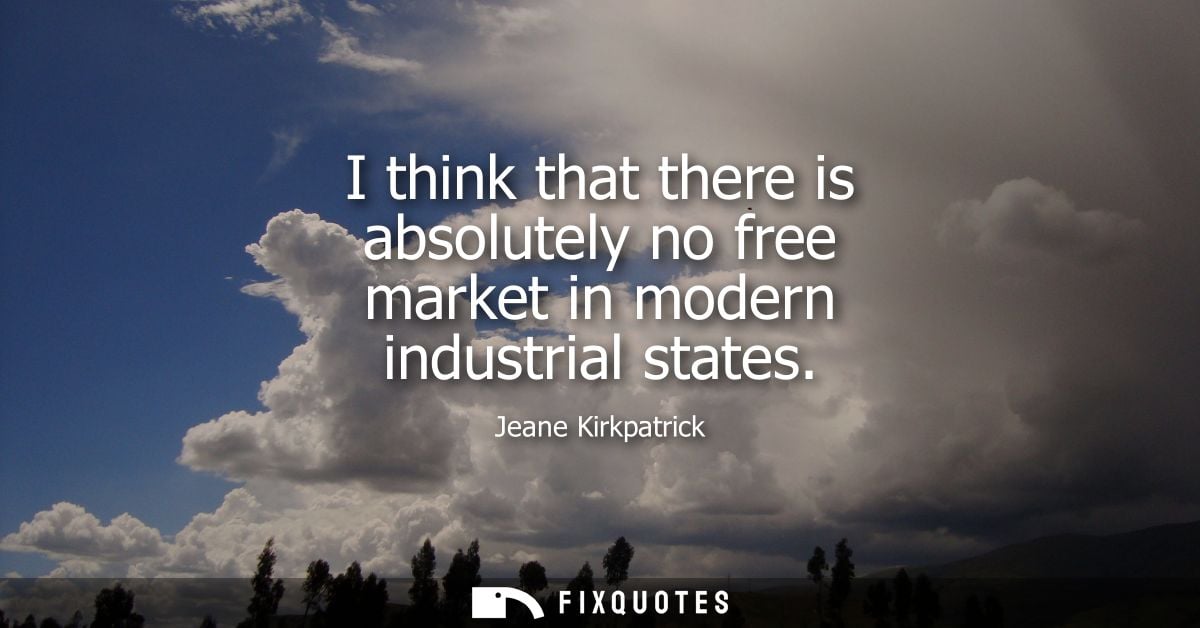
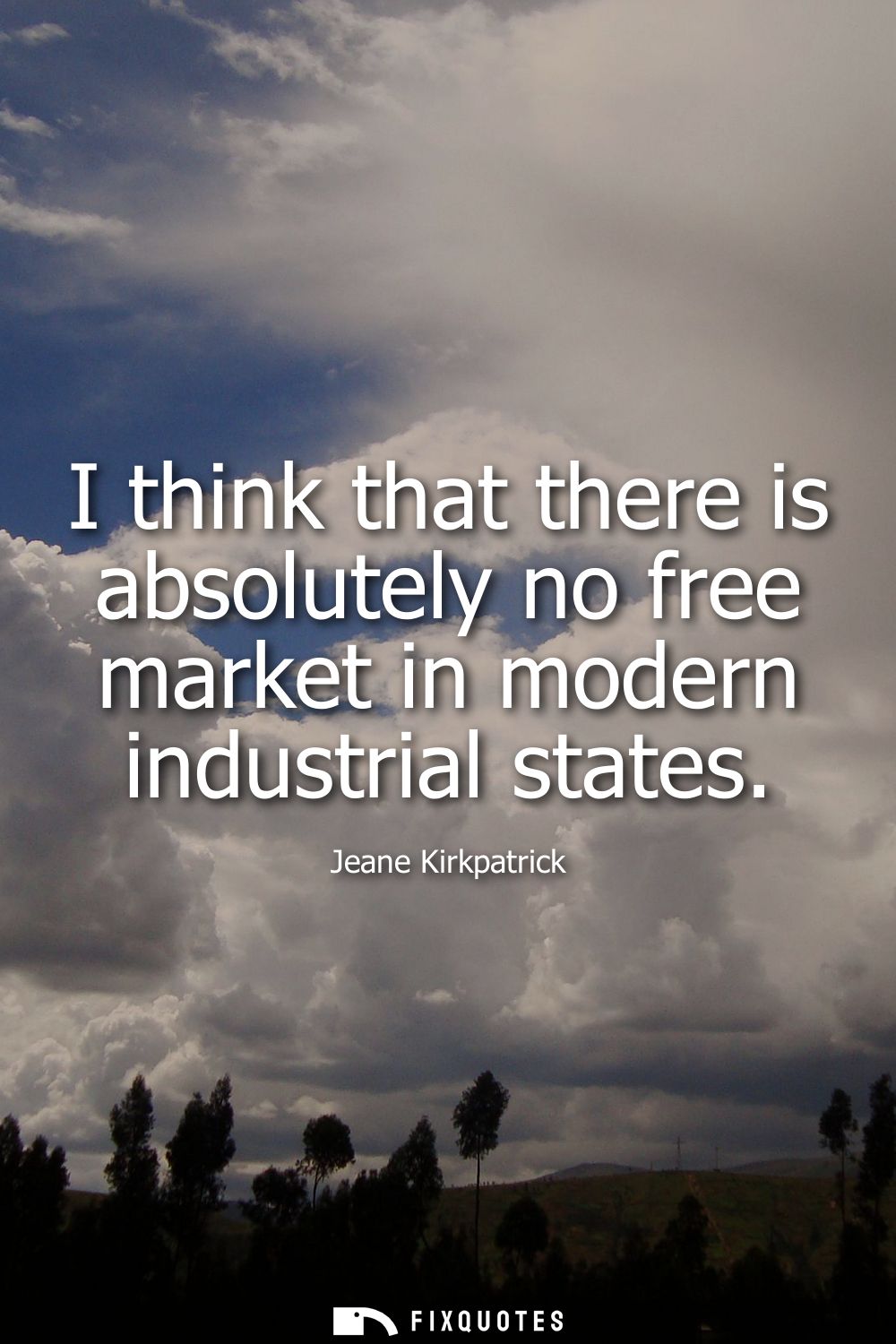
"I think that there is absolutely no free market in modern industrial states"
About this Quote
The intent isn’t to sneer at capitalism so much as to strip it of its ideological costume. Kirkpatrick, a Cold War-era diplomat and policy intellectual, understood how “free market” functioned as a moral brand in American rhetoric: it signaled virtue, modernity, and legitimacy in contrast to Soviet planning. Her subtext is that the West also plans; it just does so through different levers and with different beneficiaries. By calling industrial economies unfree, she’s nudging listeners to admit what they already know but rarely say out loud: state power underwrites private power, and the boundary between “public” and “private” is a moving line drawn by politics.
Context matters: this is a period when American leaders sold deregulation, anti-communism, and globalization with the language of freedom. Kirkpatrick’s formulation complicates that sales pitch. It invites a more honest debate about which interventions we tolerate, who gets to write the rules, and why “free market” is often less a description than a talisman.
Quote Details
| Topic | Freedom |
|---|---|
| Source | Help us find the source |
| Cite |
Citation Formats
APA Style (7th ed.)
Kirkpatrick, Jeane. (2026, January 18). I think that there is absolutely no free market in modern industrial states. FixQuotes. https://fixquotes.com/quotes/i-think-that-there-is-absolutely-no-free-market-12202/
Chicago Style
Kirkpatrick, Jeane. "I think that there is absolutely no free market in modern industrial states." FixQuotes. January 18, 2026. https://fixquotes.com/quotes/i-think-that-there-is-absolutely-no-free-market-12202/.
MLA Style (9th ed.)
"I think that there is absolutely no free market in modern industrial states." FixQuotes, 18 Jan. 2026, https://fixquotes.com/quotes/i-think-that-there-is-absolutely-no-free-market-12202/. Accessed 12 Feb. 2026.