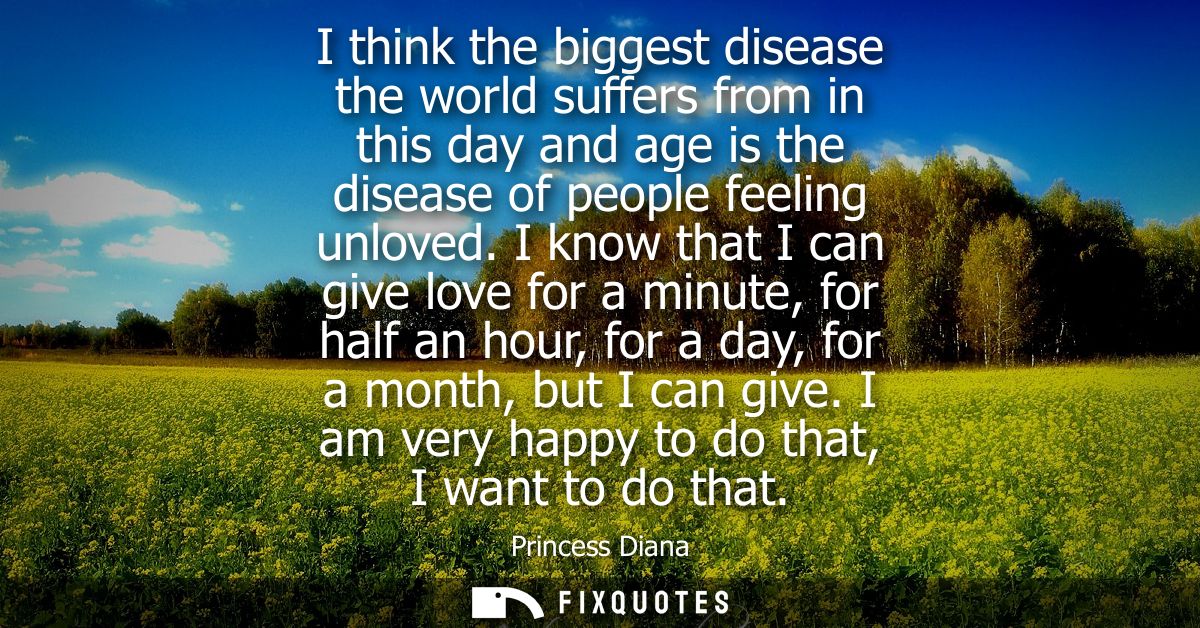
"I think the biggest disease the world suffers from in this day and age is the disease of people feeling unloved. I know that I can give love for a minute, for half an hour, for a day, for a month, but I can give. I am very happy to do that, I want to do that"
About this Quote
The line about time is the giveaway. "For a minute... for half an hour... for a day... for a month" is an inventory of limits, almost contractual. Diana isn't promising salvation; she's offering presence in measurable units. That specificity makes the generosity feel real rather than saintly, and it hints at hard-earned self-knowledge: she knows the press wants endless tenderness from her, the public wants a symbol, the palace wants composure. She answers by redefining power as something portable and repeatable, not grand and inherited. Love becomes an action she can choose, not a status she can wear.
The subtext is personal and political at once: she is describing what she needed, what she didn't get, and what she decided to become anyway. In the late 20th-century media glare that both adored and devoured her, this is Diana positioning empathy as her counter-monarchy: a form of legitimacy earned through contact, not ceremony.
Quote Details
| Topic | Love |
|---|---|
| Source | Help us find the source |
| Cite |
Citation Formats
APA Style (7th ed.)
Diana, Princess. (2026, January 14). I think the biggest disease the world suffers from in this day and age is the disease of people feeling unloved. I know that I can give love for a minute, for half an hour, for a day, for a month, but I can give. I am very happy to do that, I want to do that. FixQuotes. https://fixquotes.com/quotes/i-think-the-biggest-disease-the-world-suffers-1274/
Chicago Style
Diana, Princess. "I think the biggest disease the world suffers from in this day and age is the disease of people feeling unloved. I know that I can give love for a minute, for half an hour, for a day, for a month, but I can give. I am very happy to do that, I want to do that." FixQuotes. January 14, 2026. https://fixquotes.com/quotes/i-think-the-biggest-disease-the-world-suffers-1274/.
MLA Style (9th ed.)
"I think the biggest disease the world suffers from in this day and age is the disease of people feeling unloved. I know that I can give love for a minute, for half an hour, for a day, for a month, but I can give. I am very happy to do that, I want to do that." FixQuotes, 14 Jan. 2026, https://fixquotes.com/quotes/i-think-the-biggest-disease-the-world-suffers-1274/. Accessed 14 Feb. 2026.