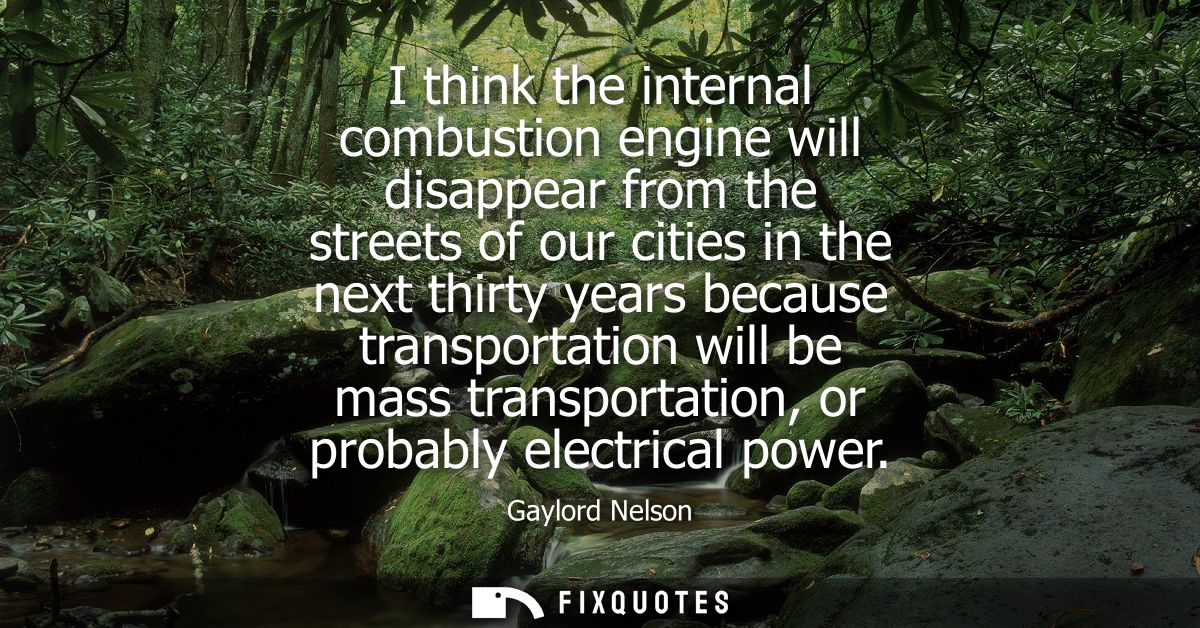
"I think the internal combustion engine will disappear from the streets of our cities in the next thirty years because transportation will be mass transportation, or probably electrical power"
About this Quote
The phrasing also smuggles in a moral hierarchy. “Mass transportation” comes first, “or probably electrical power” second, implying that electrifying private vehicles is an acceptable fallback but not the primary vision. That ordering matters. Nelson is gesturing toward a civic model where movement is shared, efficient, and publicly stewarded - transit as a kind of infrastructure democracy - rather than simply swapping one drivetrain for another and keeping the same spatial inequities.
Context sharpens the intent. Nelson, best known as the founder of Earth Day and a key environmental legislator, was speaking from an era when smog-choked cities and oil politics made the costs of combustion newly undeniable. The “next thirty years” horizon is classic agenda-setting: close enough to demand action, long enough to make transformation thinkable. The subtext is that technological change won’t save us by itself. If the engine is going to “disappear,” someone has to make it happen: through regulation, investment, and the political courage to reclaim streets from cars.
Quote Details
| Topic | Technology |
|---|---|
| Source | Help us find the source |
| Cite |
Citation Formats
APA Style (7th ed.)
Nelson, Gaylord. (2026, January 16). I think the internal combustion engine will disappear from the streets of our cities in the next thirty years because transportation will be mass transportation, or probably electrical power. FixQuotes. https://fixquotes.com/quotes/i-think-the-internal-combustion-engine-will-124686/
Chicago Style
Nelson, Gaylord. "I think the internal combustion engine will disappear from the streets of our cities in the next thirty years because transportation will be mass transportation, or probably electrical power." FixQuotes. January 16, 2026. https://fixquotes.com/quotes/i-think-the-internal-combustion-engine-will-124686/.
MLA Style (9th ed.)
"I think the internal combustion engine will disappear from the streets of our cities in the next thirty years because transportation will be mass transportation, or probably electrical power." FixQuotes, 16 Jan. 2026, https://fixquotes.com/quotes/i-think-the-internal-combustion-engine-will-124686/. Accessed 11 Feb. 2026.